About Feelers and Feelings
Please let this text sink in a little while. If you get it, it may make you more flexible. To have or to be? That’s the question. In mind=body unity, the human being can be seen as a body or as a set of many mental entities, including what we generally call feelings – such Read the full article…
Boundaries of Fluidity
Mental fluidity makes life interesting. It provides the ability to grow as a person, discover and enjoy universes inside, and realize them in many ways. But there are boundaries. In-fluidity One may speak of a healthy kind of mental inflexibility, supporting consistency over time and workable behavior that the community may appreciate. It gives predictability Read the full article…

Accept and Commit
In-depth, these two concepts are much intertwined to such a degree that they can be seen as the basis of an undivided philosophy of life ― quite congruent with AURELIS. For instance, burnout I have described burnout using this metaphor: an evolution from caterpillar to chrysalis to butterfly. The ostensible burnout phase happens in the Read the full article…
Why is Human Depth so Absent?
Of course, it isn’t absent. Each human being has immense depth inside. Therefore, the question is why it doesn’t show in many circumstances. People don’t live by it. You might want to read ‘What is Depth‘ before proceeding. ‘About which one cannot speak.’ I described this before as inner dissociation’ and basic cognitive illusion. It Read the full article…
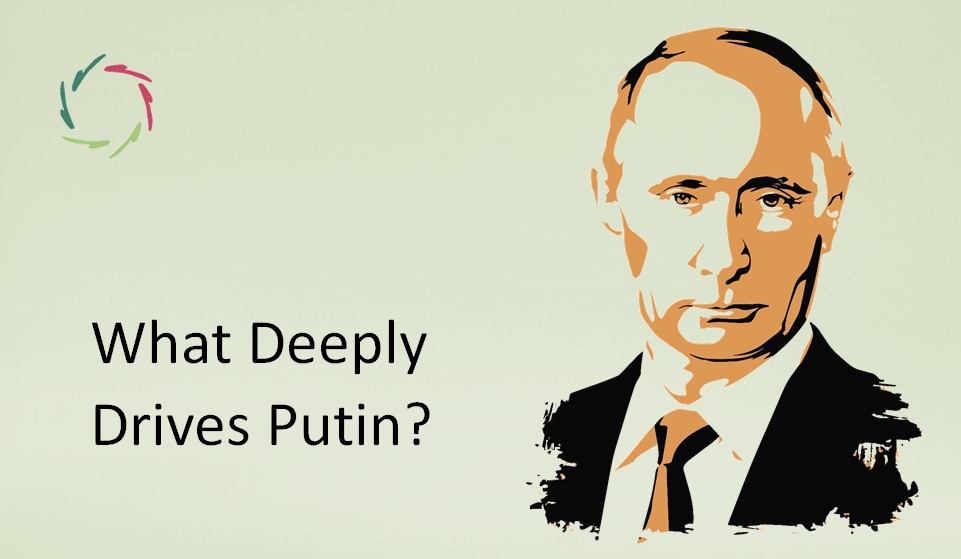
What Deeply Drives Putin?
At least, it’s worth trying to answer this question. The grotesque actions in Ukraine are an immense magnification of what may be almost nothing at the start ― a cognitive blind spot or misunderstanding. A false start would be by noting that one cannot understand a madman, or that the whole of Russia must be Read the full article…
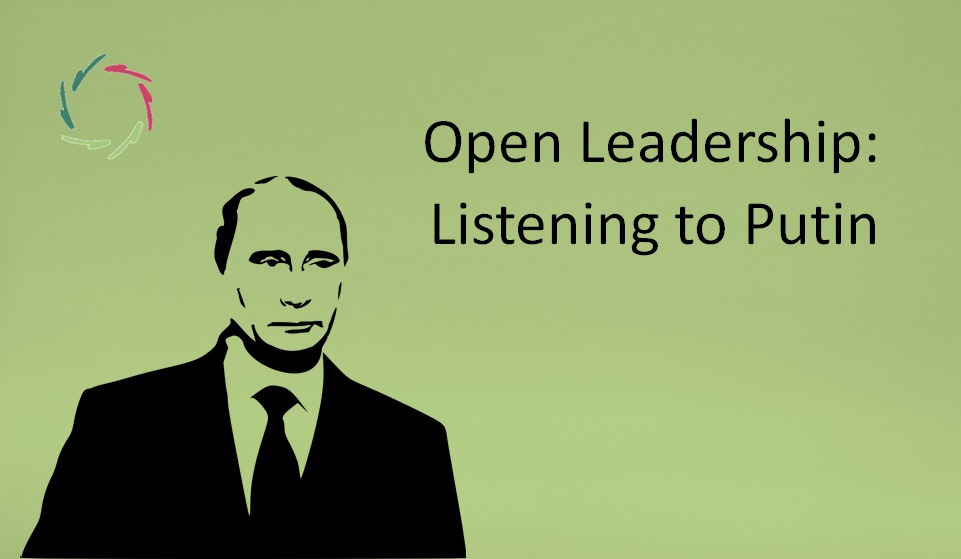
Open Leadership: Listening to Putin
April 2022. The present situation in Ukraine results from a total lack of Open Leadership. Money, power, status Of course, it’s about big money, including recent discoveries of even more oil in the Black Sea and the Donbass, taxes on the use of pipelines and the economic future of Russia versus Ukraine. Of course, it’s Read the full article…
About Dukkha (Suffering)
Central to Buddhism, from early on – and even somewhat earlier – is that dukkha (suffering, stress, fundamental unsatisfactoriness, dis-ease) exists and can be alleviated. Buddha showed a way to do so; I show two. The flower bud You find this metaphor as the first one in my e-book nr. 2, a collection of 12 primary Read the full article…
Compassionately Strong
Compassion – or what people associate with the term – may seem weak. It isn’t. Therefore, the fear of ‘weakness’ should not deter striving to be strongly Compassionate. From the inside out Basically, Compassion is related to Inner Strength, being the primary source of any durable outer strength. Without it, anything on the outside is Read the full article…
Confucian Open Leadership
In my view, Confucian Leadership is about Open Leadership after transcending some inconsistency. Allow me at first to transcend. Then – some patience needed – I will come back to Confucianism itself. Heavenly Any theorizing about ‘heaven’ as if it is conceptually graspable is not Aurelian. It denotes a direction toward the ungraspable, a direction Read the full article…
The Importance of Subconceptual
It may be invisible and even – consciously – unthinkable. Yet, it is there 24/7, being who you are. It’s vital in every human endeavor. The subconceptual is about how the mind works intrinsically. Looking at your thoughts, such as right now, you may have a much more conceptual impression. It seems like any thought Read the full article…
Goodness – it Exists
This is fundamental for a promising future, even though there has been no consensus on the matter for centuries. Are people intrinsically good or bad? This question has engendered huge discussions over many centuries, with much animosity involved. Both sides have seen moral depravity at the other side. Science, too, hasn’t very well answered the Read the full article…
The Abuse of ‘Holistic’
The term ‘holistic’ is abused very frequently, very deeply, and very inconsiderately, in many cases meaning something pretty unholistic. A holistic approach looks at the whole person, considering his physical, mental (including emotional), social, and spiritual wellbeing. The focus lies on a person’s wellness, not just his illness. That’s a great start. Away from pure Read the full article…

Is Woke Awake?
Many ‘woke’ people are so heavily against intolerance that they make an intolerant impression. This contradiction begs for insight. Several wokenesses ‘Woke’ is a weak term. Behind it also lies a weak concept. There are very diverse kinds of being woke. Unsurprisingly, there are also various ways of looking at wokeness. It’s not always the Read the full article…
Healing without Nonsense
Anything – including sheer nonsense – can positively influence health in mind and body. Still, it is crucial to get beyond. Wishing good health Most people want to see themselves as rational beings. Also, most people find their health most important, wishing each other good health, spending much money to get it for themselves and Read the full article…

Global Changes Start Inside
This is: deep inside the human mind, upon which one has little direct conscious control. ‘Global’ points to what happens between people at the grant and even global scale. Deeply ubiquitous All people share in-depth propensities that can be realized one way or another, thus on diverse domains orienting the streaming underneath in a direction Read the full article…

Rationality – Science – Technology
It all seems pretty clear. Yet there is fuzziness within that clarity. Rationality leads to science. Science leads to technology. Rationality is a specific state of mind. A human is rational if he has that state of mind. From that state of mind, he can think together a body of knowledge that is internally congruent Read the full article…
Is A.I. Dangerous to Human Cognition?
I have roamed around this on several occasions within ‘The Journey towards Compassionate A.I.’ (of which this is an excerpt) The prime reason why I think it’s dangerous is, in one term: hyper-essentialism. But let me first give two viewpoints upon your thinking: Essentialism: presupposes that the categories in your mind – such as an Read the full article…