The Goal: Freedom
… of the total person. This may assume a serious commitment, a firm attitude, discipline. It judders and clashes with all sorts of … and yet. A good starting point may be: “nothing changes me.” So also: “nothing stops me,” because if one is changing from within, then that change itself is the situation and Read the full article…
Possible Meaning of AURELIS in the World
AURELIS is a way of standing in the world, a way of ‘being’, or at least: an attempt to this end. Nobody is perfect, thank God. You could consider AURELIS as a form of ‘therapy’. Then it becomes a part of health care. People have problems/needs and they are trying to find a solution. On Read the full article…
Cause of All Suffering: Dissociation
From the time that people began to suffer (this is of course: since they exist), they are intrigued by possible causes and solutions for this suffering. As more organization came in social life and thinking, it was of course obvious that one also began to think about suffering in a more ‘organized’ way . Buddhism Read the full article…
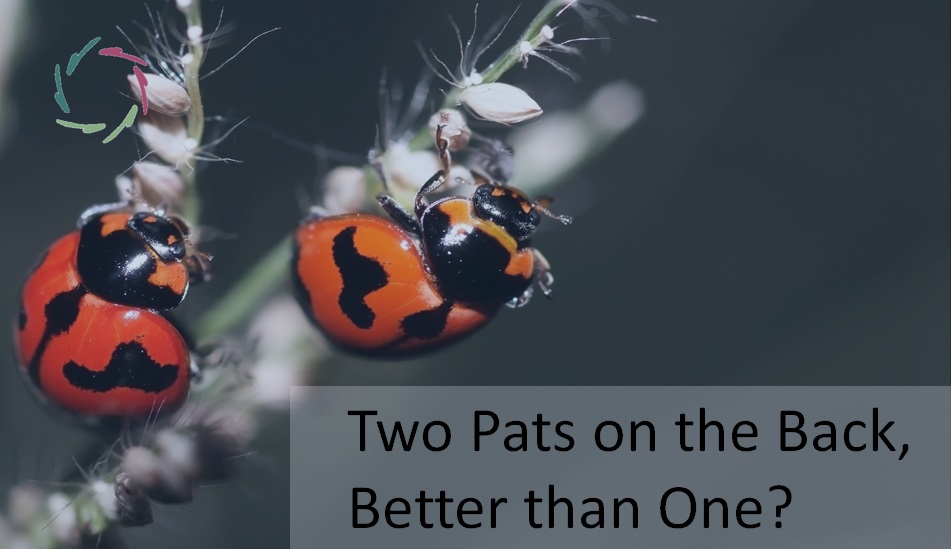
Two Pats on the Back, Better than One?
Study in US: encouragement helps 98% of the people surveyed to get to better results at work. ‘To encourage’ = ‘to put heart into.’ Literally. You recognize herein the French word ‘coeur’. It has to do with ‘the heart’. It is not just a sentence stumbled out quickly, not your shoulder pat itself that is Read the full article…
Five Aurelian Values
Since AURELIS is about rational depth, ethics is important. This comes in the guise of 5 ‘aurelian values’: openness, depth, respect, freedom, trustworthiness. Starting from the total human being as measure of morality, there is of course nothing sacred in these five. It’s a very subjective choice. In principle, it could have been five others, Read the full article…
Let True Morality Stand Up!
Basically, two ‘moralities’ can be distinguished: cognitive (thinking) and emotional. However, this is a purely conceptual, abstract distinction. Reality consistently shows them intermingled. The relevance is enormous. ‘Morality’ is the basis of culture. Almost all important decisions carry within them a factor of morality, or better: moralities. ‘Stress/distress’ is in all cases related to an Read the full article…
Morality Is the Relief of Suffering
Suffering is here broadly looked upon as: any hurt related to the loss of contact with one’s inner being. In this sense, relief of suffering of others and of oneself go together. (This text has a quite Buddhistic inspiration. The aim is to be applicable for all, always, everywhere.) In one sweep, the title of Read the full article…
‘Control’ Is Not the Answer
In a search for direct ‘control’, people tend to lose more and more a deeper kind of control. This may result in a turmoil leading to problems in health and beyond. For instance, trying to ‘control’ an addiction This makes one fight a huge fight against… oneself. An addiction is not a strange dark spot Read the full article…
A Humble Person Doesn’t Submit.
‘Acceptance without submission’ is a meaningful exercise that requires a certain dose of humility. This may be important in every domain of life. “Change what you cannot accept. Accept what you cannot change.” This well-known saying seems to put acceptance and change in competition to each other. However, acceptance may go together with trying to Read the full article…
Vision!
A coach and a leader have in common what is perhaps their main asset: the ability to ‘see what no other has seen before’, a future that is at the same time personal and universal. [Note: this is not an easy text.] This is not about eye-vision of course. In the coach’s case it may Read the full article…
When Respect Ends, Manipulation Starts
The border between motivation and manipulation is fuzzy. Yet they are very different in cause, essence and consequence. As I see it: the one big difference between ‘motivation’ and ‘manipulation’ lies in deep human respect. Even if at the outside a specific attitude (motivation? manipulation?) may look pretty much the same, deep respect can bring Read the full article…

In-Box-Thinking
It strikes me that intelligent people are sometimes immune to rationality in a circumscribed domain. This is VERY intriguing. I have as close-to-me example a quite intelligent medical colleague and friend who has… the ‘magical, healing hand’. Well… There are millions of examples like this. It’s not at all some isolated case. The term in-box-thinking Read the full article…
Symbolism and Placebo
These two domains have lots in common. Rationality cuts through both, but in essentially different ways. Power to the people As a matter of fact, the ‘power’ of a symbol doesn’t lie in the physical symbol itself, just as the ‘power’ of a placebo doesn’t lie in the placebo itself. It lies in the person Read the full article…
To Measure Is to Know?
To measure is to know… but only if you know what you are measuring. If you are confused in this, chances are you end up knowing even less than before. Western culture seems to be addicted to measuring, whether it be in management or medicine, education or economics… I see this as part of a Read the full article…
Words Like ‘Soul’ Are Not the Exclusive Right of Religion
Not of any specific religion, nor of ‘religion’ in general. It is therefore high time for a kind of ‘science of the deeper self’ that distinguishes itself from ‘religion’ in the sense that it is not based on a dogma or a story. You can compare it with astronomy that has emancipated from astrology +/- Read the full article…
Nirvana and Depression: Same Emptiness?
Concepts of Nirvana and Mental Depression are not usually brought together. Yet they do share important commonalities, to say the least. Of course, deep suffering is not bliss. Depression and nirvana Major depression is described by many sufferers as the worst experience one can get. It is the darkest emptiness, devoid of any meaning or Read the full article…
The Culminating Point
… The top and then some …. A little story from, you-probably-know-where, is about a 30 m high pile. You scramble up this pile. And then? Then you are on top of this pile. And then? Then you take a ‘step’ forward … but you’d rather not if you don’t know deeply within yourself what Read the full article…