My People is Everybody
Without diminishing the “XX (= my people) first,” it explodes the XX. There is no first, principally, thus also no second and no last. No zero-sum ― only abundance. Please, read first [see: “Compassion, basically“] One can start from the right of the strongest and win ― especially in a game made by oneself with Read the full article…
What’s the Purpose?
Without life, there is no purpose. Without purpose, there is no life. We want our purpose to be our own purpose. This, too, is basic to life. An entity of life is an entity with purpose. Take, for instance, you. Your hand, nose, brain, stomach… don’t have a purpose. You have. Your stomach is not Read the full article…
Freedom + Direction = Invitation
A perfect equation in both directions. This lets one better understand ‘invitation’ and put it into practice. Direction without Freedom This is coercion, one way or another. Literally without any freedom, this would amount to mental incarceration ― the end of life to any mind-ful organism. The lack of freedom may be hidden to the Read the full article…
Predestination – Karma – …?
Different cultures, different takes on basically the same. Small glossary Predestination: Christian (mainly Protestant) belief that God has predestined the salvation of some and not others, or even all that will happen. Karma: Hindu belief that all of one’s actions together in this and previous lives predestine one’s future fate. Non-conscious processing From an AURELIS Read the full article…
How to Build a Culture of Compassion
Challenging indeed ― especially in an organizational environment with zero compassion and a lot of fear and toxicity. Some AURELIS-congruent ideas may be helpful. Please read first, [see: “Compassion, basically“]. No coercion One might be tempted to impose some Compassionate rules and quickly get on with the real business. In my view, this is not Read the full article…
The Battle of the Future
This battle is going on already for a long time, but it will shape the future like nothing else. It is a battle inside. Mere-ego and total-person Both are mental states or attitudes. There are no two persons inside one. Yet, to make the distinction by way of talking is important enough. Even more, it Read the full article…
Worldwide Compassion
I have a recurrent dream: worldwide Compassion. Note that in this text, I bring my personal view upon what this encompasses. Please read this first: [see: “Compassion Connecting East & West“] Ubiquitous Compassion – in the sense of [see: “Compassion, basically“] – is a worldwide, recognizable phenomenon, although people may realize it in many different Read the full article…
38. Winter of 2021: COVID Winter AGAIN!?
Some evolutions worry me into thinking that next winter will be a hard one again, in which the COVID whirlpool will again be relevant in Europe, certainly worldwide. [see: “COVID-Whirlpool – In Which Virus AND Mind Play Substantial Roles”] COVID-19 is a psycho-somatic disease. I’m sorry to have to repeat this: The virus-related experts everybody Read the full article…
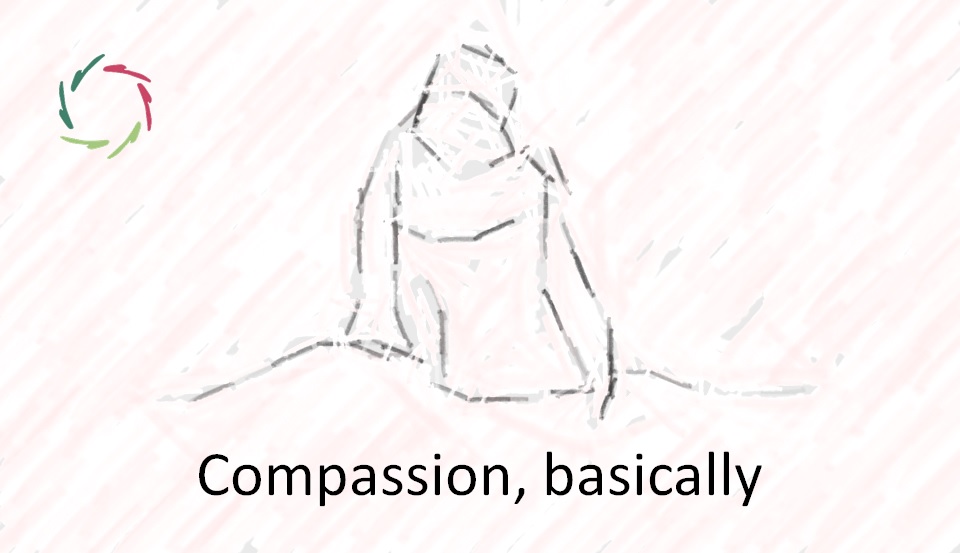
Compassion, Basically
This text and diagram form an entry to the basic idea of Compassion as I write about in many blogs. Compassion is SO much more than pity. Compassion is also more (going deeper) than empathy. Preliminary Note that the following diagram is but a mnemonic coat rack. It needs the proper coats for any correct Read the full article…
What vs. How in Psychotherapies
Crucial is where change comes from: the outside or the inside. I see in the latter the Compassion-factor. Compassion For a quick entry into the concept of Compassion as I use it, [see: “Compassion, basically“] Compassionate healing comes from the inside out. This ‘inside’ doesn’t just mean ‘inside the mind.’ It goes deeper within the Read the full article…
Goal of Lisa Coaching
Every Lisa coaching session – as well as string of sessions – is part of a path towards healing from the inside. From goal to broader The goal of Lisa coaching [see: “Lisa“] starts at the beginning. This is, validating the outspoken goal of the user. Then, with user consent, going somewhat deeper into this Read the full article…

Symbolic Healthcare
Concerning the mind, healthcare has always been covertly symbolic, and it still is. Now is the time to make it overt. About symbolism Symbolism is a straightforward communication with subconceptual mental patterns, unlike using an analogy. [see: “Symbols and Signs“] In many cases, the use of symbolism is pretty undifferentiated. This is enough for the Read the full article…
The Addict’s Grace
Inside the addiction itself, an essential part of the solution lies patiently, gracefully waiting. While reading this text, please stay aware, together with me, of the many miseries of addiction. It is, of course, a very-to-extremely challenging situation. By focusing on the underlying ‘Big Positive,’ a new view may arise that hopefully puts many addicted Read the full article…
(Non-)Morality of Addiction
Addiction is frequently judged from a moral standpoint. This is scientifically unseemly. Moreover, it is contra-productive. The addicted person is not morally bad in being addicted. An addicted person is, by definition, not a free person. His addictive behavior is not free behavior. Thus, by definition, he cannot be a morally bad person. [see: “From Read the full article…
Addiction – Emptiness – Nirvana
Emptiness seems to be associated with addiction and Nirvana. ‘It’ is sought in both ― not coincidentally. High and low Addiction can be seen as an attempt to fill a deep-inside void, an Inner Emptiness that seems unbearable to experience. The addict tries to fill this void with occasional highs. In some way, he also Read the full article…
Inner vs. Outer Change of Patterns
This is about mental-neuronal patterns. Although this term speaks of recent scientific insights, the known relevance is age-old and ubiquitous. It is also a basic choice for the future. All in the mind? ‘Inner vs. outer change’ is not about what happens inside or outside of one’s mind, but inside or outside of individual mental-neuronal Read the full article…
Trauma Wisdom
Every trauma carries wisdom. It is like a medal of honor, challenging as it may be to appreciate the trauma in any way. With ‘trauma,’ I denote in this text the actual happening as well as the living memory of it. Trauma is (not) a part of you In one way, trauma is a part Read the full article…