Emptiness
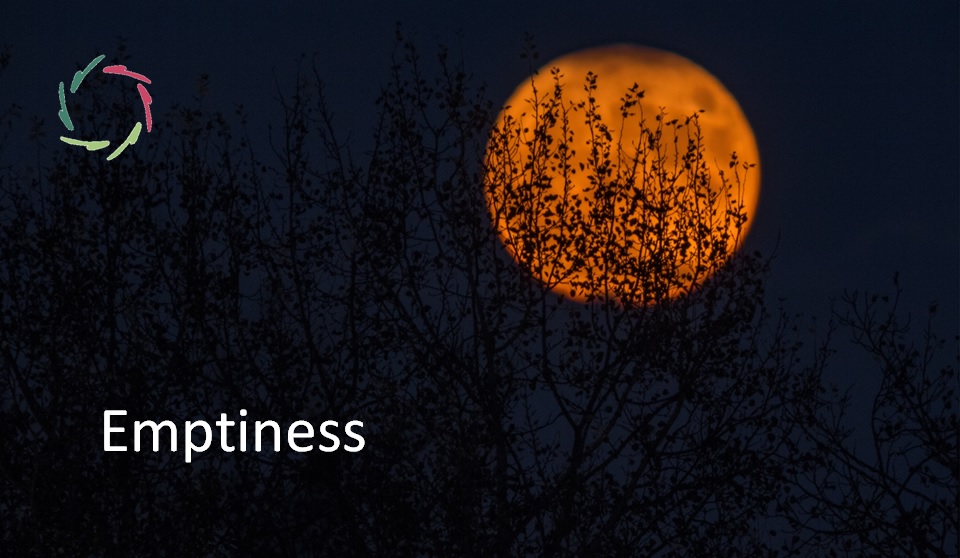
[see also: “Emptiness!“]
Empty of concepts in deep meditation.
***
Listen!
The silence.
All lines are parallel.
The universe is here.
Mind bent on infinity.
Somewhere a bird whistles. It is this bird here and now.
And then there is this great love, great compassion.
▪▪▪
I. am I. am I. am no longer I.
Nothing is needed. Everything is allowed.
Each time again I friendly put my ego aside
like a child that continuously asks for attention
and then is mainly curious
and then sits down beside me
and listens together.
Nothing is needed.
Everything is allowed.
***
Ego is not to be conquered or pushed away.
It is a genuine part of you.
The ‘I’ dissolves.
Poetry should not be analyzed in any way.
This is the first poem of ‘Poems from a Parallel World.‘
‘Parallel’ has many meanings.
Being parallel to something or someone, you learn to know intimately what this thing or person is about.
You overlap, staying who you are.
You can listen to silence
and hear many, many things.
–
Related Posts
Can Meditation Be Used as Therapy?
Yes… but with caution. Western medical therapies are designed to fight symptoms or disease. Some recommend the use of meditation as another element in this fight – as another kind of therapy. Yet there is a deep mismatch. The goal of meditation ultimately lies at the unconscious level. Some call it ‘enlightenment’, or ‘human growth.’ Read the full article…
Meditating on Compassion
Meditation = Compassion Landscape In meditation, one creates for oneself an open inner mental landscape. Feelings and thoughts can freely roam about. One keeps looking at them, knowing that one is the landscape, and one is the feelings, and one is the thoughts. After a while, one way or another, the landscape can become even Read the full article…
AureliZEN: Deep relaxation as a Foundation
[For an introduction to the AureliZen series, goto AureliZEN: a Seminar Series for Deep Growth.] Relaxation as an active force When people hear the word ‘relaxation,’ they often think of doing nothing — lounging on the couch, tuning out, escaping stress. But deep relaxation (further shortly called ‘relaxation’), the kind that recharges from the inside Read the full article…