Into the Not-Knowing
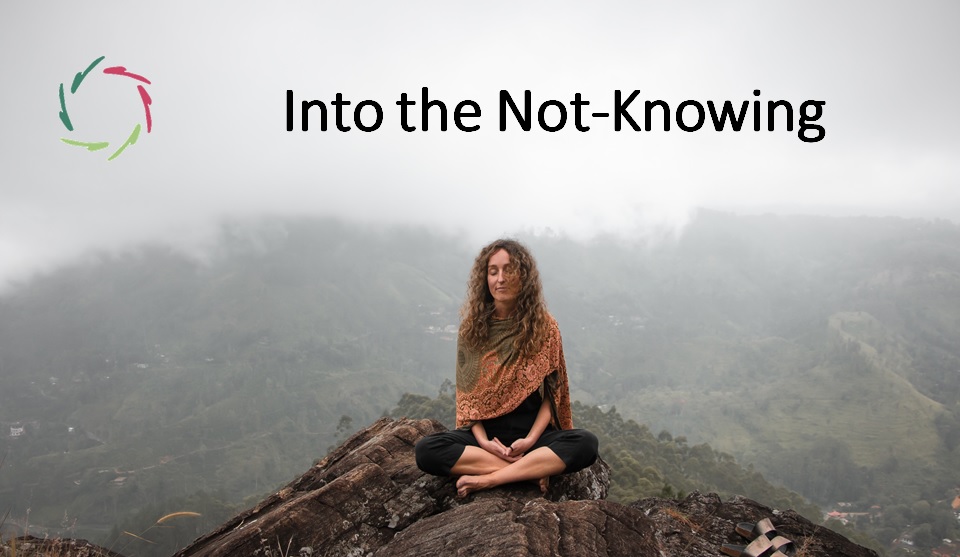
It is good to know many things. It is also good – indeed necessary – to not-know. Without not-knowing, we are not going to have a bright future, as we have not made a bright present.
Where the hyphen makes all the difference.
Not-knowing is not about a lack of knowing. It is certainly not the reverse of knowing. It is part of knowing, arguably even the biggest and most meaningful part, as it is the part where meaning itself originates. [see: “Looking for Meaning”]
Thus, the whole knowledge-endeavor (also called ‘science’) is about knowing. Knowledge is power. It gives us power over the present and the future. It’s the power to do good things, at least if we make the right choices. Knowledge can also show us what these choices are.
Without not-knowing, we are never going to reach that. Presently, we’ve stumbled into a huge mess through an inordinate striving to get rid of it, striving towards orderliness and to avoid chaos. But not-knowing is not chaos. On the contrary, it is necessary to avoid (further) chaos.
Subconceptual
To give it a modern name, we can talk about ‘subconceptual processing.’ [see: “About ‘Subconceptual’”] We can easily add to this the most modern neurocognitive science research. [see: “Patterns in Neurophysiology”]
We can now see that the conceptual in the human mind is the continual result of subconceptual processing. Both are crucial to reach a view upon the human being that leads to wise decisions. [see: “True Wisdom = Conceptual + Subconceptual“]
The consequences are immensely practical. Therefore, we must look at it with a scientific mind: striving for parsimoniousness (clear and simple theory) and reproducibility.
As in healthcare
Much and mounting problems keep growing until we incorporate the path of the not-knowing. This relates to anything in the domain of complexity [see: “Complexity of Complexity”], first and foremost our (deeper) mind.
It is detrimental not to acknowledge complexity in medicine, especially in psycho-somatics and psychiatry. It leads, as a matter of fact, to oversimplification, rampant at present. Take any psyche-related construct in healthcare (depression, chronic pain, autoimmune disorders), and you see the obvious. You find much of this in my blogs and books.
In subconceptual mental processing, as in any complexity, one encounters the field of not-knowing. Indeed, one doesn’t know what comes out of it until it comes out of it. This is theoretically compatible with determinism (without proving it, of course), but it is intractable; this is: pragmatically unfeasible to calculate.
Complexity is also eventually the reason why in medicine, we need to conduct really good RCTs (randomized controlled trials) ― studies not with a few subjects, but with many. Then we carry out meta-analyses on many such trials. Even so, in numerous cases, the extrapolations from these are pragmatically inconsistent with the real world. There is still a discrepancy between the closed world of research studies and the open world of reality because reality is complex.
In psychology, this has prompted an immense reproducibility crisis, leading knowledgeable researchers to conclude that “we know much less than we used to.”
Control?
A living fear at the core of all this is the fear of losing control. Indeed, in dealing with complexity, strict control is impossible. However, the solution doesn’t lie in trying to keep a mere semblance of control.
The more we want to get rid of not-knowing, the more we are at risk of ending up with not knowing.
Historically, medicine tried to get rid of magic, but this has crept in big-time through the backdoor as placebo ― carrying the same untruth, broadly speaking, and working in the same way. [see: “Placebo Based Medicine”]
Placebo only brings a semblance of control. In reality, it takes away control of the individual who becomes dependent on the placebo and loses Inner Strength, the strength to heal oneself from inside out, to grow organically.
The alternative: not-knowing?
Indeed: organic growth. In healthcare and more, this is a proper use of autosuggestion. It’s like inviting nature to be itself. [see: “You Are an Organism, Not a Mechanism.”] In matters of the mind, this is almost always necessary.
Meditation, if done well, is a legitimate part of the road into not-knowing. It should play a role in every physician’s education. [see: “Meditation, a World of Difference”]
If you like guided meditation, here’s a free app for you.
One of the advantages is that this can be done in a completely open way. It is not-knowing how the growth will happen, but – with proper support – being confident that it will happen in an organically optimal way and with optimal result.
This, of course, is AURELIS.
Related Posts
Human Hypocrisy
Hypocrisy is often condemned as a moral failing, yet it is deeply human. We live with contradictions — not always because we intend to deceive, but because our deeper selves are not fully aligned with our conscious beliefs. This gap between what we say and what we do is not just about dishonesty; it is Read the full article…
Beware of Positive Thinking
This is part of my book Your Mind as Cure – Autosuggestion for Everyone. The movement of positive thinking (if one may call it that) was popularized by Vincent Norman Peale (1898-1993). Peale was a Christian minister and a prolific writer. The Power of Positive Thinking is his most widely read book. It was first Read the full article…
What is a Pattern?
Patterns surround us — in nature, in our thoughts, and even in the ways we feel. Yet when we look closer, a pattern is not as simple as it first appears. It is more than a repeating structure; it is a moment of meaning. This blog explores how patterns arise at the meeting point between Read the full article…