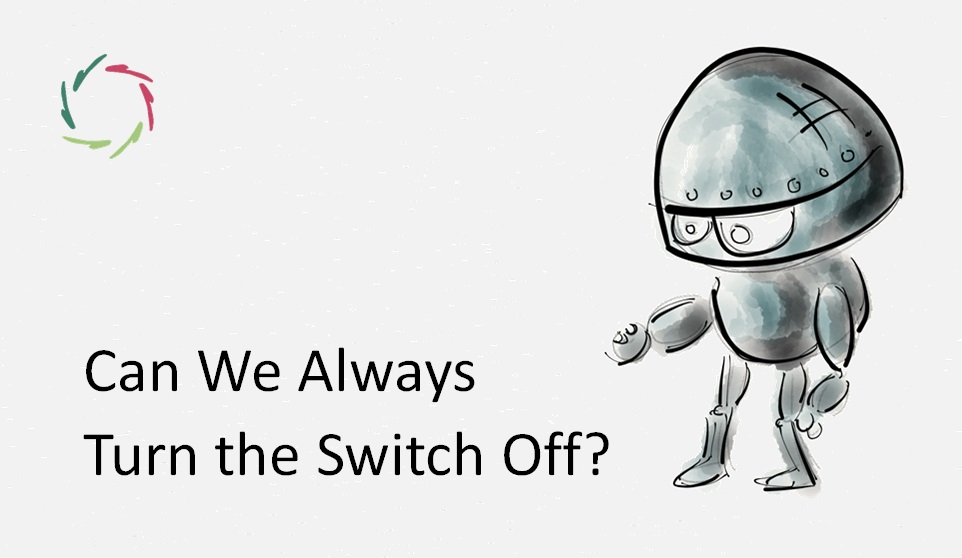
Can We Always Turn the Switch Off if A.I. Turns Rogue?
In theory, this existential issue is as simple as it can get. In practice, it’s problematic. [This is an excerpt from my book ‘The Journey towards Compassionate A.I.’] Many questions prevent a straightforward answer to the question in the title. For starters, who will turn the switch off? Let me divide the issues into 1) Read the full article…
7. COVID Crash
Nothing worse than a false sense of security. Please, take every measure of precaution. Then, read on. A virus is the smallest living thing on earth. And in a way, it’s not even living. It doesn’t replicate. It lets itself be multiplied. A virus is like a string of information caught in some genetic Read the full article…

Lonely Poem – In Times of Corona
Just let me have a bleeding heart For those who die alone In times of corona. I would like to be with each of them To die with each of them So they are not alone. ** For what is and should not be Is not one’s pain Is not one’s dying But one’s abandonment Read the full article…
6. Rethinking Covid
Nothing worse than a false sense of security. Please, take every measure of precaution. Then, read on. April 12, 2020 Kindly follow this trail: Covid-19: Pandemia or Global Hysteria? Mind and Corona The Message in the Virus Covid and Attention What To Do in Times of Covid A ‘stress’ primer The concept of Read the full article…
Anxiety
People who apparently feel little anxiety, quite often turn out to harbor a lot, arguably more so in Western cultures. The latter may seem so because it strikes me more. [See in AurelisOnLine: Anxiety] Anxiety, not fear Fear is conceptual. The object of fear is mostly well delineated. One can say: It is mechanical, directly Read the full article…
AURELIS Quick-Course
This text is for you if you have never heard of AURELIS. Many blog texts You can find many blog texts about AURELIS here. The present text is stand-alone. Mental patterns Look at a painting. What do you see? One can say ‘a Madonna with child.’ Another one can say ‘many paint molecules that are organized Read the full article…
Lisa in Corona Times
This is about what Lisa [see: “Lisa”] can accomplish in ‘corona times,’ now and in the future. Let’s hope to get her ‘live’ as soon as possible. Two ways Lisa can provide immediate help and relief of suffering through her full coaching including her guidance to AURELIS mental exercises. Lisa is also about pattern recognition Read the full article…
Mind over Covid – 12 Points
Nothing worse than a false sense of security. Please, take every measure of precaution. Then, read on. The basic ‘Mind over Covid’ hypothesis: In Covid-19 – the disease progression, not the infection – the mind may be more important than the virus in cause as well as proper management. This text is, in Read the full article…
5. What To Do in Times of Covid
Nothing worse than a false sense of security. Please, take every measure of precaution. Then, read on. March 30, 2020 This article can be read on its own. For more background, kindly follow this trail: Covid-19: Pandemia or Global Hysteria? Mind and Corona The Message in the Virus Covid and Attention [Recommendation: if Read the full article…
4. Covid and Attention
Nothing worse than a false sense of security. Please, take every measure of precaution. Then, read on. March 28, 2020 This article can be read on its own. For more background, kindly follow this trail: Covid-19: Pandemia or Global Hysteria? Mind and Corona The Message in the Virus Covid and Attention MULTICAUSALITY Read the full article…
3. The Message in the Virus
Nothing worse than a false sense of security. Please, take every measure of precaution. Then, read on. March 22, 2020 Kindly follow this trail: Covid-19: Pandemia or Global Hysteria? Mind and Corona The Message in the Virus OK. I’ve asked myself: Why not wait to bring this message until the worst part of Read the full article…
2. Mind and Corona
Nothing worse than a false sense of security. Please, take every measure of precaution. Then, read on. March 20, 2020 [Please read first: “Covid-19: Pandemia or Global Hysteria?“] Disclaimer: This article is not a scientific review. Most unfortunately, the disclaimer holds truth. This article is not a scientific review because there is no science Read the full article…
1. Covid-19: Pandemia or Global Hysteria?
Nothing worse than a false sense of security. Please, take every measure of precaution. Then, read on. March 18, 2020 This article is dedicated to Dr. Li, not because he stood up to Chinese authority but because he stood up. There is hope for humanity as long as there are individuals who are brave Read the full article…
The Journey Towards Compassionate A.I.
So, I’ve written a book. It carries the same title as this blog. It’s about intelligence, consciousness, and Compassion (with capital). Only on the background of these can one talk about the future of real A.I. (and us). First things first: ‘The Journey Towards Compassionate A.I.’ is available through many internet outlets, such as Amazon. Read the full article…
Human Vulnerability
In an A.I. future – and already now – the main vulnerability of the human race will be the result of our not seeing the most significant part of ourselves. I’m talking about non-conscious mental processing. Every feeling, every thought that arises within any person, including you, here, now, rises from somewhere, including a myriad Read the full article…
Weakness
Weakness is to be avoided. This doesn’t mean that everybody should become harder. Continua Many human features are lying on continua with extremes at both sides. If utter hardness lies at one extreme of such a continuum, weakness lies at the opposite. Still, being less weak doesn’t mean being harder. There is more complexity in Read the full article…
Energy
Deep motivation. The direction matters. Constructive or rather destructive, intentional or somewhat chaotic, used or abused. It matters when it matters to people. The more profoundly someone makes it matter, the more it matters. If you know what I mean. Depth makes it matter. That’s what depth is about, what makes it essential. Without it, Read the full article…