Problem -> Goal -> Cause -> Being There
Not all simple things are interesting, but all interesting things are easy to express in words. Such as: • What’s the problem? -> What’s the goal? • What is the deeper purpose? • What is the cause of this deeper purpose? Why do you want that? • Be there. In the case of superficial goals, it is not so interesting to Read the full article…
Lightbulbs and Human Energy
Please read first [see: “Dimming the Lightbulbs“] You can also view the image of the lightbulbs from a different angle. That is: the underlying glow of the lights is ‘human energy,’ or motivation, deeper and deeper as you enter a more meaningful and vague domain Where does the ‘glow’ ultimately come from? You may say: Read the full article…
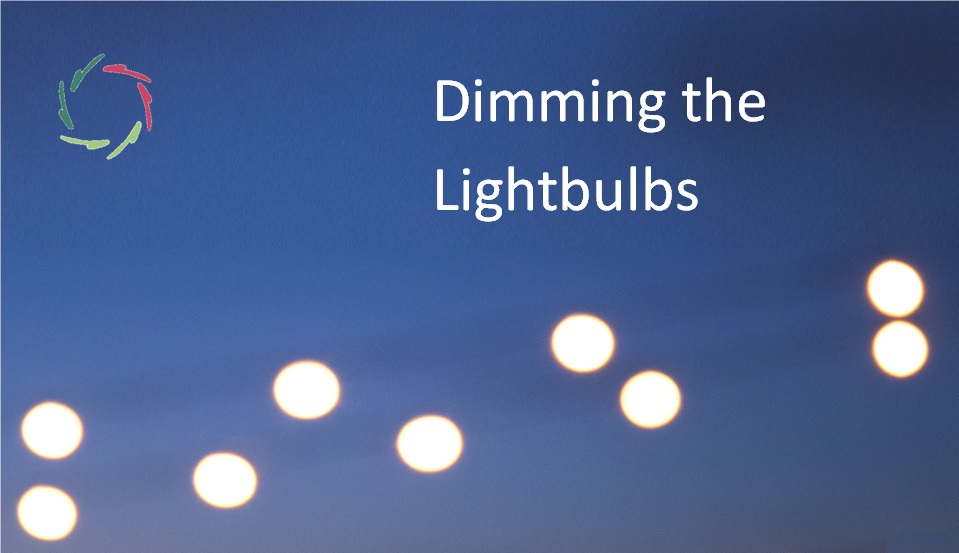
Dimming the Lightbulbs
Imagine a large number of tiny lights as a kind of lightbulbs scattered in a room. These lights represent the purely conceptual thoughts in a person’s mental landscape. This is conceptual thinking that also thinks about itself in a similarly conceptual way. In other words, this is ego-minded consciousness. Also, imagine gleams behind the bulbs (or Read the full article…

About ‘Now’ during an AURELIS Session
This is important each time someone uses an AURELIS session. At the same time, it’s something for the ‘advanced’ user. For one person, it is easy to swoop in; for the other, it is a job of thinking, feeling, perceiving for a while. Of course, you can do AURELIS sessions with a specific purpose in mind. Read the full article…

Mindfulness, Lights and Glow
One can understand ‘mindfulness’ in two different ways, which are distinguishable from each other in the metaphor of the ‘lights’ and the ‘behind the glow.’ These two ways are even opposed at this critical point, although they are two poles that also flow into each other. • mindfulness with primary attention to the lights The underlying Read the full article…
AURELIS & Expansion of Consciousness
The term ‘consciousness expansion’ is peculiar in many ways. How can consciousness be expanded? What does this ‘broad-minded’ mean? Is this mainly a feeling, or is it much more than that? [see: “Expansion of Consciousness“] AURELIS skill Expanding consciousness in all openness, kindness, and compassion, soft, firm, and realistic, in full acceptance of who you are and who Read the full article…
AURELIS = YOU as a Total Person
Suppose someone comes to you, and it turns out that he has not heard or thought much about the ‘non-conscious’. Then it is important to outline this as part of the ‘environment within which AURELIS works.’ The following is an example of a text as understandable as possible, just straightforward, that could be used in this Read the full article…

Coaching Note on Communication
To communicate = everything at once. Any division is artificial. Give people what they really want in your communications. In other words, try to get the colorit and respond to that, instead of responding to what you think the person might feel or might need on the surface. In the human painting, the colorit is Read the full article…
Somatisation and De-Somatisation
The movement from that which shows itself somatically to the same that now shows itself mentally. People can ‘feel with their bodies’ = somatization. This also means that if (physical) symptoms are loosened, people may become aware of feelings more psychologically. This gives the impression that these feelings are appearing only now, but they were Read the full article…
Psychotherapy towards What?
The question is generally not being asked. The result is that we generally don’t know much about the importance of the answer. Please also read [see: “Is Short-Term Enough in Therapy?“] Psychotherapy generally takes the mend-that-what-is-broken model This has been taken from medicine, which took it from physics. In healthcare, this is the disease model. Read the full article…

Banned from the ‘Garden of Eden’
EVERY feeling of ‘being sinful’ is the translation of a feeling of not opening. See the flower bud metaphor in e-booklet 2. Inner Dissociation The Biblical original sin lies in ‘eating the apple,’ this is: reaching a state of self-consciousness and therefore also seeing oneself, one’s nakedness. But at the same time, it also lies Read the full article…
Good Communication is a Spontaneous Reaction
Spontaneous: not superficial but from the inside out. Two facts: • The non-conscious is always present and plays a significant role in whatever you do, also in the contact between a coach and a coachee. • The non-conscious reacts much faster than the conscious mind. The latter has been well investigated in the following experiment: A green Read the full article…

Emotions and Consciousness
An emotion is, of course, always important. Yet, there is a whole gradation between ‘superficial’ and ‘deep.’ Deep as being what has more to do with more of you. But what this actually means is quite subtle. [see: “What is ‘Depth’?”] You can be aware of an emotion, but you cannot evoke an emotion with your consciousness alone. Read the full article…

Detachment
A major misunderstanding that must be put to bed in the (Western) world: ‘detachment’ is NOT the having of control over one’s feelings and emotions, nor is it the loss or not having of feelings and emotions. “The detachment of a stone is not that of a human.” Having the ability to show some detachment Read the full article…

Lisa in Career Coaching
A superb opportunity for Lisa (coaching chatbot) lies in lifelong integrated career coaching. The goal is finding work happiness, purpose and meaning in a way that also serves the greater good. Career coaching Eventually, this is indeed a person’s coaching that is meant to be ongoing over an entire career, also already during their studies, Read the full article…
Inclusiveness at Work
This is a worthy, challenging goal that can only be attained by valuing our humanness. As such, it’s about each individual person, including yourself. Inclusiveness Inclusiveness at work is about many things, such as gender, race, age, nationality, and religious denomination. The borders are those of morality. Sociopaths or people who don’t have an inclusive Read the full article…
Tuberculosis and the Mind
Suspected since millennia, nowadays backed up with scientific data, the influence of the mind on tuberculosis is a fine example of the complexity, as well as the importance to take this seriously into account in many domains. Pertinently Despite modern treatments, tuberculosis is still one of the leading causes of death worldwide, and – at Read the full article…