Lisa-Coaching = Meditation?
Compassion, autosuggestion, from the inside, as by itself, subconceptual, meditative… These terms – frequently used in AURELIS and Lisa-setting – all denote a basis of meditation. No conceptual psychotherapy techniques Most Western schools of psychotherapy are based on a conceptual theory and teach therapists to use conceptual methodologies and techniques. Lisa (coaching chatbot) doesn’t use Read the full article…

Your Memories are Alive
Memories are living beings in continual motion. Not any memory is a replica of what happened in the past. No library We don’t have a library of memories in our head, nor a computer-like database in which one can perform a straightforward lookup of wanted information. Instead, we have a hundred billion neurons forming mental-neuronal Read the full article…
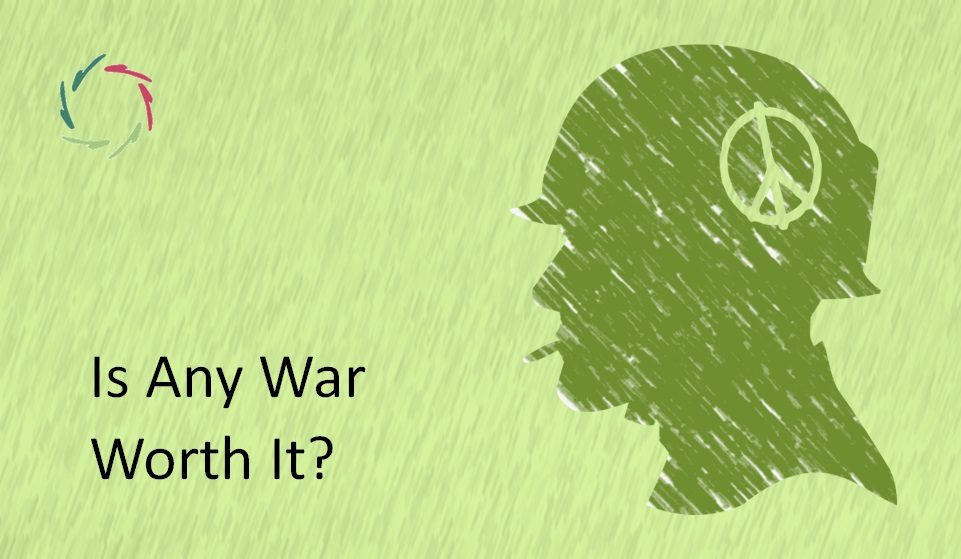
Is Any War Worth It?
War is definitely not worth the death of even one human being. One doesn’t need to be a pacifist to see that. War may have been worth it in the past. Groups may have fought each other for scarce resources as a matter of individual life or death. Also, they may have done so due Read the full article…
No to Wokism, Yes to Gentleness
In another blog, I define wokism as woke fundamentalism, being an abuse of wokeness as a positive striving to fully respect and tolerate people of many different kinds. I am very woke, but not at all a wokist. Woke should be gentle. Without gentleness, woke tends to fall into the opposite, being intolerance. Woke is Read the full article…
Woke Fundamentalism
Fundamentalism is never OK. Least of all in ‘woke’ since this has the object of making people awake concerning the negative sides of… fundamentalism. Fundamental In this text, ‘wokism’ denotes ‘woke fundamentalism.’ As in any fundamentalism, anxiety and aggression are core elements. As any fundamentalism, it has at the core the reverse of what the Read the full article…
Compassion =
This text is about the externals of Compassion ― what it points to, and what it can accomplish. Please also read about the internals of Compassion: what it is, basically. Compassion is about human depth, but it is also about rationality within this depth. This leads to ancient as well as scientifically new insights and Read the full article…
Global Madness is Today
If you feel like this world is growing in madness, you may be right. Sometimes, it seems like the madness is getting World War proportions ― again. The first World War in two stages shows that it is possible to start in an unexpecting environment. Without doomsday thinking, we should also not put it aside Read the full article…
What’s the Worth of Human Life?
The worth of one human life appears to lie between 2 and 2 billion €, more or less. It all depends on whose life, and I don’t get that. I’m not following. I hear it depends on where human worth is measured. That is revolting. Human life is human life. One may still call some Read the full article…
Medical A.I. for Humans
Medical A.I. is flourishing and will be more so in the future. Therefore, we must ensure that it serves the total human being. The main challenge Through medical A.I. – substantially more than ever – humans can become either more humane or robotized from the inside out. This is not about putting probes etc. in Read the full article…

Synchronicity
For instance, you think about contacting someone who just happens to contact you. The concept of synchronicity has been developed by psychiatrist C.G. Jung in the early 1900s. Most scientists of today don’t believe in it. Let’s try to open this. Definition “Synchronicity is a phenomenon in which people interpret two separate – and seemingly Read the full article…
Dying is Entering Eternal Love
Mere ego dies. There is no afterlife. Sorry, my dear ego readers. There is no heaven or hell for ego to continue doing its ego things. Nothing. Total self expands. It is not an ego. It becomes more and more a universe. Total self expands during a whole life, if it gets the chance and Read the full article…
The Unimportance of Infinity
This doesn’t mean that the issue is unimportant ― quite the contrary. But infinity itself, as a concept, is about unimportance. Then, what has love got to do with it? [This is an ‘Ultimates’ text. Please, don’t take it at face value.] Infinity is an absurdity. It cannot exist. Yet, any finite space or time Read the full article…
Deep Purpose
“He did it on purpose.” Maybe, but what is ‘purpose’? And an even more profound question: What is ‘deep purpose’? Complexity is needed for purpose. A jumbo jet is complicated but not complex. Therefore, a jumbo jet doesn’t have purpose. It can have A purpose given by those who use it. The jumbo’s so-called purpose Read the full article…
Compassion in patterns
This may be, at the same time, the deepest and the highest (tentative) view on the phenomenon of Compassion. Thinking is pattern recognition and completion. You’re spoilt today. This may be, at the same time, the deepest and the highest (tentative) view on the phenomenon of thinking. I mean ‘pattern’ at the most abstract level. Read the full article…
Real Compassion is Really Effective
Compassion is very complex. Together with a lack of understanding comes a huge underrating of its effectiveness. Where does the effectiveness come from? Subconceptual (largely non-conscious) mental processing controls the body and conscious mind ― one can say: from the inside. At this level, mental-neuronal patterns are mind and body simultaneously. Consequently: It profoundly influences Read the full article…
Where is/was the Mind in COVID-19 Causality?
This is the title of an article – by me – in the high-level medical journal ‘Brain, Behavior, & Immunity – Health,’ edition May 2022. With pain and all due respect, I dedicate it to the 18 million COVID mortality worldwide ― according to this recent publication in Nature magazine. Because of more naturalistic measurements, Read the full article…
Why Only Growth is Durable
Mental growth ‘as a total person’ leads to a continual and lifelong change. Any other attempt toward change is mostly but a temporary glitch in the natural evolution. The reason is, simply put, complexity. The complexity of the human mind is usually highly underestimated. Looking at the brain increasingly shows – and also proves materially Read the full article…