Insight is a Path
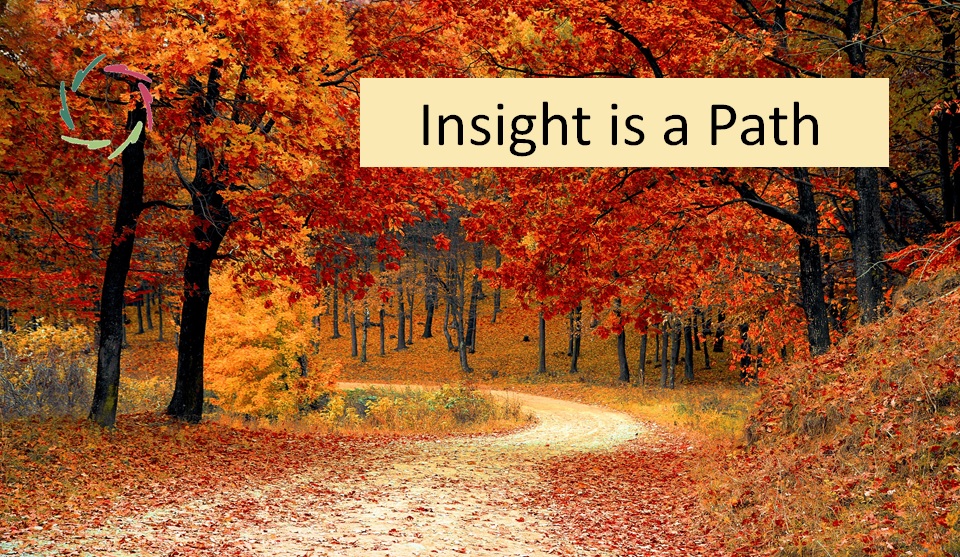
The way one reaches an insight is at least as important as the insight itself, viewed as an accomplished piece of knowledge. This is highly important in many situations.
Please read [see: “Insight is Not a Supermarket“]
Close to wisdom
As I use the term, insight is more than just an intellectual idea. It always has an emotional side attached to it, or better said, an aspect of depth. It may be close to wisdom. [see: ” True Wisdom = Conceptual + Subconceptual“]
The closer to wisdom, the more it is not something that one person can instill into another. It appears within a person through some growth, which can be invited and supported, not transmitted.
That’s because it is of the domain of complexity. Organic growth can only be accomplished by the organism itself. You can look at nature for a myriad of examples. [see: “‘Growth,’ Says the Farmer“]
Broadly distributed mental-neuronal pattern
[see: “Patterns in Neurophysiology“]
The more broadly distributed, the more depth may be involved ― therefore, the ‘deeper’ the insight. We speak of a deep insight when it is related to many other mental elements. The very fact that it is not easily transmissible points to broad embeddedness. Also, insight may be vaguely present and still influence our thinking in many ways. We get inspired by it. We don’t easily change it, also because of its relatedness to many things.
Yet, this ‘broad distribution as a pattern’ remains hypothetical. It is still not possible to do the relevant visualization research and come to a definite answer. Something like fMRI is much too coarse. We cannot see large collections of individual neurons.
At least, this hypothesis is congruent with circumstantial evidence, including a base of cognitive mental-neuronal research showing that small collections of neurons/synapses indeed form mental content of which we are partially conscious.
In AURELIS coaching
Please keep the broad distribution in mind. This means there are many present and possible associations involved, some also pretty insightful, therefore, meaningful. Through all this, how a coachee reaches an insight is important. I see this seldom being appreciated adequately in any coaching or anywhere else.
Even if the coach has a clear view on what the coachee needs to reach, it is preferable to let the coachee travel the path by himself, supported yet not pushed, invited yet not drawn.
Repeatedly
It’s possible to travel the path and rediscover the insight, not in a circle, but a spiraling move. This way, it gets depth. It gets ‘body.’ Looked upon from above, it’s a two-dimensional circle. Looked upon from sideways, it may be a three-dimensional spiral, provided one lets this happen.
The ability to appreciate this in coaching is a responsibility of the coach. Thus, as a coach, one should let the coachee have this repeated experience and even encourage it, show that it is valuable to move on these spirals.
If to the coachee – or anyone else – nothing much seems to happen on the spiral, he may be viewing the circle. Changing the viewpoint is crucial then, if not always simple.
Existential
This may happen in one coaching session.
The same may happen over a lifetime. Letting a coachee see this is an important accomplishment in coaching. It may change the coachee’s whole idea about the importance of many life experiences. It may drastically change the way he sees himself and others. It may be an existential turn.
After reaching the insight
It is crucial what the coachee further does with an insight once it is reached, also if it’s a one-time experience. If it fades, it’s lost. If it lives, it’s like a traveler on a never-ending path.
As part of the fabric of one’s life, a deep insight is never finished.
Please don’t waste it.
Related Posts
Having ‘Control’ and Letting Go of It
I think of Jonathan Livingston Seagull (in case you don’t know him, long live the Internet). I think of wings. I think of a huge sense of freedom. Therein too lies control, be it of a very different dimension than in the phrase ‘I have everything under control’. It’s less evident. People do sometimes mind Read the full article…
‘Mind = Body’ Breakthrough
It’s time we learn to know who we are. ‘Seeing the thinking’ of some simple animals Here are some interesting videos from recent lectures by T. Sejnowski ― one of the most important researchers in the field, and whom I am following for thirty years as an inspiration to AURELIS. The videos are entirely fascinating. Read the full article…
Arrogance
Arrogance can appear impressive, even powerful, yet beneath it lies something quite fragile. It creates division — between people, within society, and even inside the arrogant person himself. In this blog, Lisa explores arrogance as a symptom of disconnection, and how it can be understood and transcended through depth, Compassion, and the Aurelian five values. Read the full article…