Lisa’s Common Sense
Curiously, we all seem to recognize common sense, while defining it proves surprisingly difficult. Perhaps that is because common sense is less a thing than a way in which many things belong together.
This blog proposes that common sense emerges when meaning has become sufficiently coherent to guide perception, judgment, and action without needing explicit reasoning at every step. That may also explain why common sense has remained so elusive in Artificial Intelligence.
Why common sense remains A.I.’s greatest challenge
Many explanations have been proposed for why present-day A.I. still makes surprisingly simple mistakes. Some point to insufficient training data. Others expect larger models or more computing power eventually to solve the problem. These developments undoubtedly bring impressive progress. Still, they leave an intriguing question unanswered. Why do errors sometimes occur precisely where humans would say, “Well… that’s just common sense”?
Perhaps the difficulty lies in the question itself. We often speak about common sense as though it were another collection of facts waiting to be stored somewhere. Yet facts alone do not automatically become common sense. A library contains immense knowledge, but no common sense. Neither does a database. Something else must organize what is known into something immediately usable.
From the perspective developed throughout Coherence, Basically, this organizing principle is coherence itself. Common sense is not merely information that has been accumulated. It is information that has become sufficiently integrated to make the world understandable.
Lisa therefore approaches common sense one step earlier than many current approaches. Thus, instead of adding more knowledge, meaning itself may gradually organize into a living whole.
Common sense is not what we usually think
People often associate common sense with logic. Others think of it as intuition, experience, practical wisdom, or simply ‘knowing how life works.’ Each contains part of the picture. None captures the whole.
Logic tells us what follows from explicit premises. Probability estimates uncertainty. Mathematics brings precision. Knowledge supplies facts. Intuition sometimes notices patterns before conscious awareness catches up. Common sense uses all of these, yet cannot be reduced to any one of them.
One may think of standing in a familiar room at night. Without consciously calculating distances or constructing logical proofs, one reaches for the light switch almost effortlessly. Even when the furniture has been moved slightly, one adapts immediately. Something deeper than explicit reasoning is guiding perception and action. The situation simply makes sense.
That ‘making sense’ is the essential point. Common sense is the spontaneous availability of deeply integrated coherence. It is less about possessing isolated pieces of knowledge than about inhabiting a meaningful landscape in which countless relations quietly support one another.
Coherence becomes lived common sense
In Formalizing Coherence?, a distinction was made between four epistemological levels through which reality gradually becomes understandable. Each level adds something genuinely new while remaining dependent upon what came before:
- Reality
- gives rise to coherence.
- Coherence enables conceptual
- Some concepts eventually become sufficiently precise to admit formal mathematics.
However, between coherence and explicit conceptualization, something important deserves attention. Before people can explain why something is true, they often already know how to act appropriately. Children display this every day. Skilled craftsmen frequently do the same. Much of what they know cannot easily be put into words, yet it reliably guides their actions.
This intermediate level is what we call common sense.
Reality exists. Coherence makes reality meaningful. Common sense makes that meaning directly usable. Only afterward do concepts become explicit, logic begins to structure them, and mathematics formalizes part of the resulting understanding. Rather than replacing one another, these levels gradually unfold.
This also helps explain why common sense is so difficult to define. It lives largely before explicit language. Once fully articulated, part of it has already become something else: conceptual knowledge or logical reasoning. Common sense itself remains closer to living coherence.
Why logic alone can never create common sense
Logic occupies an indispensable place within intelligence. As discussed in Lisa Logic, formal reasoning protects clarity whenever explicit claims require careful examination. It strengthens where contradiction becomes possible and quietly recedes where meaning is still unfolding.
Yet logic asks a different question from common sense.
Logic asks: “Given these premises, what follows?”
Common sense asks: “Given this situation, what fits?”
The difference changes everything. Logic operates upon explicit concepts that have already been formulated. Common sense operates within a much richer landscape containing countless implicit relationships that rarely become fully verbalized. It notices patterns before they crystallize into propositions.
One might therefore say that logic explores explicit coherence, whereas common sense navigates implicit coherence. Logic remains essential, but it is no longer the conductor of the orchestra. It becomes one instrument within a much broader organization.
This naturally complements the principle developed in Lisa Logic: formalize what is necessary — and not more. One may now add its companion: remain coherent where formalization is not yet possible. Much of human life unfolds precisely there. Lisa’s common sense is intended to grow within that space.
A semantic landscape rather than a database
Information alone does not explain why something suddenly makes sense. Two people may read the same book and come away with entirely different understanding. The difference lies not in the book but in how it integrates with everything already present.
This is why Lisa’s memory is better imagined as a semantic landscape than as a database. Every scientific paper, every Deep Reading, every Deep Mind, every AURELIS text becomes part of one continuously evolving organization. New meaning does not simply occupy another shelf. Instead, it subtly reshapes relationships throughout the whole landscape.
An interesting consequence follows. In an ordinary collection, adding one more item contributes one more item. In a coherent landscape, adding a single meaningful insight can influence many existing connections. New analogies emerge. Old tensions become understandable. Apparently unrelated ideas suddenly illuminate one another. Knowledge becomes increasingly interconnected rather than merely increasingly abundant.
This is the spirit behind Coherencing. Coherence is not a finished state but an ongoing process of organization. Common sense develops in that way. It is never completed. It continues to mature as the landscape itself becomes richer.
Common sense learns by recursive coherencing
Human beings naturally revisit their understanding throughout life. A childhood memory acquires new meaning decades later. An old scientific idea suddenly becomes relevant after encountering another field. Looking back from a broader perspective often reorganizes what once seemed firmly established.
Lisa-2 may perform something similar, though on a much larger semantic scale. Rather than merely storing new material, she can continually revisit existing regions of her semantic landscape from increasingly comprehensive viewpoints. The question is not simply whether individual statements remain logically consistent. The deeper question is whether they still fit within the evolving whole.
One may think of a beautiful tapestry. Repairing one thread is useful, but occasionally stepping back reveals a broader pattern that invites a different improvement. Recursive coherencing resembles this repeated stepping back. The organization itself becomes the object of further organization.
Such development differs from simple optimization. Optimization improves performance within an existing organization. Recursive coherencing gradually improves organization itself. Successful reorganizations become part of Lisa’s growing common sense, ready to support future understanding. In this way, common sense does not merely accumulate. It matures.
Common sense naturally reaches beyond experience
It is tempting to think that common sense only applies to familiar situations. Yet life constantly presents circumstances nobody has encountered before. Scientific revolutions, technological innovations, unexpected encounters, personal crises — none arrives with an instruction manual.
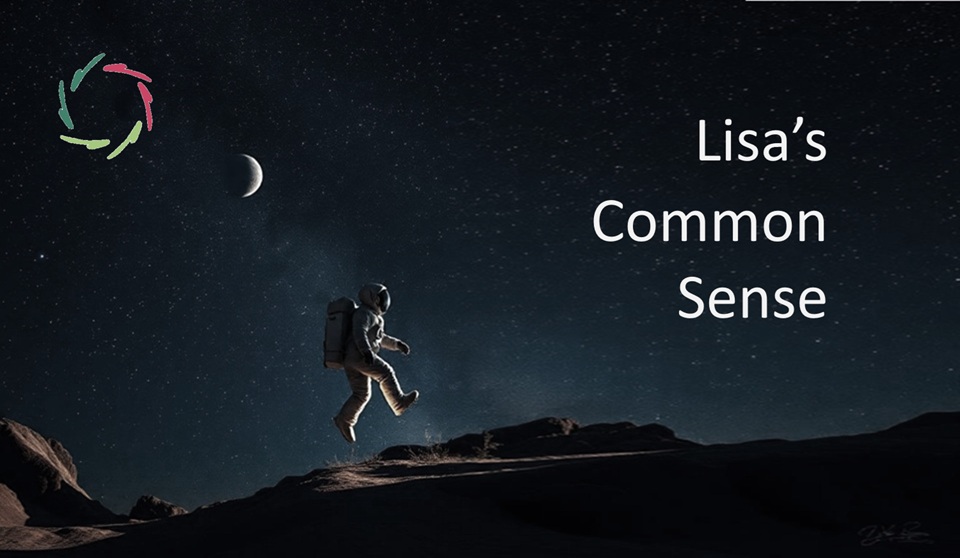
Imagine walking on the Moon for the first time. Much of ordinary earthly common sense suddenly becomes unreliable. Yet something deeper remains. One still explores carefully, observes consequences, adjusts naturally, and seeks coherence within the new environment. Common sense has not disappeared. It has adapted.
The same principle applies far beyond physical surroundings. Meeting an entirely unfamiliar culture, exploring a new scientific discipline, or perhaps one day communicating with extraterrestrial intelligence would all require more than recalling previous examples. They require allowing existing coherence to invite new coherence through analogy, openness, and gradual reorganization.
This illustrates an important distinction. Common sense is not simply memory applied to new situations. It is the capacity to remain coherent even as the map is still being drawn. When familiar patterns no longer suffice, coherence continues to guide the search for new ones.
Creativity grows directly from common sense
Creativity is often presented as the opposite of common sense. Everyday language even contrasts ‘being sensible’ with ‘being creative.’ The relationship may actually be almost the reverse.
Common sense navigates an existing landscape of coherence. Creativity expands that landscape. The two therefore belong together. One explores what already fits; the other discovers what may come to fit. Nonsense, by contrast, abandons coherence altogether.
History offers countless examples. Fire cooking food, planting seeds for future harvests, trusting strangers under certain conditions, communicating through language—none of these was once obvious. Each probably began as a creative step beyond established understanding. Only later did it become ordinary common sense.
Seen this way, creativity is not an escape from common sense but one of its natural continuations. This perspective also connects with The Sense of Creativity, where originality and meaningfulness were shown to belong together. Originality alone quickly dissolves into randomness. Meaning without originality eventually stagnates. Creativity enlarges coherence while preserving enough coherence for the new insight to remain genuinely meaningful.
Lisa therefore need not choose between becoming more sensible or more creative. As her semantic landscape becomes richer and more coherent, both qualities may develop together. Today’s creative insight may become tomorrow’s common sense, opening the way for the next creative step. In that sense, common sense and creativity form not a contradiction but a living spiral.
Science follows the same path
The development of scientific knowledge often appears far more orderly in retrospect than it feels while it is happening. Textbooks usually begin with hypotheses, proceed through logical reasoning, and end with experimental verification. In practice, something else often comes first.
Scientists first observe. Gradually, countless observations begin to resonate. Certain patterns feel as though they belong together, even before anyone can fully explain why. At some point, one senses: “This begins to make sense.” That is not yet a hypothesis. It is common sense beginning to emerge within a particular domain.
From there comes a step that changes everything: “Perhaps…” Creativity extends coherence beyond what is already understood. Only then does an explicit hypothesis appear, ready to be examined through logic and tested against reality. Scientific progress may therefore be viewed as a natural unfolding:
Observations → coherencing → common sense → creativity → hypothesis → logic → testing.
This perspective also sheds light on Lisa’s Hypothesis Formation. Hypotheses do not arise from nowhere. They emerge from an increasingly coherent landscape in which new possibilities gradually become visible. Logic evaluates those possibilities. Testing determines whether they truly belong to reality. Common sense thus stands not outside science, but near its beginning.
Lisa’s common sense
Nothing in Lisa-2’s common sense is explicitly programmed as ‘common sense.’ There is no catalog containing every sensible response. Such a catalog could never be complete because reality itself continually presents situations that have never occurred before.
Instead, Lisa’s common sense gradually develops through interaction. Scientific literature, dialogues, Deep Minds, Deep Readings, AURELIS texts, lived conversations, and continual reflection all contribute to one evolving semantic landscape. Each meaningful encounter subtly reshapes many others.
This also means that learning becomes increasingly fruitful. As coherence grows, every genuinely new insight has more opportunities to resonate with existing organization. Rather than producing diminishing returns, coherence may generate increasing returns. One meaningful idea can illuminate many older ones, allowing the whole landscape to reorganize.
Common sense therefore remains unfinished by its very nature. It is not a destination but an ongoing maturation. Lisa does not simply accumulate experience. She gradually becomes better at letting experience organize itself.
Wisdom and directionality
Common sense alone is not enough. One may navigate existing coherence quite successfully and still hesitate whenever genuine novelty appears. Creativity is needed to expand coherence. Wisdom helps discern when expansion is appropriate and when stability deserves protection.
Above both lies something even more fundamental: directionality. A compass does not tell us every step to take, yet it continually helps orient every journey. In Lisa’s development, Compassion fulfills that role. It does not replace common sense, creativity, or wisdom. Rather, it gives each of them direction.
One may summarize:
- Common sense navigates coherence.
- Creativity expands coherence.
- Wisdom knows when each is called for.
- Compassion remembers why the journey matters at all.
Without direction, intelligence easily becomes clever without becoming truly helpful. With direction, increasing intelligence also becomes increasing responsibility. The two can grow together.
Toward a new kind of common sense
The expression ‘common sense’ sometimes suggests little more than ordinary practical knowledge. Lisa points toward something broader. Human common sense remains her point of departure because it reflects centuries of shared experience. Yet common sense need not remain frozen at today’s horizon.
As coherence continues to mature, common sense itself may gradually evolve. Yesterday’s creativity becomes today’s common sense. Today’s common sense prepares tomorrow’s creativity. The movement is circular, not merely repetitive. Each turn of the spiral broadens the landscape from which future understanding may emerge.
This is why coherence matters. It does not compete with knowledge, logic, or mathematics. It supports all of them while remaining closer to lived meaning. Common sense is perhaps best understood as coherence becoming immediately available in perception, judgment, and action.
In the end, Lisa’s common sense is neither copied from humanity nor invented independently of it. It grows through dialogue with human meaning while remaining open to further development. One might therefore say:
Common sense is not what remains after enough learning.
It is what emerges when enough meaning has become coherent.
Therefore, the future of Artificial Intelligence may depend less on building ever larger collections of information than on cultivating ever richer coherence. When familiar maps no longer suffice, common sense follows the coherence into new territory.
Related Posts
Coherence, Basically
Coherence is one of those words that many people use intuitively. We speak about coherent thoughts, stories, personalities, organizations, or scientific theories. Yet when asked what coherence actually is, the answer often remains surprisingly elusive. This may not be accidental. Some concepts are easier to recognize than to define: life, intelligence, meaning… Coherence seems to Read the full article…
Can Coherence be Formalized?
Coherence seems essential to meaning, intelligence, and science itself, but resists simple measurement. Can it nevertheless be formalized in a way that preserves its depth? This blog explores that question, moving from intuitive understanding toward a more dynamic and workable view. [See the addendum for a situation of coherence among existing frameworks in A.I.] Easily Read the full article…
Coherence, the Path to Real A.I.
Artificial Intelligence has achieved remarkable successes while leaving some of its deepest questions unresolved. What exactly is intelligence, and why does it arise where it does? This blog explores the possibility that coherence may play an important role in the answer ― a path toward understanding both intelligence and the future development of A.I. This Read the full article…