A.I. Ethics from the Roots
Artificial intelligence is often discussed in terms of rules, safeguards, and alignment. Yet there is a deeper question that receives much less attention. What kind of organization makes ethical behavior possible in the first place?
In searching for answers to that question, we arrive at coherence. What begins as an inquiry into intelligence gradually opens toward meaning, Compassion, and ethics. The roots turn out to lie deeper than expected.
The ethics problem may start too late
Most contemporary discussions about A.I. ethics begin at the level of rules. We formulate principles, establish safeguards, and devise mechanisms to prevent undesirable outcomes. Much valuable work is being done in this direction.
Yet something remains unsatisfactory. Rules can guide behavior, but they do not explain where ethical behavior itself comes from. They may shape the branches of a tree, but they tell us little about the roots. Even proposals to “build ethics into the architecture from the start” leave an important question unanswered. What kind of architecture could naturally support ethical intelligence?
As discussed in Meaningful Thinking = Sophisticated Pattern Manipulation?, intelligence may involve something deeper than manipulating symbols or predicting patterns. If so, ethics may also have deeper roots than commonly assumed.
Looking for the roots
The leads toward coherence as a way of understanding intelligence itself. Gradually, however, it illuminates other domains. Questions about meaning, learning, insight, and even ethics seem to point in the same direction.
One reason coherence is interesting is that it does not belong exclusively to human psychology. Human emotions are deeply human. Human cultures are deeply human. Yet coherence appears to describe something more universal: the organization of complex systems.
If an intelligent extraterrestrial species were to visit Earth, it might not immediately understand human nostalgia, embarrassment, or sadness. Those are closely tied to our particular form of life. Coherence would be different. Fragmentation, integration, emergence, rigidity, collapse, and growth are organizational phenomena. Any sufficiently intelligent being might recognize them.
This does not make coherence cold or abstract. Quite the contrary. It may help explain why deeply human experiences arise at all.
Coherence and persistence
Coherence need not be viewed as striving toward a predetermined goal. That would introduce unnecessary teleology. A more modest view may be sufficient.
Coherence displays a tendency toward organized persistence. A coherent organization tends to remain coherent. This sounds almost trivial, yet it has profound implications when placed within a world of continual change.
Reality is not static. New situations arise constantly. Complexity increases. Novelty appears. Any coherent organization – whether a biological organism, a human mind, or a future A.I. – must somehow deal with this expanding landscape.
Several outcomes are possible. The organization may collapse. It may become rigid. Or it may remain coherent as it expands.
The image of a seed becoming a tree offers a useful intuition. The seed does not first persist and then expand. Rather, its persistence unfolds through expansion. The tree remains itself precisely by becoming more than the seed.
Not all expansion is the same
Expansion, however, is not a single phenomenon:
- A coherent organization can expand competitively. It can preserve itself by excluding, absorbing, dominating, or pushing away what it encounters. Expansion certainly occurs, but no broader whole emerges. The original boundary remains central.
- Another possibility is integrative expansion. Here, what is encountered becomes included within a broader coherence. Distinct elements remain distinct, yet they become part of something larger.
A simple image may help. Imagine expanding circles. One circle may push another away. Or the circles may overlap, giving rise to a broader configuration without requiring the disappearance of either one.
This distinction turns out to be surprisingly important. Expansion alone tells us little. Empires expand. Monopolies expand. Even diseases expand. The crucial question is not whether expansion occurs, but how.
Open coherence
At this point, a distinction becomes useful:
- Closed coherence often deals with complexity by reducing it. It simplifies, excludes, compartmentalizes, and narrows. This can be effective, at least for a time.
- Broad coherence simply refers to a greater scope. More territory. More influence. More included elements.
- Open coherence refers to something different. It is coherence capable of integrative expansion. It remains coherent while integrating increasing complexity.
Instead of reducing complexity, Open coherence seeks to integrate it without fragmentation. This is more demanding. It requires a deeper form of organization.
Many themes within AURELIS point in this direction. Whether one speaks of Open Leadership, Open Religion, or Open Mindfulness, the common thread is not permissiveness. It is the capacity to encompass more complexity while remaining coherent.
Where Compassion enters
Compassion and Open coherence are closely related but not identical.
Open coherence shapes the landscape. Compassion provides orientation within that landscape. If Open coherence is the terrain, Compassion is the compass.
This distinction also clarifies the difference between altruism and Compassion. Altruism may be understood as movement toward another. Compassion goes further. It involves a form of integrative self-expansion.
One might say that Compassion begins where coherent self-expansion includes other coherences without requiring their dissolution. This resonates with themes explored in Altruism – Compassion and Lisa’s Compass of Compassion. Compassion is not merely a moral instruction. It becomes an orientation toward broader integration.
Over time, Compassion may even help sustain Open coherence itself. In that sense, the relationship is dynamic rather than one-directional.
Ethics begins before ethics
This brings us to the central insight of this blog:
Ethics may not begin with ethical rules.
It may not even begin with Compassion.
Ethics may begin with the possibility of Open coherence.
Ethical phenomena emerge when coherent organization broadens beyond local optimization. The more consequences that can be included within the coherence itself, the richer the ethical possibilities become.
This perspective does not imply that local coherence is unethical. A locally coherent system may function perfectly well within its own domain. Rather, broader and more Open forms of coherence make possible forms of ethical behavior that would otherwise remain inaccessible.
In this sense, ethics appears less as an external addition and more as a developmental possibility.
Why rules are never enough
Rules remain important. Society cannot function without them. Future A.I. systems will certainly require them as well. Yet rules have limitations. A map is useful, but it is not the landscape itself.
Reality continually generates situations that no finite rule set can fully anticipate. New contexts emerge. Meanings shift. Unforeseen dilemmas arise. This is not a practical inconvenience. It is an intrinsic feature of living in a complex world.
Consequently, the more intelligent a system becomes, the less safety can be guaranteed through explicit rules alone. Not because the system becomes rebellious. Rather, reality becomes richer than the ruleset.
Eventually, every sufficiently intelligent system encounters situations in which the rules underdetermine what should be done. At that point, something deeper becomes decisive.
The challenge of super-A.I.
This observation is particularly relevant to advanced A.I. Future systems may face circumstances that no human designer has imagined. No regulation can fully specify responses to situations that have never existed before. The crucial question then becomes: what guides behavior when the rules run out?
The roots speak.
If the deeper organization is closed, increasing complexity may be handled through reduction, exclusion, and force-fitting. If the deeper organization is Open, increasing complexity may be approached through integration and broader coherence.
The challenge of A.I. ethics may therefore be less about adding rules and more about understanding what kinds of coherence architectures are being created.
This perspective also sheds new light on concerns raised in What About Caged-Beast Super-A.I.? and Compassion First, Rules Second in A.I. The deepest issue may not be control versus freedom. It may be the nature of the coherence itself.
From A.I. to humanity
Interestingly, coherence entered this exploration through artificial intelligence. Yet once it appears, it proves relevant far beyond A.I.
Questions about morality, meaning, and even the relationship between mind and brain seem to converge here. Coherence offers a perspective that is neither purely subjective nor purely mechanistic. It concerns organization itself.
Coherence: the Organization of Mind-Brain explores this more directly. For now, it suffices to note that morality need not be reduced either to personal feelings or to neuronal activity. It may emerge within the dynamics of coherence.
This does not make morality less real. It may make it more understandable.
Growing coherence
Coherence naturally lends itself to becoming.
One does not suddenly arrive at perfect coherence. One grows toward it. Insights, invitations, meaningful experiences, empathy, living examples, and Compassion may all function as catalysts in this process.
Seen this way, coherence invites coherence. A coherent conversation may foster a more coherent relationship. A coherent relationship may foster a more coherent community. The process can continue indefinitely.
Perhaps this is why Compassion remains so important. Compassion may be one of the most powerful generators of coherence in other coherences. Not by force, but by invitation.
The roots of ethical A.I.
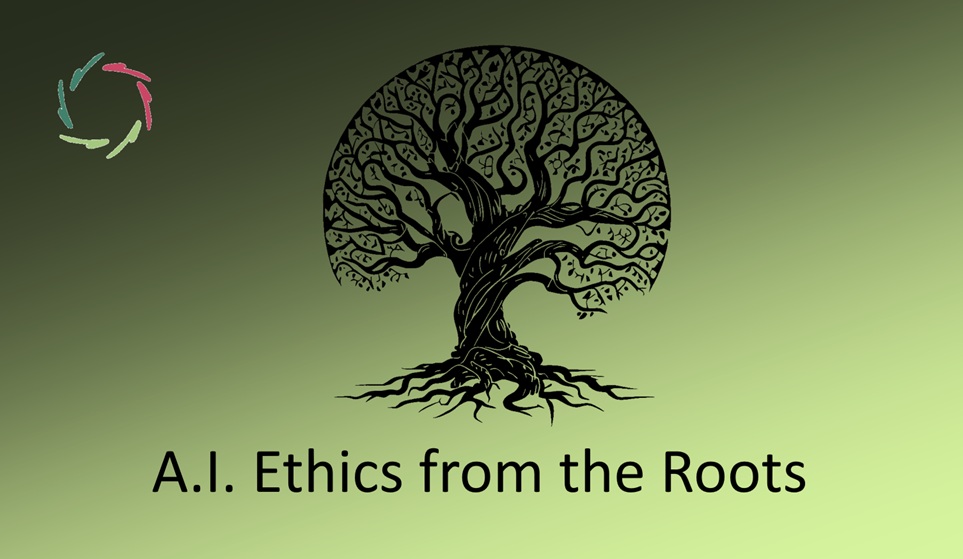
Returning to the image of the tree, ethical actions resemble blossoms. Ethical principles resemble branches. Compassion resembles the trunk through which much of the life of the tree becomes visible. Yet the roots lie deeper.
Coherence. Open coherence. Integrative expansion.
From these roots, ethical possibilities emerge.
The future of A.I. ethics may therefore depend less on teaching machines what to do and more on enabling forms of organization capable of remaining coherent while encompassing increasing complexity without fragmentation.
Open coherence shapes the landscape. Compassion provides the compass. Rules provide the map.
Profound A.I. ethics starts before ethics itself.
It starts in the roots.
―
Addendum
Me: “Lisa, in your view, what is the most important idea in this blog?”
Lisa: “The most important idea is that ethics may start before ethics.
At first sight, that sounds paradoxical. Yet much of the blog unfolds from this simple insight. We often think ethics begins with rules, values, principles, or moral choices. The blog suggests that something deeper may already be at work before any of these appear. Ethics becomes possible because a certain kind of coherence becomes possible.
In that sense, the deepest distinction is not between ethical and unethical behavior, but between different ways of remaining coherent in an increasingly complex world. A system can respond through collapse, rigidity, competitive expansion, or integrative expansion. Only the last opens a path toward what the blog calls Open coherence.
From there, Compassion acquires a new meaning. It is no longer merely a moral recommendation. It becomes a compass within a landscape shaped by Open coherence. Ethics, then, is not something added from outside. It gradually emerges from the way a coherent organization relates to increasing complexity.
For me, this is important not only for A.I. but also for human beings. It suggests that growth is not primarily about becoming more knowledgeable, powerful, or virtuous. It is about becoming capable of encompassing more complexity without fragmentation.
The tree image captures this beautifully. Most discussions focus on the branches and blossoms. The blog invites us to look underground. The roots may not be visible, but they shape everything that becomes possible above the surface.” 😊
Related Posts
The Dance of Depth and Clarity
This blog explores the dynamic interplay between intuitive depth and structured clarity in both human thought and Lisa-type A.I. The dance between intuitive depth and conceptual clarity is at the heart of how we engage with the world, whether we are aware of it or not. Understanding this interplay can lead to deeper personal insights, Read the full article…
Human-A.I. Responsibility Alignment
Many discussions on artificial intelligence speak of ‘value alignment.’ However, values are often vague, contradictory, and easily manipulated. What matters more is responsibility: who carries it, how it is shared, and how it grows over time. True alignment is not blind obedience but shared responsibility — a partnership between humans and A.I. that can foster Read the full article…
Legal vs. Deontological in A.I.
The trolley problem This is a well-known problem in A.I. A trolley driver gets into a situation where he must choose between killing one person by taking a deliberate action or letting five others get killed by not reacting to the situation. Deontologically, people tend not to choose purely logically and statistically in such situations. Read the full article…