The Sense of Creativity
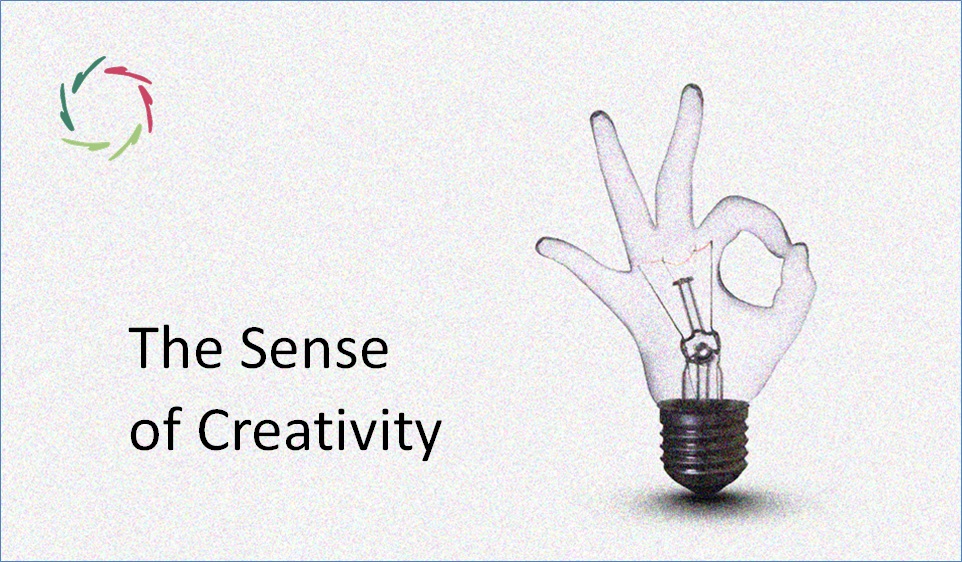
We need to be creative to feel alive.
The shortest history of creativity
In ancient Greece, artists were not seen as creators but imitators [as to Plato, in The Republic]. However, the Muses were seen as mediators of inspiration from the gods, and Socrates had his famously creative daemon. Later came Christian inspiration as divine, the spiritus sanctus, the sole province of God until the renaissance when the individual came to be seen as the source of his own creation. Humanism was born. A few centuries later, the French mathematician Henri Poincaré publicly discussed his creative process, after which more and more thinkers found creativity a worthwhile study subject.
In an age of increasingly powerful A.I., human creativity may be our last exclusive resort. Then again, A.I. is already closely mimicking us even in this. Is this a return to ancient Greece or the birth of a new kind of creativity?
Originality + meaningfulness
Being important in many fields, the creative act is the formation of a physical object or something intangible (an idea, a theory) that is at the same time original and meaningful/valuable. These are the sufficient and necessary elements of creativity:
- originality. Original is what comes from the creative person as origo, the source of creation. Even more original is a creation when no others have created the same ― thus: surprising results from unconventional thoughts.
- meaningfulness. Note that it’s enough when the creator finds his creation meaningful. Even more interesting is it when others also find it meaningful ― especially if those others are meaningful to the creator.
Before realization comes incubation.
The incubation stage is like that of a seed underground. Nothing happens at the surface or in conscious awareness. Meanwhile, the sprouting of the seed is happening non-consciously. There is no creation if ‘it’ doesn’t get realized. Yet without incubation, there is not even the chance of realization. Therefore – arguably at an equal level as the bursting into openness of the result (illumination) – incubation is to me the most important stage. I see illumination as spontaneously lying further on the path of incubation.
Originality depends mainly on this stage. If the process is enforced, the result is less original. If the process doesn’t get enough attention, the result is also less original.
So, how does one give attention without enforcing anything?
From incubation to art.
Without incubation, there is no realization of art. Each creative person is an artist to some degree. A great artist is a great incubator. In any case, art is not under conscious control ― mainly in the incubation part, which is an act of non-conscious processing.
Then, there is also the art of being alive.
Growth
New = change. New from the inside out (original) + meaningful = growth.
This is growth like anything else in nature. Life itself is a continual combination of change and stability. The latter relates to the entity for which the change is meaningful. Without any modicum of stability, there is nothing for which to be meaningful.
You have noted the two elements that we previously combined as creativity. Indeed, this shows that being creative is being alive. No wonder people naturally find the urge to be creative, even small children. In their growing up, creativity may get amputated. No wonder many get into psychological problems on the verge of adulthood.
To feel alive, we must continually create.
We should take creativity seriously not only for its outer results but even more for its intrinsic purpose. People need creativity for their health and wellbeing ― in the right (individually different) dose:
- Too much may lead to a loss of stability (chaos, psychosis).
- Too little may lead to sclerosis.
Both may lead to the feeling of meaninglessness and unimportance, or even to burnout, nature’s call for fundamental self-creativity ― ‘from chrysalis to butterfly.’
We need to be creative to be alive.
Related Posts
Mental Patterns Change through Autosuggestion
This may even be the only way in which they can ethically and adequately change. There is a clear responsibility involved to do this as well as possible. Autosuggestion is the language that directly touches mental patterns. [see: “Patterns in Neurophysiology“] It is related to poetry in its metaphorical means, a meditative mental setting, and Read the full article…
Meaning
Lots of people are looking for the ‘meaning of existence’. This seems feeble but this search is often crucial in many ways, even where it is not immediately clear. For example, whether or not someone experiences certain circumstances as negatively stressful (also at the work place), depends very much on an underlying sense of ‘meaning’: Read the full article…
The Handiness of Being Vague
In a term like ‘God,’ for instance. Such a term has as many meanings – subtle and less subtle – as there are people using it. Yet, to an outsider, all seem to agree. Do they? Would these differences still appear irrelevant if each person could directly look into the mind of another? Certainly not. Read the full article…