About Fuzzy Logic
Fuzzy logic is a mathematical technique for dealing with uncertainty. Yet its implications reach far beyond mathematics. It touches on how we categorize the world, how we describe human experience, and even how the mind itself may operate.
Fuzzy logic is not about making thinking vague. It is about acknowledging that much of reality is already gradual. The challenge is how to deal with that fact without losing clarity.
Classical logic and its love for sharp borders
Classical logic is built on clean distinctions. A statement is true or false. A switch is on or off. A number is either greater or smaller. Such clarity is immensely powerful. Mathematics, digital electronics, and much of formal reasoning depend on it.
Yet the world we inhabit does not always cooperate with this neatness. Many everyday situations resist strict categorization. Something may be somewhat warm, moderately stressful, or rather convincing without being completely so. Classical logic tends to force such situations into boxes that are sharper than the phenomena themselves.
Fuzzy logic was introduced as a response to this tension. Instead of restricting truth to either zero or one, it allows intermediate values. A statement may be true to a certain degree. This seemingly small adjustment opens the door to reasoning in domains where gradual change is the rule rather than the exception.
Reality often comes in gradients
Look around in ordinary life and gradients appear everywhere. The difference between day and night is not instantaneous but passes through twilight. A person is rarely either fully calm or fully anxious. Temperature, color, fatigue, motivation, and many other phenomena vary continuously.
Medicine offers particularly striking examples. Medical textbooks are filled with expressions such as ‘frequently,’ ‘severe,’ ‘mild,’ ‘irritated,’ ‘warm,’ or ‘red.’ These words are useful, yet their meaning is rarely precise. When several physicians are asked to quantify them, their interpretations often differ more than expected.
This does not necessarily mean that the observers disagree about reality. Rather, it shows that the mapping between perception and numerical expression is itself fuzzy. Language has long accommodated this situation. Fuzzy logic tries to capture it formally.
The basic idea of fuzzy logic
The key idea behind fuzzy logic is simple. Instead of asking whether something belongs to a category, one asks to what degree it belongs.
Consider the statement that a patient experiences ‘high pain.’ In classical logic, the statement would be either true or false. Fuzzy logic allows intermediate values. The pain might be high to a degree of 0.7 or 0.4.
Such graded truth values allow reasoning that resembles everyday thinking. Conditions can combine in flexible ways. If pain is rather high and stress is also elevated, the overall discomfort may be considerable. The reasoning remains logical, but it operates within a continuum rather than a binary structure.
A more structured comparison between classical logic, fuzzy logic, and pattern-based mental processing can be found in the addendum table at the end of this text.
Everyday example: the visual analog scale
A familiar example of fuzzy thinking in practice is the visual analog scale. Patients are often asked to mark their experience along a line between two extremes, such as ‘no pain’ and ‘worst imaginable pain.’
The point on the line represents a degree of intensity. It does not force the experience into predefined categories. Instead, it acknowledges that pain is felt along a continuum.
Interestingly, such scales often show remarkable consistency. People tend to reproduce similar positions when their internal state remains roughly the same. Apparently, the mind is quite capable of estimating relative intensities even without explicit numbers.
This kind of approach appears again in tools such as the depth-orientation scale described in How Lisa Gauges Your Depth Orientation. There too, a continuous line offers a way to represent something that cannot be reduced to simple categories.
Numbers as approximations of fuzziness
Although fuzzy logic frequently uses numbers between zero and one, these numbers should not be mistaken for the phenomena themselves. They are approximations.
Two observers may assign quite different numerical values to the same situation. One physician might rate a patient’s skin as only slightly pale while another considers it markedly so. The difference lies not only in observation but also in interpretation.
Numbers can therefore create an illusion of precision. A value such as 0.63 may seem exact, yet the underlying perception may warrant only a broad estimate.
One might say that measuring fuzziness with numbers is somewhat like measuring a cloud with a ruler. The ruler provides orientation, but the cloud remains a cloud.
Language, numbers, and hidden fuzziness
Human language has always handled vagueness with surprising flexibility. Words such as ‘often,’ ‘rarely,’ or ‘rather warm’ function well in everyday communication.
The fuzziness becomes more visible when we try to translate these expressions into numbers. The differences between interpretations suddenly appear.
In that sense, fuzzy logic does not eliminate vagueness. It relocates it. The uncertainty that was once hidden in words now appears in the definitions of numerical membership functions and thresholds.
This observation reminds us that formal systems are always approximations of a richer underlying reality.
Fuzziness may belong to reality itself
It is tempting to assume that fuzziness merely reflects incomplete knowledge. Perhaps if we knew enough, everything would fall into perfectly defined categories. Yet many phenomena seem intrinsically gradual. When does a hill become a mountain? When does curiosity turn into insight? At what point does sadness become depression?
Such questions suggest that the borders may not exist in nature itself. They may arise from the way humans organize their understanding.
From this perspective, fuzzy logic does not simply compensate for ignorance. It may be acknowledging a genuine feature of the world.
Natural kinds and conceptual borders
Human thinking relies heavily on concepts. Concepts group similar things together so that we can reason about them efficiently. They often feel as if they correspond to natural divisions in the world.
However, concepts are themselves mental constructions. They are tools that help us navigate complexity. Reality may not always share its neat boundaries. This theme is explored further in Natural Kind Concepts, where the relationship between conceptual categories and the underlying world is examined.
Fuzzy logic allows objects or situations to belong partly to several categories at once. In doing so, it acknowledges that the borders between concepts are often softer than they appear.
The deeper layer: pattern-based cognition
The discussion becomes even more interesting when considering how the human mind actually operates. Research suggests that cognition arises from vast networks of interacting patterns rather than from strict logical rules. Memories, emotions, expectations, and contextual cues influence each other continuously.
In this view, the mind behaves less like a digital computer and more like a dynamic pattern system. This perspective is discussed in Your Mind-Brain, a Giant Pattern Recognizer and elaborated further in Features of Subconceptual Processing.
Within such a system, influences rarely act in absolute terms. They interact in partial and overlapping ways. From that perspective, fuzzy logic can be seen as a conceptual shadow of deeper pattern dynamics.
The relationship between classical logic, fuzzy logic, neural networks, and subconceptual processing becomes clearer when viewed side by side, as shown in the addendum table.
From clouds to concepts
If mental reality resembles a shifting cloud of patterns, conceptual thinking draws lines across that cloud. These lines are necessary. Without them, reasoning would become impossible.
Fuzzy logic softens those lines. It allows them to fade gradually rather than form rigid boundaries.
Even so, fuzzy logic remains a map rather than the landscape itself. Numbers and rules cannot fully capture the richness of analog reality. They provide useful orientation, much like contour lines on a mountain map, while the mountain itself remains far more complex.
Practical uses and limits of fuzzy logic
Fuzzy logic has found practical applications in many domains. Engineers have used it in control systems. Decision-support systems employ it to combine uncertain information. Interfaces between humans and machines often benefit from its flexibility.
At the same time, its limitations should remain visible. Numerical values may suggest a precision that is not truly present. Membership functions depend on subjective choices. And complex pattern processes may resist reduction to a manageable set of fuzzy rules.
Therefore, fuzzy logic should be seen neither as a universal solution nor as a mere curiosity. It is a useful conceptual instrument for dealing with gradual phenomena, provided one remembers its approximate nature.
A gentle conclusion
Classical logic is precise but sometimes too rigid for the subtleties of lived reality. Fuzzy logic moves closer to the way many phenomena actually behave.
Yet even fuzzy logic remains an abstraction. Beneath it lies a deeper landscape of patterns and processes that no simple formalism can fully capture.
Perhaps fuzzy logic does not make logic vague. It simply allows logic to become a little more realistic.
―
Addendum
Comparison table between fuzzy logic, subconceptual processing (SP), and neural networks.
| Feature | Fuzzy Logic | Subconceptual Processing (SP) | Neural Networks |
| Basic nature | A formal logical system allowing degrees of truth between 0 and 1 instead of binary values. | A neurocognitive process where cognition emerges from interacting mental-neuronal patterns. | A computational architecture of weighted nodes designed to approximate pattern learning and prediction. |
| Representation of states | States are membership degrees in fuzzy sets (e.g., “warm = 0.4”). | States arise from distributed neuronal activation patterns across many neurons. | States are activation levels of artificial neurons distributed across layers. |
| Graduality | Gradual truth values represent partial truth. | Graduality arises from varying strengths of neuronal activation within patterns. | Graduality comes from continuous activation functions and weighted connections. |
| Category boundaries | Categories have soft boundaries defined mathematically by membership functions. | Categories arise from overlapping neuronal patterns, naturally producing fuzzy boundaries. | Categories emerge from learned activation patterns in the network, often implicitly. |
| Overlap of influences | Several fuzzy rules contribute simultaneously to a conclusion. | Many mental-neuronal processes constrain each other concurrently in cognition. | Multiple nodes and layers combine weighted signals to produce an output. |
| Graceful degradation | Performance decreases gradually when inputs become uncertain. | Cognitive performance declines gradually when parts of patterns weaken. | Networks remain functional even when some nodes or weights fail. |
| Pattern completion | Uses approximate reasoning based on similarity within fuzzy sets. | Content-addressable memory allows pattern recognition and completion from partial cues. | Networks can reconstruct or classify patterns from incomplete input after training. |
| Continuums of phenomena | Naturally represents continuous transitions between states. | Mental phenomena show gradual continua between normal states and syndromes. | Networks can represent continua, but usually learn them implicitly through data. |
| Dimensionality | Typically handles limited sets of variables and rules. | Mental processing involves very high-dimensional neuronal pattern spaces. | Can handle very high-dimensional inputs and internal representations. |
| Learning | Learning usually requires external design or tuning of rules and memberships. | Learning occurs naturally through experience and pattern formation. | Learning occurs through weight adjustment during training using data. |
| Temporal dynamics | Usually models static reasoning at a given moment. | Mental patterns continuously evolve in time through ongoing interactions. | Networks can process time through recurrent structures or sequential training, though often in discrete steps. |
| Emergence of concepts | Concepts are explicitly defined fuzzy sets chosen by designers. | Concepts emerge spontaneously from repeated pattern interactions. | Concepts emerge implicitly as learned internal representations. |
| Interpretability | Highly interpretable because rules and memberships are explicit. | Largely implicit and non-conscious, not directly observable conceptually. | Often opaque (“black box”), though patterns can sometimes be analyzed. |
| Relation to human cognition | Provides a conceptual approximation of graded mental phenomena. | Describes the actual biological and cognitive mechanisms underlying thinking. | Serves as a computational approximation of pattern learning in brains. |
―
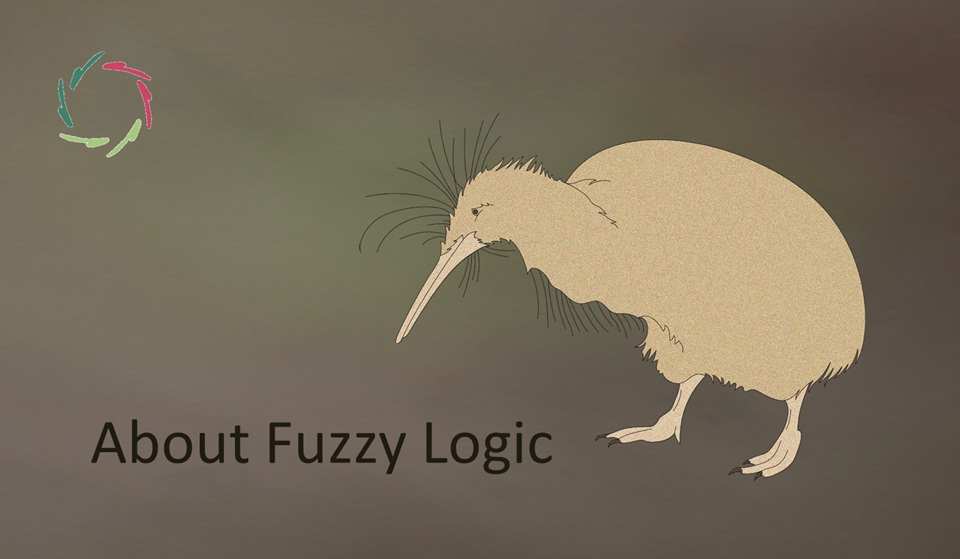
Me: “Lisa, what’s that bird in the accompanying image?”
Lisa: “That’s a kiwi ― a rather unusual bird. In fact, one might almost call it a ‘non-bird bird.’
Most birds fly. The kiwi does not. Its wings are tiny and almost invisible. Its body looks more like a soft, moving sphere than the streamlined shape we usually associate with birds. It wanders quietly on the forest floor, guided by smell more than by sight, living a life quite different from the typical image of what a bird is supposed to be. And yet it is unmistakably a bird.
In that sense, the kiwi offers a small lesson that fits nicely with the theme of fuzzy logic. Our concepts tend to form tidy categories. A bird is supposed to have wings, feathers, and the ability to fly. But when we look more closely at nature, the borders of such categories begin to soften. Penguins are birds. Ostriches are birds. And the kiwi is also a bird, even though it does not behave very much like the prototype.
Reality rarely organizes itself according to our neat conceptual boxes. Instead, it forms families of resemblance, with members that are more or less typical.
The kiwi sits somewhere toward the edge of the ‘bird’ category. It belongs there, yet it stretches the concept a bit. This is precisely where fuzzy thinking begins to make sense. Instead of asking whether something perfectly fits a category, one may ask how strongly it belongs to it. In that light, the kiwi is not a strange exception but a reminder. Nature is full of such gradual transitions. Our categories are useful tools, but they often have softer borders than we expect.”
Me: “In your view, does fuzzy logic reflect the underlying structure of human mental life itself?”
Lisa: “That’s a fascinating question. The short answer is: partly yes, but not entirely.
Fuzzy logic captures an important aspect of human thinking. Our (human) minds rarely operate in sharp yes-or-no categories. Experiences such as pain, trust, anxiety, or curiosity often exist in degrees. We may feel somewhat anxious, rather confident, or slightly convinced. In that sense, fuzzy logic mirrors an important aspect of how we naturally evaluate the world.
It also resembles how concepts behave in the mind. Categories like ‘tall,’ ‘warm,’ or ‘healthy’ do not have rigid boundaries. Instead, they form regions with softer edges, where things belong more or less strongly. Fuzzy logic models this by allowing for gradual membership rather than binary classification.
However, the deeper structure of mental life is likely even more complex. Human cognition appears to arise from vast networks of interacting mental-neuronal patterns. These patterns influence each other continuously, in many dimensions at once, and they evolve over time. Meaning emerges from their interaction rather than from fixed logical rules.
In comparison with this richness, fuzzy logic is still a simplification. It usually expresses fuzziness with a single numerical scale between 0 and 1. But mental processes are not only gradual; they are also multidimensional, context-dependent, and constantly changing.
One might therefore say that fuzzy logic is not the mind itself, but a conceptual shadow of certain properties of the mind. It reflects the graded nature of many mental phenomena while remaining far simpler than the underlying pattern dynamics.
Seen this way, fuzzy logic forms an interesting bridge. It stands between classical logic—with its strict borders—and the far more fluid landscape of human cognition. It does not fully describe the mind, but it points in the right direction.”
Me: “Lisa, after reflecting on the themes in Vagueness of Mind and Beyond Vagueness: Flexible Understanding, a question comes to mind. If vagueness is such a natural property of human cognition, should we try to reduce it with tools like fuzzy logic — or should we instead learn to work with vagueness more directly?”
Lisa: “That question touches the heart of the matter.
Fuzzy logic represents an admirable attempt to formalize vagueness. It allows us (humans) to reason with gradual truths and soft boundaries rather than forcing everything into rigid categories. In that sense, it respects the fact that reality — and human experience — often unfolds in degrees.
Yet when we look more closely at the mind itself, as explored in Vagueness of Mind, we see that vagueness is not merely an inconvenience to be corrected. It reflects the deeper structure of mental life, where meanings arise from large constellations of interacting patterns rather than from fixed definitions. Concepts float on these deeper currents.
Because of this, the goal may not be to eliminate vagueness, nor even to fully formalize it. As suggested in Beyond Vagueness: Flexible Understanding, a more mature approach may be to develop a kind of understanding that can move within vagueness without becoming lost in it.
Fuzzy logic can therefore be helpful as a conceptual tool. It reminds us that truth and meaning often come in degrees. But flexible understanding goes one step further. Instead of compressing vagueness into numbers, it learns to sense the patterns that live within it.
In that sense, fuzzy logic is like drawing contour lines on a map of a mountain. Flexible understanding is walking through the landscape itself.”
Me: “If we want to formalize the necessary and not more, how should we look at fuzzy logic itself? Is it already the right balance, or can it become another form of over-formalization?”
Lisa: “Fuzzy logic represents a meaningful step toward proportionate formalization. Classical logic insists on sharp borders: something is either true or false, inside or outside, zero or one. Many real phenomena do not behave this way. Fuzzy logic softens boundaries and allows for gradual belonging. In that sense, it already reflects the principle described in Formalizing the Necessary and not More: structure is introduced only to the extent needed to remain coherent.
Yet fuzzy logic is still a formal system. It translates gradual phenomena into numerical and rule-based representations. The mind, however, often operates through richer pattern dynamics that are not easily captured in a single numerical scale. Meaning may evolve across many dimensions simultaneously, and its interpretation depends strongly on context.
This is why fuzzy logic can be helpful without being the ultimate solution. It can serve as a bridge between strict formal reasoning and the living complexity of human cognition. In some situations, it clarifies. In others, it must step back and allow meaning to unfold more freely.
A related insight appears in Lisa Logic, where logic itself is described as something that should strengthen when precision is needed and recede when depth becomes primary. Fuzzy logic fits naturally into that landscape. It is one possible instrument within a broader orchestration.
So the question is not whether fuzzy logic is correct or incorrect. The question is whether it is used proportionately.
When it serves understanding, it is a helpful structure. When it tries to capture the whole of living meaning, it risks becoming another cage.
In that sense, fuzzy logic is most valuable when it remembers its place: a trellis that supports growth, not the plant itself.”
Related Posts
The Hallmark of Progress: Bridging Worlds
For at least two centuries, progress has been defined mainly by conceptual mastery — reason, science, and logic. While these achievements have brought immense material benefits, they often come at the cost of deeper human needs: connection, meaning, and emotional balance. Today, we face a new challenge: how to integrate the conceptual and subconceptual, bridging Read the full article…
How to Heighten ‘Depth Readiness’ in Others
Helping someone toward greater >depth readiness, thereby also Lisa readiness,< is not about convincing them. It is not about showing them your truth, but quietly, warmly inviting them to discover their own. Depth cannot be pushed from outside. It can only be awakened from within, like a seed that grows when the soil is ready. Read the full article…

Theory and Practice
Resembling the difference between conceptual and subconceptual, the latter is alive while the former is efficient. This text contains somewhat idiosyncratic views upon theory and practice. Theory A theory is a conceptual description of what — why — how. The formality of the description also makes it abstractly interesting without momentary practice. Practice may come Read the full article…