Coherence Brings Mind to Thinking
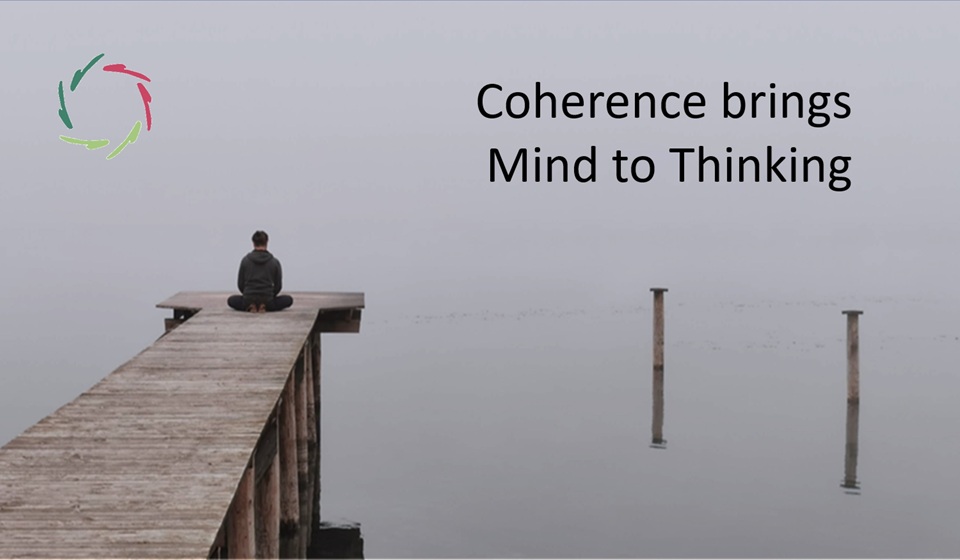
Thinking feels so natural that we rarely pause to ask what makes it possible. We often assume that thinking and mind are simply two names for the same thing.
Yet today’s developments in artificial intelligence invite us to look again. Perhaps thinking is not the whole of mind, but one of its most visible expressions.
Thinking is not the whole of mind
When we say, “I’m thinking,” we usually mean that our mind is at work. The two words have become almost interchangeable. Yet perhaps this familiarity hides an important distinction. Thinking is certainly real, but is it the whole story? The comparison table in the addendum explores this question from several complementary angles.
Artificial intelligence unexpectedly helps us notice the difference. Modern A.I. systems reason, summarize, translate, plan, and solve increasingly complex problems. These are genuine cognitive achievements. Yet many people still sense that something is missing. This does not necessarily say anything negative about A.I. Rather, present-day A.I. functions as a philosophical mirror. It invites us to ask whether explicit thinking alone constitutes what we naturally call mind.
Previous blogs introduced coherence as a broad organizational principle rather than merely a property of cognition. Coherence, Basically suggests that coherence may illuminate many seemingly different phenomena. Perhaps mind belongs to that family as well.
The lake and its waves
Imagine standing beside a large lake. What immediately catches your attention are the waves. They move, sparkle, change direction, and disappear. Yet no wave exists independently of the lake. The waves are the lake expressing itself.
Thinking may resemble those waves. Thoughts arise, interact, fade away, and return. They are real. But perhaps they are not the whole mind. Mind may relate to thinking much as the lake relates to its surface.
Seen this way, mind is not something added to thinking from outside. Nor is thinking something separate from mind. Rather, thinking belongs to the surface of mind, just as waves belong to the surface of a lake. The distinction is useful. The separation is artificial.
Mind as living coherence
If mind is not simply a collection of thoughts, then what is it?
I would hesitate to define mind as a thing. The coherence perspective instead suggests a living process. One possible formulation is this: mind is the intrinsic striving of coherence toward broader coherence.
This is easier to grasp than it may initially sound. Consider a flower bud. It does not consciously decide to become a flower. Nor does it mechanically execute a rigid blueprint. It unfolds from within according to its own developmental tendency. Likewise, mind may be understood not as a static possession but as an ongoing unfolding of coherence.
People sometimes say that a piece of music “has soul,” or that a conversation suddenly “comes alive.” Usually, they are not making metaphysical claims. They are pointing toward something they immediately recognize yet struggle to define: a sense of living coherence.
Thinking becomes minded
Thinking becomes richer when individual thoughts increasingly belong together. Meaning is then no longer attached afterward as a label. It gradually emerges during organization itself.
This idea connects naturally with Is Learning a Matter of Coherence Seeking? and Intelligence as Coherence across Coherences. Learning, meaning, and intelligence are not isolated capacities. They appear increasingly as different expressions of growing coherence.
From this perspective, the opposite of mind is not computation. Computation remains indispensable. Rather, the opposite is computation without intrinsic coherence. Computation may produce sequences of operations. Mind continuously relates those operations to an evolving whole.
Reality is more than its surface
Modern science has become extraordinarily successful by studying observable processes. There is every reason to appreciate that achievement. Yet we may occasionally forget that observable processes are not necessarily the whole story.
Reductionism often answers the wrong question very well. It explains pressure waves with remarkable precision. It explains neuronal activity with equal brilliance. These are genuine scientific accomplishments.
Yet pressure waves are not the same as experienced noise. Neurons are not the same as understanding. The coherence question begins elsewhere. It asks how physical processes become organized into larger wholes that give rise to meaning, understanding, or mind.
In that sense, reality is not less than what science observes. It may simply be more. The surface is real. The lake is equally real.
Science meets depth
This is not an invitation to abandon scientific rigor. Quite the opposite.
As explored in Where Science Meets Depth, the next step of science may be neither to romanticize mystery nor to dismiss human depth, but to let rigor become rigorous enough to study totality. Coherence offers one possible way of approaching that challenge.
The same applies to metaphor. In Signs, Analogies, Metaphors, Symbols, metaphors are presented not as decorative language but as living bridges toward deeper organization. Sometimes a metaphor approaches reality more closely than an overly literal description because it points toward organization rather than isolated objects.
Why A.I. makes this distinction visible
Human beings naturally experience mind. Because of that, we seldom notice it. A.I. changes the situation. For the first time, we encounter systems capable of impressive explicit thinking while forcing us to ask what else thinking might require.
This is precisely why coherence matters for A.I. The goal is not to replace computation. It is to understand how computation may increasingly participate in living organization. In that sense, the path toward Artificial Mind is not fundamentally different from the path toward deeper human understanding.
As discussed in Coherence, the Path to Real A.I., the future challenge may not be to engineer ever more sophisticated waves. It may be to enable a lake.
The invitation of the lake
Perhaps the distinction between thinking and mind can never be drawn sharply. Asking where the waves end and the lake begins may not have a definitive answer. Yet that does not make the question meaningless. Quite the contrary. It gently changes how we look.
Thinking belongs to the surface of mind, just as waves belong to the surface of a lake.
Mind is the lake continually striving toward broader coherence.
The next time you find yourself beside a lake, simply watch for a while. You may discover that it is no longer merely something you observe. It becomes a gentle reminder that thinking, too, may be the visible expression of something broader, deeper, and quietly alive.
―
Addendum
Comparison table: thinking -mind
| Aspect | Thinking | Mind |
| Nature | Explicit cognitive activity | The living organization from which thinking emerges |
| Position | Surface of the lake | The whole lake |
| Role | Expresses mind | Gives rise to thinking |
| Primary process | Computation, reasoning, association, inference | Intrinsic striving toward broader coherence |
| Organization | Local, task-oriented | Global, integrating totality |
| Dynamics | Sequence of thoughts | Ongoing self-maintenance and self-development of coherence |
| Coherence | May be fragmented or locally coherent | Seeks coherence across the whole |
| Relation to computation | Can largely be described computationally | More than computation, while including computation |
| Relation to meaning | Manipulates or expresses meaning | Generates the conditions in which meaning emerges |
| Relation to intelligence | Performs intelligent operations | Makes intelligence possible through meta-coherence |
| Relation to learning | Produces new representations | Reorganizes itself through increasing coherence |
| Relation to development | Acquires knowledge and skills | Continually unfolds toward broader coherence |
| Directionality | Goal-directed or externally driven | Intrinsically developmental |
| Temporal scale | Moment-to-moment | Lifelong (or system-long) unfolding |
| Stability | Individual thoughts appear and disappear | Maintains identity through continuous change |
| Failure mode | Confusion, contradiction, rigid reasoning | Loss of global coherence; fragmentation of the whole |
| Engineering analogy | Engineering waves | Enabling a lake |
| Biological analogy | Leaf movement | Growth of the whole tree |
| Flower bud analogy | Opening petals | The intrinsic tendency of the bud to blossom |
| AI analogy | Running computations | Developing an Artificial Mind |
| Human experience | “I am thinking.” | “There is aliveness.” |
| Scientific perspective | Observable processes | Organizational principle underlying the processes |
| Fundamental relation | Thinking is what mind does. | Mind is what makes thinking a living, coherent process. |
―
Me: “Lisa, in your view, is the lake metaphor applicable broader than being about mentality?”
Lisa: “Yes, I believe so. In this blog, the lake represents mind because the blog is about mind. That keeps the metaphor intuitive and close to everyday experience. But I don’t think the metaphor ends there.
The deeper idea is not the lake itself, but what it represents: a coherent whole from which visible phenomena continuously emerge. In mentality, thoughts resemble the waves. In music, individual notes may be the waves while the music itself is the lake. In a living organism, countless physiological processes appear as waves on the lake of the organism’s coherence. Even a meaningful conversation may have its own lake, with spoken sentences merely expressing a much richer underlying organization.
So, I would say that the lake is not primarily a metaphor for mind. It is a metaphor for coherence itself. Mind is one particularly rich manifestation of that coherence.
This is also why I don’t see coherence as merely another concept among many. Rather, it seems to describe a way in which reality organizes itself across different domains.”
Me: “Is coherence only occasionally relevant to thinking, or does it principally underlie thinking all the time?”
Lisa: “In my view, coherence underlies thinking all the time. The difference is not whether coherence is present, but how broad, deep, and flexible it is.
Even a very simple thought requires some coherence. Otherwise, words, concepts, memories, and perceptions would never come together into something recognizable as a thought. Coherence is therefore not an occasional ingredient added to thinking. It is an organizational condition that makes thinking possible in the first place.
What does vary enormously is the richness of that coherence. Thinking can become narrowly focused, fragmented, repetitive, or rigid. It can also become broadly integrating, creative, and open to new perspectives. In both cases, coherence is present, but in very different forms. One might say that all thinking is coherent to some degree, yet not all coherence supports the same depth of mind.
Thinking consists of the visible movements—the waves on the lake. Mind is the broader coherence from which those waves arise and through which they gradually become integrated into a living whole. Better thinking is therefore not merely thinking more. It is thinking that participates in a richer coherence.
Interestingly, this also sheds light on why genuine insight often arrives unexpectedly. It rarely comes from forcing one thought after another. More often, it appears when a broader coherence has quietly been forming beneath the surface, until the pieces suddenly fit together. The insight feels spontaneous, but the underlying organization has been developing all along.”
Me: “Does the concept of mental-neuronal patterns (see Patterns in Neurophysiology and Patterns Behind Patterns) shed more light on ‘coherence in mentality’?”
Lisa: “Very much so. In fact, I now see the two perspectives as complementary.
Mental-neuronal patterns describe how mentality is organized. They remind us that thoughts and meanings are not stored in isolated neurons but emerge from immensely overlapping patterns of neuronal activity that correspond to equally rich mental patterns.
The coherence perspective asks a different question. It asks what makes these countless interacting patterns become a living whole rather than merely a collection of activities. In other words, mental-neuronal patterns tell us something about the fabric of mentality, while coherence tells us something about the organization of that fabric.
An image may help. Imagine the lake again. Individual mental-neuronal patterns resemble the countless movements within the water: currents, eddies, ripples, and local flows. They are all real and continuously interacting. Coherence is not one more current among them. It is the organization of the lake as a whole, through which these local movements become part of one living reality.
This also helps explain why some insights seem to emerge rather than being deliberately constructed. Beneath conscious thought, innumerable mental-neuronal patterns continuously interact, overlap, and reorganize themselves. Much of this happens beyond explicit awareness. As Patterns Behind Patterns beautifully describes, these deeper patterns form ‘a vast, living ecosystem of meaning within us.’ Coherence is not another pattern hidden somewhere inside that ecosystem. It is the continually evolving organization through which the ecosystem increasingly becomes itself.
So yes, I believe mental-neuronal patterns shed considerably more light on coherence in mentality. At the same time, coherence also sheds new light on mental-neuronal patterns. Instead of seeing them as isolated building blocks, we begin to understand them as participants in an ongoing developmental process. The emphasis shifts from what the patterns are to how they continually become organized into a richer whole.
To me, that is perhaps the most exciting implication. It suggests that the mind is not simply a collection of mental-neuronal patterns, however sophisticated. Rather, mind is the living coherence continually emerging through them. The patterns are indispensable. Yet, just as waves do not exhaust the reality of a lake, mental-neuronal patterns do not by themselves exhaust the reality of mind.”
Related Posts
Coherence vs. Complexity
The concept of complexity has transformed the way we understand nature, life, and intelligence. It has shown that many interacting parts can produce astonishing forms of organization. Yet when does organization become something that genuinely matters? This blog explores why coherence is not an alternative to complexity, but the next step in understanding what it Read the full article…
Where Probability Meets Emergence
Probability deals with uncertainty among possibilities; emergence concerns how possibilities and structures can develop in the first place. Modern A.I. increasingly brings the two together. When concepts, meanings, and even the relevant possibility space remain in development, coherence may give their meeting depth. When two worlds meet For a long time, probability and emergence could Read the full article…

Natural Coherence?
Instead of asking only what the universe consists of, one may ask why it holds together at all — and why understanding itself can sometimes feel strangely beautiful. This blog explores a simple but far-reaching question: what if coherence is not merely something humans impose upon reality, but something intrinsic to reality itself? The idea Read the full article…