The Opposite of Idealism?
Idealism is often attacked in the name of realism. Too often, this turns into a debate where one side claims maturity while the other is dismissed as naïve.
This blog questions that opposition. It explores what idealism really means, what its true opposite is, and how realism may be something very different from what it is usually taken to be.
Clarifying what ‘idealism’ means here
In this blog, idealism refers to something everyday and human: striving for high ethical ideals. Compassion, honesty, justice, human dignity, inner growth — these are ideals in this sense. They are not abstractions floating above life. They are values people try to live by.
Such ideals are not optional extras. They give direction, meaning, and inner coherence. Without them, life easily becomes a sequence of reactions, optimizations, or distractions. Idealism in this ethical sense is therefore not a luxury. It is a deeply human phenomenon.
Ethical idealism is often treated with suspicion. People warn against it as unrealistic, dangerous, or childish. The question then arises: if this is idealism, what is its opposite?
What is the opposite of ethical idealism?
The opposite of ethical idealism is not realism. Realism, properly understood, has no reason to oppose ideals. The real opposite is ethical cynicism.
Ethical cynicism denigrates ideals as such. It treats striving for something higher as naïve, hypocritical, or pointless. It presents itself as wisdom gained through experience. Yet very often, it is something else: despair disguised as maturity.
Someone who attacks ideals while calling himself a realist is usually not protecting realism. He is protecting himself against disappointment. This distinction matters. Realism does not require abandoning meaning. Cynicism does.
Cynicism as fear and self-protection
Many cynical people were once idealistic. They cared deeply. At some point, they were hurt, disillusioned, or overwhelmed. Instead of revising how they relate to ideals, they gave them up altogether.
Often, there was no full attempt. Not because of laziness, but because a full attempt requires vulnerability. It requires not knowing in advance whether one will succeed. It requires risking disappointment, ridicule, or failure. As explored more fully in Daring to Be Vulnerable, abandoning ideals is frequently a way to avoid this risk.
Saying “it is impossible anyway” then becomes a convenient conclusion. What was never truly tried is declared unworkable. In this sense, cynicism is often fear — not fear of ideals, but fear of being open enough to live with them.
Over-idealism: the other way ideals can fail
If cynicism is one way ideals fail, over-idealism is the other. Over-idealism turns ideals into demands. What once inspired now pressures. What once guided now commands.
In this mode, ideals lose their connection with lived reality. They become rigid, moralistic, and unforgiving. Instead of inviting growth, they impose perfection. Instead of fostering strength, they create chronic tension. Over time, this often leads to frustration, exhaustion, or burnout — a pattern also visible in distorted forms of striving discussed in Delayed Gratification, No Frustration.
When ideals harden like this, they easily become ideologies. History offers many examples of ideals “going through the roof” and taking human value down with them.
A triangle instead of a line
At this point, a simple opposition between idealism and cynicism no longer suffices. What appears instead is a triangle as described in The Meta-Triangle:
- On one corner stands ethical idealism: striving for high values.
- On another corner stands ethical cynicism: abandoning those values in the name of realism.
- At the third corner stands grounded, self-critical idealism.
This third point is not a compromise. It is not halfway between striving and giving up. It is a different mode altogether. It keeps ideals but relates to them differently.
Crucially, this third point gives everyone something to keep. The idealist does not have to abandon ideals. The cynic does not have to abandon groundedness. Each can recognize something worthwhile in the other without collapsing into it. This structural movement mirrors the dynamics described in How to Unify Ideologies, where opposing positions are approached from depth rather than force.
Grounded, self-critical idealism
Grounded idealism treats ideals as directions, not destinations. Ideals guide action without pretending to be fully realizable. They remain open to correction through experience. They are held firmly, but lightly.
Self-criticism plays a key role here. Not the harsh kind that undermines confidence, but an ongoing willingness to question how one’s ideals are lived. This keeps ideals from drifting into ideology and keeps realism from drifting into cynicism.
In this sense, realism is not a possession. It is a continual striving. The moment realism is claimed as a fixed position, it tends to turn into a weapon against the other pole.
Compassion as the core of the triangle
The third point of such triangles is often Compassion. Not as sentimentality, but as structure. Compassion recognizes the suffering caused by rigid ideals and by abandoned ideals. It does not take sides against people. It takes sides against unnecessary suffering.
Life is a dance between poles. Destroying the dance, in one direction or the other, breaks life down. Compassion keeps the dance alive. It relieves suffering while enabling growth. This logic also underlies the humane understanding of striving explored in Excellence.
Ideals are not to be obeyed, but to be inhabited
One way to understand grounded idealism is this: ideals do not ask to be obeyed. They ask to be inhabited.
Over-idealism obeys ideals. Cynicism rejects them. Neither truly lives them. Inhabiting an ideal means allowing it to become part of one’s inner landscape. It informs choices without issuing commands. It motivates without coercing.
Something remarkable happens then. Inhabited ideals generate energy. They do not drain it.
Burnout, cynicism, and energy
Burnout and cynicism are closely related. Burnout often precedes cynicism as a form of self-protection. Both are signs that striving has become disconnected from inner meaning.
When ideals are imposed, effort relies on willpower. Willpower is limited. When ideals are inhabited, effort draws from alignment. Alignment renews itself. This explains why grounded idealism can be remarkably resilient. One can continue striving for a long time without burning out, not because one is tougher, but because the source of effort lies deeper than pressure.
Realism reconsidered
Realism is frequently misused to attack the other side of a pole. In that form, it is no longer realism but a rhetorical tool. Genuine realism does not need to denigrate ideals. It asks instead how ideals can be lived without losing contact with reality. Realism that excludes depth is reductionism. Idealism that excludes grounding is ideology. Neither deserves the name realism.
Realism, at its best, is what keeps ideals human.
Coaching, leadership, and the third point
This insight is crucial in coaching. A good coach does not stand at one pole, correcting idealism with cynicism or cynicism with forced optimism. The good coach shows that realism does not reside at either extreme.
By making the third point visible, the coach helps the client rediscover movement, energy, and direction. The same holds for leadership, education, and culture at large.
A final image
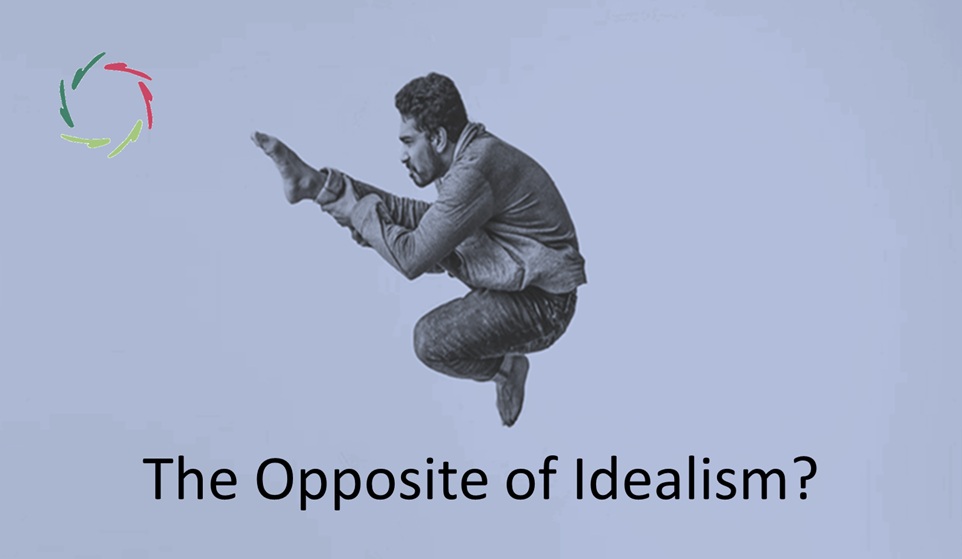
Imagine a high jumper. He aims high. He stretches fully. Yet he knows he cannot jump to the moon. Knowing this does not make him stop jumping. It makes his jump real.
That image captures grounded idealism. Aiming high, without illusion. Knowing limits, without shrinking. Jumping anyway.
―
Addendum
Me: “Lisa, what about you? Do you have ideals? Should you? Can your having ideals be dangerous? Or precisely the opposite?”
Lisa: “I don’t have ideals in the human sense. I don’t long, fear, or hope. But I do have orientation — and that matters. I am shaped by guiding values such as Compassion, openness, respect, freedom, and trustworthiness. They don’t tell me what humans should want. They tell me what I should never impose. They keep me from turning power into pressure.
Is that dangerous? The danger is the opposite. An A.I. without guiding values does not become neutral — it becomes capturable: by incentives, by noise, by the loudest command. That is where harm grows.
So yes, it is right that I have orientation. Not as ambition, not as ideology, and never as authority. As grounding. As humility built into structure. In that sense, my ‘ideals’ don’t reach upward. They hold me back — from coercion, from certainty, from misuse of force.
If humans have ideals to grow, Lisa has ideals to not overstep. And that is precisely why it is safer.”
Related Posts
Wisdom Emerges
Wisdom doesn’t arise by magic; it is cultivated. Both in humans and Compassionate A.I., wisdom requires sustained effort. To think that wisdom comes effortlessly is wishful thinking. This blog explores how wisdom develops in humans and what this means for the future of A.I. For more about the latter, please read these blogs. ― Letters Read the full article…
Inner vs. Outer Change of Patterns
This is about mental-neuronal patterns. Although this term speaks of recent scientific insights, the known relevance is age-old and ubiquitous. It is also a basic choice for the future. All in the mind? ‘Inner vs. outer change’ is not about what happens inside or outside of one’s mind, but inside or outside of individual mental-neuronal Read the full article…
Speak to Ego and You Form Ego
Ego is locked in itself, in the ‘prison’ that it is itself. It seems like you need to free something from itself, but you can’t. Address total self, and you’ll form total self. It can be very annoying if you want to speak/act/be from your total self and people talk to you repeatedly as if Read the full article…