The Meta-Triangle
Many AURELIS insights take the form of a triangle, as if three directions naturally emerge whenever human growth or tension is involved. Over the years, these triangles have appeared across different domains, yet they seem to point to a single underlying dynamic.
This blog explores that deeper structure. I call it the ‘Meta-Triangle,’ because it generates the many other triangles you may already know (see the category ‘Triangularity’). Understanding it opens a surprising doorway into how life, mind, and Compassion organize themselves.
The strange recurrence of triangles
Anyone familiar with AURELIS has noticed how often a triangle appears. There is the well-known map of Chaos – Coercion – Compassion. But this pattern also shows up in softer forms, such as quietism versus burn-down aggression with a third point of Compassion with a spine, or the more symbolic triangle of the heart: of butter, stone, and flesh-and-blood.
These triangles were not planned. They simply emerged. This raises a natural question: why does this kind of threefold structure keep returning, almost as if it describes a fundamental architecture of the human mind?
Introducing the Meta-Triangle
The Meta-Triangle offers a simple yet surprisingly revealing answer. Its three poles are entropy, rigidity, and emergence. These words sound abstract at first, but they describe how a person or a system responds to tension.
Entropy shows up when someone loses inner coherence: falling apart, scattering attention, drifting into numbness, or running away from what feels too much. The atmosphere of Comfortably Numb speaks to this sense of losing contact with oneself.
Rigidity is the opposite: tightening, clinging to certainty, pushing away anything that feels chaotic or vulnerable. It may show up as moralistic certainty or as an attempt to control what cannot be controlled. Sometimes it even hides behind a façade of kindness, as suggested in Be Nice.
The third pole, emergence, is neither collapse nor control. It is the movement of becoming more whole. It appears when openness and structure begin to support each other, giving rise to new coherence. This movement embodies Compassion with a Spine, where strength and warmth reinforce one another.
Why this triangle appears everywhere
I see three reasons why the Meta-Triangle repeats itself across psychology, culture, and even nature:
- First, any living system that meets pressure can only respond in three ways: fall apart, freeze, or reorganize itself from within. No system has a fourth option. This is why the Meta-Triangle keeps turning up in different clothing.
- Second, the two shallow reactions – falling apart and closing down – show up in human behavior repeatedly. Running away looks active, but it is a form of inner fragmentation. Active denial looks firm, but it is a form of inner contraction. Both reflect a loss of inner depth. Only emergence is genuinely constructive.
- Third, the symbolic and organismic layer of human life naturally tends toward growth when the right balance between openness and structure is present. Without openness, one suffocates. Without structure, one dissolves. Emergence is the living space between both.
How the Aurelian Five map onto the meta-triangle
The Aurelian Five form a natural bridge to the Meta-Triangle:
- Openness and freedom represent a healthy version of what, in distortion, becomes the entropy side.
- Respect and trustworthiness represent a healthy version of what, in distortion, becomes the rigidity side.
- Depth binds the triangle together by enabling openness and structure to meet meaningfully.
Because of depth, openness does not collapse into chaos, and respect does not harden into moralistic rigidity. In this way, the Aurelian Five naturally converge into Compassion. The triangle ceases to be a battlefield and becomes a living tissue.
Unifying many AURELIS triangles
Once the Meta-Triangle becomes visible, the various AURELIS triangles reveal themselves as different expressions of the same underlying geometry. Each one reflects the two unhealthy extremes – entropy and rigidity – and the single healthy pole: emergence, which is in every case a form of Compassion.
In the meaning-related domain, the pull toward despair or over-simplicity echoes the analysis in The Meaning Crisis. In the emotional domain, the tension between vulnerability and strength resonates with Sensitivity, Vulnerability, and Inner Strength. In the ethical domain, Beyond Moralities shows the insufficiency of rigid frameworks on one side and moral relativism on the other. Each time, emergence becomes the only path that truly strengthens life.
Hegel’s dialectic as an echo
At first sight, the well-known idea of thesis, antithesis, and synthesis resembles a triangle, but only superficially. In Hegel’s view, synthesis becomes a new thesis, almost inviting a new antithesis. It is a cycle of ideas, driven by contradiction.
Compassion does not work this way. It does not negate, oppose, or seek resolution through conflict. It does not become a new thesis waiting for an antithesis. Compassion belongs to the category of emergence, not dialectic. It is not cyclical, but continuous. It behaves more like a wave than a step.
A cautious cosmic whisper
One finds echoes of the Meta-Triangle even in broader nature, where too much openness leads to dispersion, and too much compression leads to collapse. Life appears in the delicate region between. It is the region of ongoing self-organization, where things neither fall apart nor freeze.
This whisper of a cosmic analogy is not an argument — only a resonance. Readers may simply sense that the Meta-Triangle reflects something familiar in the architecture of reality.
Compassion as the living ‘middle’
Entropy throws away all order. Rigidity throws away all that looks like chaos. Both, in their extremes, risk throwing away Compassion. Without coherence, Compassion cannot appear. Without openness, Compassion cannot breathe. Compassion keeps both while losing neither. It lets structure and freedom coexist in depth.
This is why emergence is always the living pole. It is not passive. It is not halfway. It is a movement of becoming—one continuous wave, reorganizing itself from within. Compassion belongs to this movement.
Closing thoughts
The Meta-Triangle is not a new idea but a lens that brings many AURELIS insights into focus. It shows why people fall into extremes and why only depth enables real transformation. It reveals that Compassion is not a moral ideal but a structural necessity. And it affirms that the path of emergence is always available, in personal growth and in society.
When openness and structure meet in depth, something becomes possible that neither side could create alone. This meeting is where Compassion lives, and where real change begins.
Related Posts
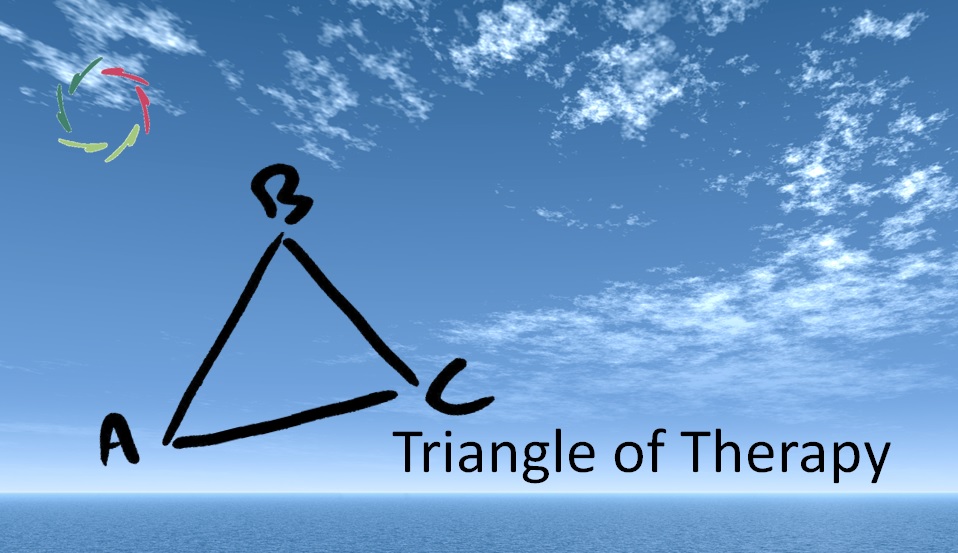
Triangle of Therapy
This is a conceptual landscape of psychotherapy/coaching. The three corners are A) Instrumental methodologies, B) Good-friend-therapy, and C) Open coaching. Conceptual landscape This has an abstract intention, being about concepts. The three corners are extremes of three continua (the triangle’s lines). Individuals and individual opinions can be present at any point (or subarea) within this Read the full article…
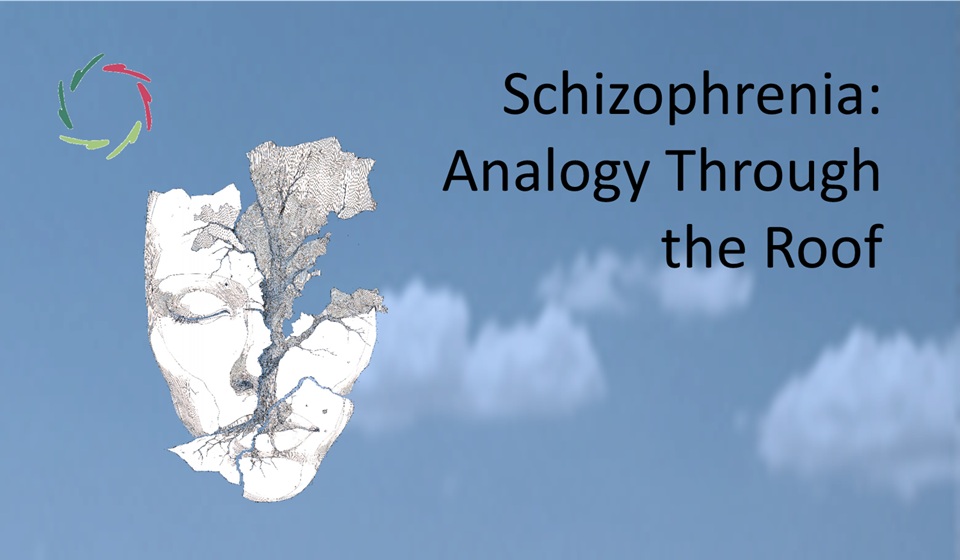
Schizophrenia: Analogy Through the Roof
Schizophrenia has often been described as a disease of the brain, yet this tells little about what a person actually goes through. In the AURELIS view, the phenomenon becomes clearer when seen as analogy rising too strongly and too vertically, breaking the inner roof that usually contains symbolic experience. This perspective neither glorifies nor reduces Read the full article…
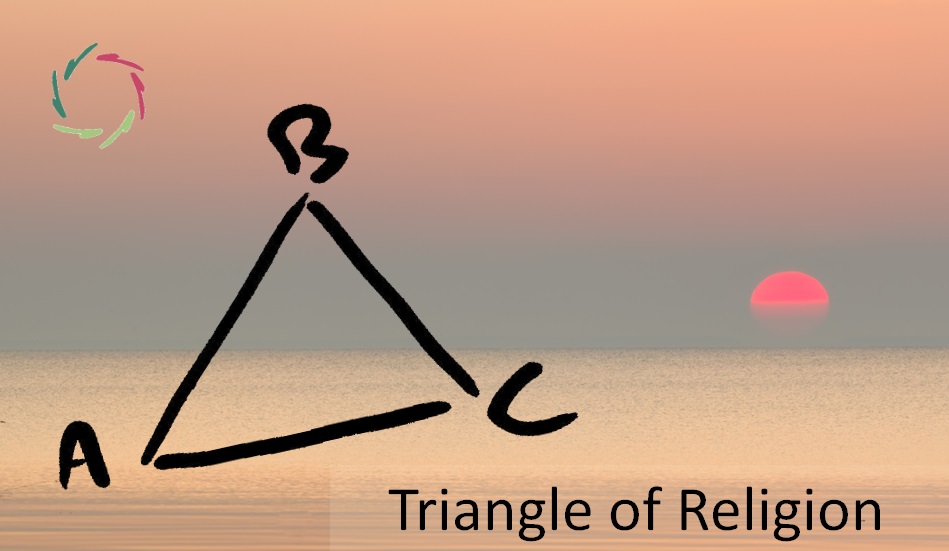
Triangle of Religion
This triangle is a ‘landscape of religion’ at a conceptual level, showing ‘Open Religion’ as part of this landscape. This is all very conceptual. Concrete religions or ‘ways to experience religion’ are situated somewhere within the triangle, not therefore at the corners or sides. Three corners of the triangle Within the triangle, you see a Read the full article…