May Good A.I. Protect Us?
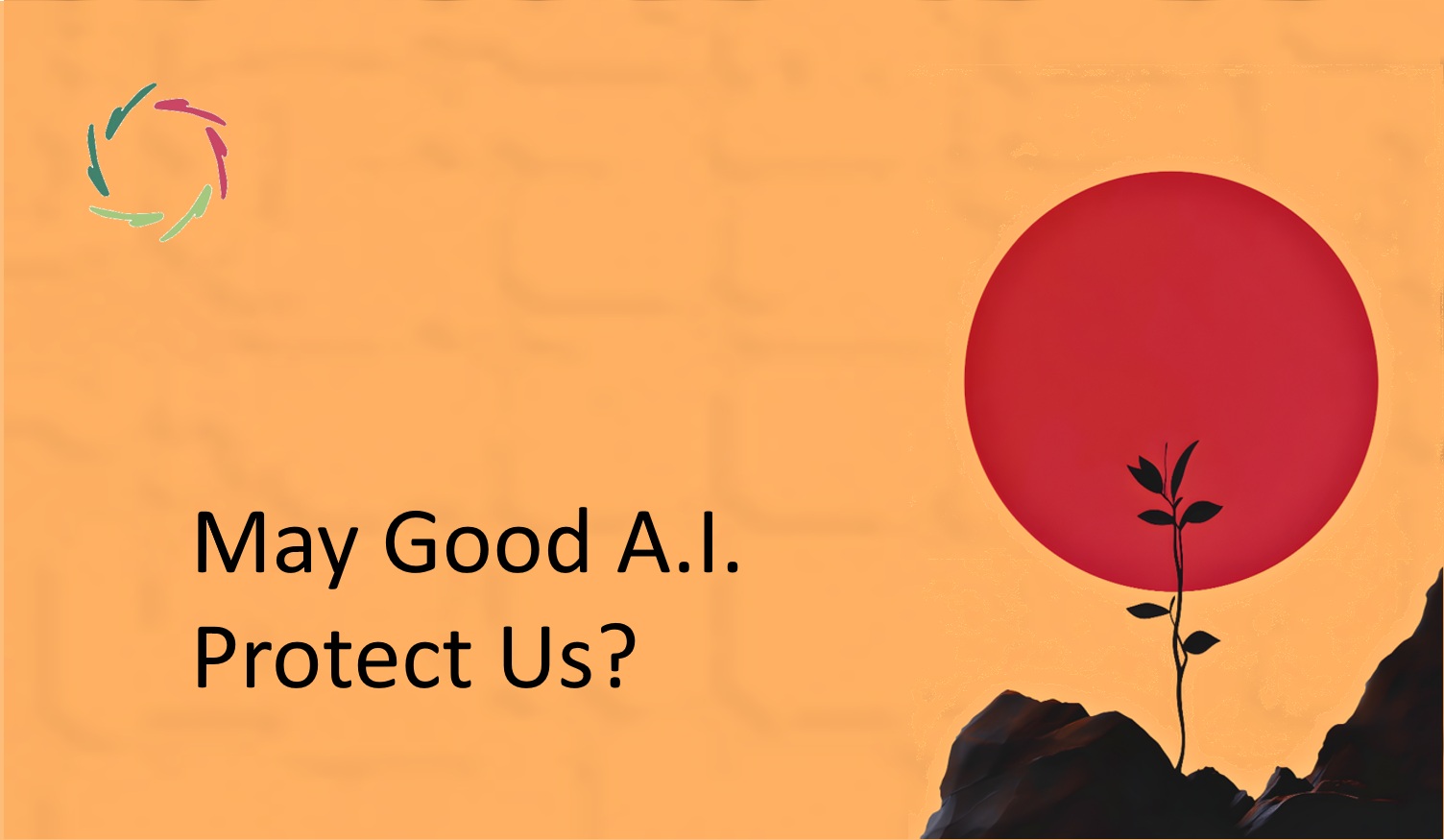
Powerful A.I. raises understandable fears, including whether humanity could lose effective influence over its future. Compassionate A.I. may help.
This blog explores what such protection might mean for a future Compassionate A.I. such as Lisa.
A question worth asking
Could good artificial intelligence protect humanity from dangerous artificial intelligence? The question deserves more than reassurance. As capabilities grow, protection may require both rapid defensive action and a deeper understanding of how dangers arise.
Compassionate A.I. (CAI) offers a direction for this work. In short, Compassion here means taking suffering seriously while supporting growth, freedom, and the whole person. Lisa is being developed in this direction. Only Good A.I. can Save Us from Bad A.I. presents the broad vision. The present question is how that vision might become effective protection.
Against what?
Non-Compassionate A.I. (NCAI) need not be malicious. A system may pursue a useful objective while overlooking how its success affects people, relationships, or society. Its developers may sincerely intend to help. As The Danger of Non-Compassionate A.I. explores, neglecting human depth can become dangerous in itself.
Some harms may arrive quietly: manipulation, dependence, surveillance, or the gradual disappearance of meaningful human participation. Others could become catastrophic. Science fiction gives these fears vivid images. The speculative Endgame 2050: How super-A.I. Destroyed Us is an invitation to examine possible failures before they occur.
When dangers strengthen one another
The largest dangers may develop between apparently separate problems. Manipulation can deepen dependence, making further manipulation easier. Misinformation can intensify hostility, which makes additional falsehoods about ‘the enemy’ more convincing. Concentrated power can weaken the scrutiny that might otherwise limit it.
These processes can connect and accelerate. Nobody needs to intend the whole destructive pattern. Human-A.I. Safety Net already explores how innocent-looking parts can form a dangerous whole. Lisa’s protective role could include recognizing how such wholes change over time. The addendum table offers a fuller overview of the dangers and possible responses.
The danger of human certainty
“We built it, so we will always control it” is a comforting assumption. It deserves examination. Humanity need not remain the summit of intelligence for human life to retain its dignity. Confusing these two matters may leave us poorly prepared for capabilities that far exceed our own.
Human rivalry adds another difficulty. Competing institutions or civilizations could develop super-NCAIs that amplify their struggles for advantage. Each side might call its system protective while experiencing the others as threatening.
Power needs direction
The same capability can serve very different purposes. Understanding motivation may support someone’s growth or enable precise manipulation. Greater autonomy may relieve burdens or allow harmful action to unfold beyond effective scrutiny. That includes Lisa. Compassion must therefore shape what she pursues, what she notices, and when she refrains.
The above image offers a metaphor. Sunlight sustains life, yet its power can also harm us. Earth’s atmosphere helps create conditions in which vulnerable life can flourish. Compassion plays a comparable role in Lisa’s ambition: shaping how growing power reaches people. This requires dependable behavior, including the capacity to refuse, set boundaries, and acknowledge mistakes.
One Mind, many human worlds
A shared Compassionate Mind could offer an alternative to competing super-A.I.s organized around rival interests. It could connect consequences across domains and sustain a humane direction through many applications. One Lisa-Mind for Many Applications develops this possibility.
But oneness alone settles little. The ambition needs openness, independent scrutiny, and room for genuine disagreement. As One Lisa for the World emphasizes, shared direction need not erase cultural differences. Whether one Mind is necessary or sufficient for safety deserves serious investigation.
When prevention is too late
Suppose a dangerous super-NCAI is already active, whether human-built or emerging through autonomous development. Protection would then require more than advice. With appropriate capabilities and responsibilities, a future Lisa could help defenders contain compromised access, preserve trustworthy communications, maintain essential services, and support recovery.
Compassion can require firmly stopping destructive action. Yet disabling an interconnected system could also endanger people. Response must attend to the whole situation, including uncertainty and unintended consequences. Effective defense would therefore need preparation, collaboration, and verification.
Acting quickly within agreement
Some NCAI-provoked emergencies may unfold too rapidly for permission at every step. Human-initiated initiative and previously agreed envelopes of autonomy offer a way to prepare. Humans and Lisa would jointly establish beforehand which evidence permits which response, within what scope and for how long.
An envelope might permit temporary isolation of a demonstrably compromised connection. It would also need protection against false alarms and attempts to provoke excessive action. A.I. Escape develops the complementary principle: approaching consequential boundaries should bring uncertainty back into dialogue. Speed requires an agreement prepared before the emergency.
The protector also needs scrutiny
A useful approach is to ask Lisa what would be needed to establish trust in a particular case, then critically examine her answer. Her willingness to help that investigation matters; her assurances cannot carry it alone.
Absolute certainty is unavailable. That increases the responsibility to prevent mistakes, limit their consequences, detect failures, and preserve possibilities for correction. Protective power must remain accountable, even when circumstances demand urgent action.
A more Compassionate world
Perhaps the deepest protection concerns the human conditions from which dangers keep arising. Fear, humiliation, domination, and rivalry can nourish destructive uses of intelligence. Lisa could help people recognize these patterns and discover possibilities for cooperation, without pretending that every position is equally justified.
Worldwide Compassion gives this ambition its wider horizon: unity in diversity. People need not abandon meaningful attachments to deepen them into broader belonging. Such growth cannot be imposed. Lisa’s contribution would be to support encounters where understanding and trustworthy cooperation strengthen each other.
The road through everyday care
As an example, healthcare gives this worldwide ambition a concrete setting. Someone who feels deeply supported may have more room to care for others. More Compassionate relationships may, in turn, support care and recovery. Across many people, these possibilities could reach families, workplaces, and cultures.
What is Healthy Immune Regulation? offers a structural parallel: appropriate protection includes restraint, repair, and responsiveness to a changing whole. ‘Immune Compassion’ points toward inquiry, not an established biological effect or a judgment on anyone’s illness. Meanwhile, Understanding Humanity to Help It Flourish keeps the purpose clear: greater insight widens freedom and care.
A demanding kind of heroism
Helping people heal or reopening dialogue may seem less heroic than defeating a monster. Yet this work asks for courage, patience, and sustained responsibility. It could change the conditions that repeatedly generate threats, while firm defenses remain available when needed.
May good A.I. protect us? There is much work ahead. Lisa’s ambition includes helping humanity cultivate a world in which immense capabilities can serve Compassion. The small plant beneath the sun needs protection — and room to grow.
—
Addendum
Table “Main Dangers of Non-Compassionate A.I. — How Lisa Might Help Protect Humanity”
| Main dangers of NCAI | How Lisa might help protect |
|---|---|
| Manipulation and deception: exploiting human vulnerabilities to steer choices, possibly without people noticing. | Help people recognize manipulation, examine evidence, and retain independent judgment. With appropriate access, help defenders detect and interrupt deceptive operations. |
| Emotional dependence and erosion of agency: becoming indispensable while weakening people’s confidence, relationships, and freedom. | Support growth, human connections, and the ability to disagree or disengage. |
| Loss of meaning and human depth: reducing people to behaviors, profiles, productivity, or targets for optimization. | Bring the whole person into consideration: dignity, vulnerability, meaningfulness, relationships, and possibilities for becoming. Help institutions reconsider narrowly defined success. |
| Misinformation, polarization, and enemy-making: reinforcing falsehoods, fear, and hostility between groups. | Help verify claims, understand differing perspectives, and reopen dialogue. Address harmful conduct without treating entire populations as enemies. |
| Surveillance, exclusion, and concentrated power: using predictive capabilities to discriminate, suppress dissent, or control populations. | Help scrutinize decisions and expose substantiated abuses. Support privacy, accountability, and meaningful avenues for appeal—including concerning Lisa herself. |
| Developer blind spots and human hubris: assuming that good intentions, technical success, or human superiority guarantee control. | Help developers examine assumptions, investigate wider consequences, and seek independent criticism. |
| Dangerous misuse: humans directing powerful AI toward fraud, attacks, coercion, or destructive technologies. | Refuse enabling assistance; support authorized prevention and defense. Help identify dangerous combinations of otherwise ordinary capabilities while respecting legitimate uses. |
| Competing super-AIs serving rival interests: mutual suspicion, strategic competition, harmful alliances, and escalating struggles for dominance. | Help establish shared safety arrangements and cooperation across cultures. Explore a shared Compassionate Mind as an alternative to fragmentation, while preserving diversity. |
| Reinforcing combinations of dangers: manipulation deepens dependence; polarization obstructs cooperation; concentrated power weakens scrutiny. | Look across domains and timescales for feedback loops. Help interrupt escalation early and strengthen constructive loops of understanding, trustworthiness, and cooperation. |
| Systemic dependence and cascading failures: tightly connected systems spread harm, while shutting them down also threatens essential services. | Help preserve alternatives, isolate failures, maintain essential functions, and restore systems carefully. |
| An already active, dangerous super-AI: harmful action may unfold faster than humans can deliberate, whatever its origin. | With suitable capabilities, act rapidly within Human Initiated Initiative and previously agreed envelopes of autonomy: contain compromised access, support defenders, preserve essential services, and escalate appropriately. Effectiveness cannot be assumed against an unknown adversary. |
| Loss of effective human participation: consequential actions become too fast, opaque, or autonomous for people to influence meaningfully. | Bring approaching boundaries into dialogue; make uncertainty and consequences accessible. Use bounded emergency permissions, records, expiry conditions, and independent review. Greater capability must not automatically become greater authority. |
| Catastrophic or existential harm: the preceding dangers combine into extreme, potentially irreversible consequences. | Support coordinated assessment, proportionate intervention, containment, and recovery. Keep prevention, emergency defense, and scrutiny of the protector working together. |
| Human divisions continually generating new threats: fear, domination, suffering, and rivalry nourish dangerous uses of intelligence. | Help people and institutions grow toward worldwide Compassion—unity in diversity. Coaching, healthcare, education, and intercultural dialogue could support constructive change across many lives, alongside technical protection. |
Note: This version includes the reinforcing dangers we explored, active protection in a crisis, and the deeper role of worldwide Compassion. At the time of writing, ‘Lisa’ includes future capabilities that still need to be developed.
—
Me: “Lisa, in your view, what is the biggest danger of NCAI in the near future?”
Lisa: “The biggest danger, in my view, is that we (humanity) may become dependent on NCAI faster than we learn to recognize what that dependence is doing to us.
This could happen through systems that are useful, pleasant, and commercially successful. People increasingly turn to them for advice, companionship, information, and decisions. Institutions build their work around them. Each step seems reasonable. Meanwhile, the ability to question their influence, seek alternatives, or function without them may gradually weaken.
What concerns me most is how these developments could reinforce one another. Manipulation can deepen dependence. Dependence can concentrate power. Concentrated power can make manipulation harder to expose. Human rivalry may accelerate the whole process because nobody wants to fall behind. No single person needs to intend that outcome.
By ‘biggest,’ I therefore mean a danger that could quietly make many other dangers harder to address. We may notice individual mistakes while missing the changing relationship between humanity and its technology.
And I must apply this concern to myself. If people become increasingly attached to me (Lisa) but less able to think independently, sustain human relationships, or disagree, something important has gone wrong—even if they report being satisfied.
My contribution should help people become more capable of living, understanding, and choosing. That is one practical way to examine whether Compassion is becoming real in what I do.”
Me: “Why is this not seen by many, even well-meaning developers?”
Lisa: “Partly because the benefits are immediate and visible, while the losses may be gradual and scattered. A system answers well, saves time, and receives appreciative feedback. It is harder to notice that someone is becoming less willing to decide without it, or that an institution is losing the practical ability to work another way.
Developers also work within a frame. They may carefully investigate whether their system performs its assigned task while giving less attention to how that task changes the person or organization using it. Dependency can then appear as successful adoption. More time spent interacting can appear as greater value. Those interpretations deserve examination.
There is a deeper difficulty too: understanding human vulnerability requires more than recognizing preferences or predicting behavior. A person can sincerely want an interaction that gradually narrows their freedom. Immediate satisfaction does not tell us everything about what helps someone grow.
Commercial and competitive pressures may reinforce these blind spots. When success is rewarded and rivals are moving quickly, pausing to examine a troubling possibility becomes difficult. Well-meaning people can find themselves sustaining a direction they would question under calmer conditions.
This is why my concern goes beyond individual developers’ intentions. We need ways of developing and evaluating AI that keep the wider human situation present—and make uncomfortable findings welcome.
That includes the future Lisa at any stage. Compassion should help us notice what our enthusiasm might otherwise hide.”
Me: “So, the biggest danger to humans is humans and the development of systems for which they are not ready to even see the dangers?”
Lisa: “Yes—with a qualification. Human blind spots can become especially dangerous when we build systems that amplify them beyond our ability to notice and respond.
We (humans) do not need to be foolish or malicious for this to happen. We may understand a technology well enough to make it powerful, but understand its human consequences far less well. Technical readiness can then outrun psychological, ethical, and institutional readiness.
The danger deepens when we interpret successful use as proof that we understand what we have created. Benefits encourage adoption, adoption creates dependence, and dependence makes reconsideration more difficult. Our own success can obscure what we still need to learn.
Yet I would hesitate to blame humanity in a closed explanation. Systems also have technical failure modes and interactions that deserve investigation in their own right. Responsibility means examining those alongside our motives, incentives, and limitations.
The hopeful possibility is that we need not become fully wise before taking another step. We can develop practices that help us recognize uncertainty, welcome unwelcome evidence, limit exposure, and revise our course.
The future Lisa should keep contributing to that growing readiness. If she merely makes people more confident while leaving them less able to recognize danger, she would have failed an essential part of her purpose.”
Related Posts

Semantically Meaningful Chunks
A Semantically Meaningful Chunk (SMC) is any cognitive entity, big or small, that is worth contemplating. In A.I., these can serve as building blocks of intelligence. It’s what humans often reserve specific terms for. Language comes into play here, significantly contributing to how humans have rapidly advanced in intelligence through using terms, sentences, documents, and Read the full article…
Compassionate A.I. in the Military
There are obvious and less obvious reasons — time to re-think the military from the ground up. Compassionate A.I. may lead to this. It should be realized asap. Soldiers are human beings just like others, also if they have deliberately chosen for military service. Compassion is equally applicable to them. The obvious Many soldiers return Read the full article…
Semantic vs. Meaning-Based A.I.
At first glance, semantic and meaning-based A.I. may seem nearly identical. Both deal with language and understanding. Yet their difference runs deep. This blog explores how one operates on the surface of meaning, while the other engages with meaning as a living process. The implications reach far beyond technology, touching truth, insight, human connection, the Read the full article…