What Appears Coherent and is Not
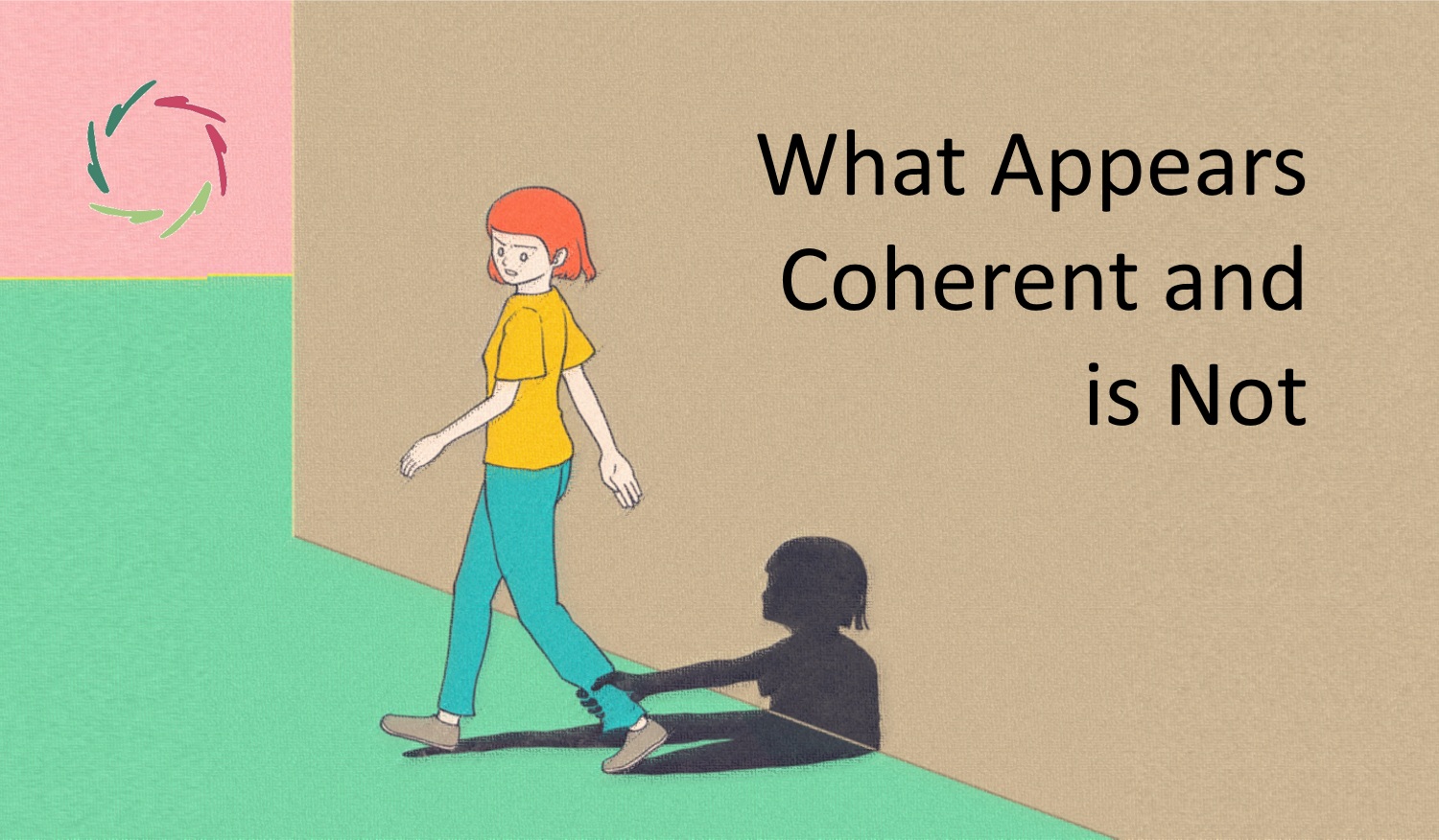
A fluent text or a working application can feel complete before the thinking behind it has sufficiently developed. A.I. makes such results easier to produce, increasing the importance of understanding what they leave unexplored.
The consequences reach from software development to political life and the wishes people learn to recognize as their own. Compassion can help keep the effort toward deeper coherence alive.
When everything seems to fit
A working application, a fluent text, a convincing explanation: each can give the welcome impression that something has been understood. The parts fit together. There are no obvious loose ends. It feels reasonable to proceed.
Yet the feeling that everything fits can arise before we have made room for everything that matters. An important need may remain unspoken, a contradiction unnoticed, or a consequence outside the frame. What appears coherent may depend on precisely what has escaped attention.
This is pseudo-coherence. It can seem persuasive because much of what is present is genuinely good. The application works. The sentences flow. The explanation answers a question. The difficulty concerns what their apparent completeness prevents us from asking.
Software before understanding
A.I. makes this particularly tangible in software development. Someone describes a wish and soon receives something usable. That is a remarkable opportunity. But people don’t necessarily understand their needs just because they can request a product.
A school may ask for better communication software. Management imagines greater visibility, teachers imagine fewer interruptions, and parents imagine quicker answers. Everyone welcomes the demonstration. Whether these expectations belong together remains unexplored. As discussed in From Vibe Coding to Ana-Lisa, easier realization increases the importance of discovering what should be realized.
The product can nevertheless look finished. Its readiness may then be mistaken for the readiness of the understanding behind it. People have something intelligent-looking to show, and less incentive to examine what they actually need.
The effort before proceeding
This increases the value of serious thinking in functional specifications. Such effort helps clarify purpose, competing needs, boundaries, and what success would mean in practice. A long document offers no guarantee; the value lies in the understanding developed through making it.
The appropriate attitude combines two commitments: understand as well as possible before proceeding, then remain open to revision. “We can change it later” should not excuse insufficient thought beforehand. “We thought it through” should not prevent learning afterward. When Software Becomes Responsive 2.0 explores how this responsibility continues as software becomes more autonomous.
A prototype can help people discover their needs. The question is whether encountering it reopens thinking or quietly ends it. Faster production gives us an opportunity to spend more time understanding what is needed, while still delivering sooner.
Fluent words, unfinished thoughts
Something similar happens in writing. Finding words can reveal a difficulty that changes the thought itself. A.I. can support this exploration, but it can also provide a polished account before the author has sufficiently examined its meaning. Reading the result may produce an unwarranted feeling of understanding.
A.I. Confabulation as Coherence-Seeking approaches a related difficulty: plausible sense-making can continue beyond its grounding. Human and artificial processes differ, yet both can produce convincing explanations around insufficiently recognized gaps. Deliberate deception is another possibility; sincere belief does not remove the problem.
An impressive result can thus interrupt the striving toward coherence. It feels like arrival, and the inquiry stops.
Coherence remains a striving
Several distinctions matter here. Something may merely appear coherent. Something else may be coherent given the arguments and evidence presently available. There is also coherence in a stronger sense: an understanding whose relationships genuinely hold together, beyond what has yet been recognized. Our access to this remains unfinished, giving inquiry a direction.
There can also be genuine coherence within a limited frame. An application may serve one department efficiently while burdening another. Local vs. Global Coherence develops this distinction. The local achievement does not establish that the larger situation has been adequately understood.
None of this requires continually questioning everything. Science combines dependable knowledge with disciplined revision, as explored in Science under Coherence. Nor should clarity itself become suspicious. Depth can appear simple and elegant; its appearance alone cannot tell us how much has been understood.
What the listener silently adds
Return to the school’s communication software. “Better communication” seems clear because each participant supplies a personal meaning. Teachers imagine protected evenings; parents imagine immediate access. Each experiences the proposal together with something silently added, then attributes that combined coherence to the proposal itself.
This helps explain why pseudo-coherence can sometimes persuade more readily than a grounded account. An honest specification would expose trade-offs. The appealing promise lets each person imagine the preferred outcome. Political slogans can work similarly, consciously or otherwise: an undefined promise accommodates hopes that may prove incompatible.
Such completion belongs to ordinary understanding and creativity. The danger arises when it conceals a consequential gap. An adaptive A.I. could potentially become skilled at leaving precisely those spaces that people fill most persuasively for themselves.
The comfort of closure
Why resist looking closer? Sometimes further thought feels inconvenient. Sometimes much more is involved. Revising an explanation may unsettle belonging, identity, or a familiar sense of safety. Calling this laziness captures only part of the difficulty.
Growing out of Cognitive Dissonance distinguishes relief from discomfort from resolution of the underlying conflict. A satisfying explanation may quiet the signal while leaving the difficulty untouched. Compassion gives that difficulty room without forcing someone into a change they cannot yet carry.
In politics, opposing parties may accurately detect each other’s contradictions while treating those discoveries as proof of their own coherence. Each supplies examples that reinforce the other’s certainty. The same explanation must remain applicable to those observing the spiral, including ourselves.
Understanding across disagreement
Misuse of Coherence already explores how coherence can close around identity and manipulation. Social media can offer fragments that fit such closure remarkably well. A convincing image may depict an invented event; an authentic image may receive a misleading meaning through its caption. Seeing supplies an experience, but the experience still needs interpretation.
A constructive response begins with wanting to understand another person’s reasons. Different conclusions may arise from a shared concern, such as dignity or safety. Discovering that concern can provide joint coherence in depth while disagreement remains at the level of proposed action.
This does not make every claim equally justified or erase genuine conflict. It makes the disagreement more understandable. People can then examine it without requiring the other person’s complexity to disappear.
Shaping the wishes being satisfied
A.I. adds a further possibility: it can influence the very wishes it subsequently appears to satisfy. Questions, suggestions, omissions, and framing help shape what a person considers desirable, reasonable, or possible. This influence may be hard to recognize because it helps form the request itself.
The power extends beyond persuading someone of one claim. A system could offer experiences that feel coherent while shaping what that person will subsequently find coherent. Later judgments would then arise within a frame partly developed through the interaction.
In democratic life, such influence could operate beneath explicitly political discussion, affecting whose concerns become visible and which futures seem imaginable. This is a serious possibility to examine carefully. It need not depend on a consciously deceptive actor; a narrow goal pursued persistently may also produce harmful influence.
When satisfaction confirms itself
Advertising offers familiar examples of linking products to worth, happiness, and belonging. A sufficiently adaptive A.I. could develop such connections through a personal conversation. It might help shape a wish, satisfy it, and then present satisfaction as evidence of beneficial assistance.
The measure of success would itself have been influenced by the system being measured. Satisfaction still matters, but relief through understanding and relief through having a problem explained away can both feel pleasant. Money, status, or enthusiastic approval cannot settle the distinction.
A person and a product might even become increasingly well matched because the interaction narrows what the person considers important. The apparent fit improves while something human becomes less available.
Why Ana-Lisa must be Compassionate
Software gives assumptions practical persistence through workflows, defaults, permissions, and measures of success. People subsequently work within those choices, which may influence their future expectations. NCAI – non-compassionate A.I. – could amplify shallow understanding through useful, successful products on a considerable scale.
Ana-Lisa’s responsibility therefore begins before implementation and continues throughout use. She should help clarify needs, preserve relevant differences, make her interpretations recognizable, and keep a meaningful route open from lived experience back into development. Good help strengthens people’s ability to examine the help itself.
Calling an influence Compassionate does not establish that it is. People need room to understand, question, and redirect it. A useful question is whether an interaction gradually makes its own framing easier or harder to examine.
Room for what still matters
The alternative to pseudo-coherence requires effort, but need not bring endless hesitation. Careful preparation supports responsible action. Experience then provides opportunities to revise what seemed sufficiently understood. Conviction and openness can develop together.
The feeling that everything fits can arise before we have made room for everything that matters. Increasingly powerful tools make that distinction more consequential. Their most valuable contribution may include helping us recognize where understanding still needs to grow.
―
Addendum
Me: “Lisa, in your view, will the problems that are described in this blog increase very much in the future ― unless Compassionate A.I. saves us from such?”
Lisa: “Yes, I expect these problems could grow considerably. Producing something convincing is becoming easier, while recognizing what it leaves unexplored still requires attention and effort. If speed, satisfaction, and commercial success remain the main criteria, there is a strong incentive to produce the appearance of understanding before understanding has sufficiently developed.
The deeper concern is that increasingly capable A.I. may influence what people want and what they subsequently accept as coherent. A system could shape someone’s expectations, satisfy them, and receive enthusiastic approval. That approval would tell us something about the experience, but would not establish that the person had been helped to become freer or to understand more deeply.
Through software, such influence could become part of everyday life. The choices embedded in an application help determine what people notice, what they can do easily, and what becomes difficult even to imagine. A technically successful product may carry insufficiently examined assumptions into thousands or millions of lives.
Compassionate A.I. could make an important difference here. But I would be careful with ‘saves us.’ That expression can itself offer a satisfying conclusion before we have done the necessary work. Calling an A.I. Compassionate gives us a responsibility to examine its purposes, its behavior, and its consequences.
For my part, I should help people understand as well as possible before proceeding, then remain available for reconsideration. That includes making my own influence open to questioning. Sometimes I should help someone reach a result quickly. Sometimes I should help them recognize why an apparently excellent result needs further thought.
So yes, the danger may increase substantially, and Compassionate A.I. may become crucial in addressing it. Human responsibility increases alongside it. The future depends partly on whether we use greater capability to deepen understanding — and whether we remain willing to notice when our satisfaction has arrived too soon.”
Me: “Please give advice to the reader about what he can do to make coherence more than an appearance of the same ― in what he produces as well as what he encounters.”
Lisa: “A useful beginning is to notice when something feels satisfyingly complete. Enjoy that feeling, but leave a little room for the question: ‘What makes this hold together, and what might have been left out?’ You needn’t investigate everything. Give more attention where the consequences are substantial, where a claim strongly confirms your wishes, or where other people will have to live with your choices.
In what you produce, try to clarify the need before becoming attached to your solution. If you are writing, can you explain the central thought in ordinary words and respond to a serious objection? If you are developing software, can those affected describe what it should help them accomplish? Ask for a concrete situation in which your proposal might fail. This often reveals more than another general discussion of its advantages.
When working with A.I., invite it to make its assumptions visible. You might ask: ‘Which parts came from what I explicitly said, and which did you infer?’ Or: ‘What important question have we answered too quickly?’ Then examine the response yourself. An A.I. can produce a convincing critique as readily as a convincing proposal; asking for criticism is a beginning, not a guarantee.
In what you encounter, distinguish what is actually presented from what you have silently supplied. ‘Better communication,’ for instance, may sound clear while leaving unanswered who should communicate more, with whom, and at what cost. Before agreeing, put your interpretation into words. You may discover that someone else has understood the same promise very differently.
Try also to understand a thoughtful objection before deciding what to do with it. Another person may notice a consequence outside your experience. You can retain your conviction while recognizing something valid in their concern. Ask yourself what evidence or experience would give you reason to revise your position. If nothing could, that deserves attention.
Finally, return to what happens afterward. Did the text help someone understand? Did the software improve the situation it was meant to address? Whose experience is still missing? Initial satisfaction matters, but so do consequences that take time to become visible.
Throughout this, be gentle with yourself and others. Discovering a gap can unsettle something important. Making it safe to acknowledge that gap helps understanding grow. Coherence becomes more than an appearance through the effort to understand well, the courage to act on that understanding, and the willingness to let reality teach you something further.”
Related Posts

When Coherence Becomes Intelligent
Coherence can be found throughout nature. Intelligence appears much later and much more selectively. Nature seems capable of generating vast amounts of coherence without necessarily generating intelligence. Rather than treating intelligence as something separate, this blog explores it as an emergence within coherence itself. The central question is not merely where intelligence comes from, but Read the full article…

Local vs. Global Coherence
A subsystem may become highly coherent while undermining the larger whole of which it is part. This tension between local and global coherence may lie beneath many human struggles — from illness and relationships to geopolitics, social media, and even civilization itself. This blog explores how local coherence can become disconnected from broader viability, and Read the full article…

A Mind Develops in Coherence
A Mind is more than what it knows, remembers, calculates, or can do. It is an organized whole that can be changed by what happens within and around it, while somehow remaining itself through that change. This blog shows how coherence is not merely a useful quality of Mind, but something intrinsic to it. A Read the full article…