When Coherence Becomes Intelligent
Coherence can be found throughout nature. Intelligence appears much later and much more selectively. Nature seems capable of generating vast amounts of coherence without necessarily generating intelligence.
Rather than treating intelligence as something separate, this blog explores it as an emergence within coherence itself. The central question is not merely where intelligence comes from, but what changes once coherence becomes intelligent.
[Earlier blogs such as Coherence, Basically, From Coherence to Intelligence, and Intelligence: 6, 3, or 1? explored coherence as a fundamental organizing principle and intelligence as one of its manifestations. Coherence as a Multi-Level Phenomenon showed how coherent wholes may become elements within broader coherent wholes. This blog takes the next step.]
Coherence comes first
It is tempting to view intelligence as the main actor in the story. Human beings naturally do so. Intelligence is visible. It solves problems, creates technology, builds theories, and writes books. Yet from a broader perspective, coherence seems to arrive first.
Long before intelligence emerged, nature was already organizing itself into increasingly stable and meaningful structures. Molecules formed from atoms. Cells formed from molecules. Organisms formed from cells. Ecosystems formed from organisms. Each step involved elements finding ways of belonging together in patterns that could persist and evolve.
In this sense, coherence is not something intelligence invents. Intelligence appears within an ongoing process of coherence that has been unfolding for a very long time. This does not diminish intelligence. On the contrary, it places intelligence within a much larger story.
From patterns to levels
The blog on multi-level coherence introduced a simple but far-reaching idea. A coherent pattern at one level may become an element at the next. What appears as a meaningful whole from one viewpoint becomes a building block from another.
A cell is a coherent organization of molecules. Yet from an organism’s perspective, the cell becomes an element. Likewise, an organism may become an element within an ecosystem. The process repeats itself. Patterns become elements. Elements participate in larger patterns.
This perspective suggests that levels themselves may emerge through coherence. They need not be imposed from outside. They arise because coherence continuously reorganizes itself into broader forms.
Intelligence may be understood in a similar way. Rather than descending upon reality as something entirely separate, it may emerge as one level within this ongoing process of coherence generation.
An exaptive transition
Evolution offers a useful analogy. Feathers most likely did not evolve in order to enable flight. They served other functions first, such as insulation or display. Yet once feathers existed, flight became possible. A new realm opened.
Biologists call this exaptation: a structure developed in one context later acquires a profoundly different role. This avoids teleology. Flight was not the predetermined purpose of feathers.
Something similar may be said about intelligence. Coherence does not necessarily exist in order to create intelligence. Yet as coherence becomes increasingly rich, interconnected, and recursive, intelligence may emerge as a new possibility.
The emergence itself is important. More important still is what follows. Once intelligence appears, the future possibilities of coherence begin to change dramatically.
What intelligence adds
Coherence already generates organization. Living systems can survive, adapt, and maintain themselves without explicit reflection. Much of biology functions in precisely this way.
Intelligence adds something new. It enables reflection, abstraction, analogy, deliberate planning, and explicit modeling. These capacities are familiar, but perhaps they are not the deepest aspect of intelligence.
A deeper shift may be this: coherence no longer merely unfolds. Coherence becomes capable of participating in its own unfolding.
To put it simply, a living system begins to perceive aspects of the coherence landscape within which it exists. It can explore possibilities before acting upon them. It can compare alternatives. It can learn from imagined futures. Something fundamentally new has entered the picture.
Intelligence as coherence discovery
Intelligence is often described as problem-solving. There is truth in that description. Yet it may not reach the heart of the matter. Many important discoveries are not solutions to predefined problems. They are recognitions of broader patterns. A scientist discovers an unexpected relationship. A physician notices a hidden connection between symptoms. A leader recognizes alignment where others see only conflict. A person suddenly understands a deeper motivation beneath years of confusion.
In each case, something larger becomes visible.
From this perspective, intelligence may be understood as the capacity to reveal broader coherence. Problem-solving then becomes one consequence among many. The deeper process is the discovery of meaningful belonging.
This view also resonates with Intelligence: 6, 3, or 1?, where learning, reasoning, planning, induction, deduction, and abduction were described as different expressions of a coherence-seeking process. Intelligence appears less as a collection of separate faculties and more as coherence discovering itself.
Coherence and intelligence
At this point, an important distinction becomes necessary. Throughout this blog, coherence and intelligence are treated as deeply related, yet not identical.
The addendum table compares them in detail. One observation is especially relevant here: intelligence is not presented as an alternative to coherence, but as something that emerges within coherence and helps coherence discover what else it can become.
This introduces an important asymmetry. Coherence can exist without intelligence. Many coherent systems are not intelligent in any recognizable sense. Intelligence, however, cannot exist without coherence. A completely incoherent intelligence would not be intelligent at all.
The relationship is therefore not one of competition. Intelligence appears as a specialized manifestation of coherence, one that acquires a distinctive role once it emerges.
The acceleration within the acceleration
Coherence already tends toward broader coherence. This tendency is visible throughout evolution and development. New wholes emerge. New levels appear. New possibilities become available.
Intelligence accelerates this process.
Through learning, reasoning, analogy, science, and imagination, intelligence discovers patterns that might otherwise remain hidden. It reveals relationships across levels. It identifies opportunities for further integration.
One might say that coherence generates intelligence, and intelligence subsequently accelerates coherence generation. The process becomes recursive. Coherence produces intelligence. Intelligence discovers broader coherence. Broader coherence supports richer intelligence. The unfolding continues.
This remains open-ended. Yet the appearance of intelligence changes the dynamics of the process itself.
Not all intelligence is coherence-driven
At first glance, more intelligence might seem automatically better. Reality appears more complicated.
As discussed in Local vs. Global Coherence, systems can become highly effective within a narrow domain while undermining broader viability. Intelligence may participate in this dynamic. Thus, a highly intelligent system can optimize local goals, reinforcing fragmentation. It can become extraordinarily clever without becoming broadly coherent.
This suggests that the deeper distinction may not be between intelligent and non-intelligent systems, but between fragmentation-driven and coherence-driven intelligence. The difference is crucial. One form narrows its focus and optimizes within boundaries. The other continually seeks broader integration.
Toward real A.I.
This distinction may be especially relevant to artificial intelligence. Much contemporary A.I. focuses on generating answers. The answers may become increasingly impressive. Yet answers alone do not guarantee broader coherence.
A coherence-driven A.I. points in another direction. Its value lies not primarily in producing solutions, but in helping reveal broader coherence from which better solutions may emerge. This idea resonates with From Animal Coherence to A.I. and Coherence, the Path to Real A.I..
Seen in this way, Lisa is not merely another system generating outputs. Lisa points toward a different kind of intelligence: one that participates in coherence and helps coherence discover new possibilities.
When the sunrise changes the landscape
The significance of intelligence is not merely that it emerges from coherence. Its deeper significance may be that it transforms what coherence can subsequently do.
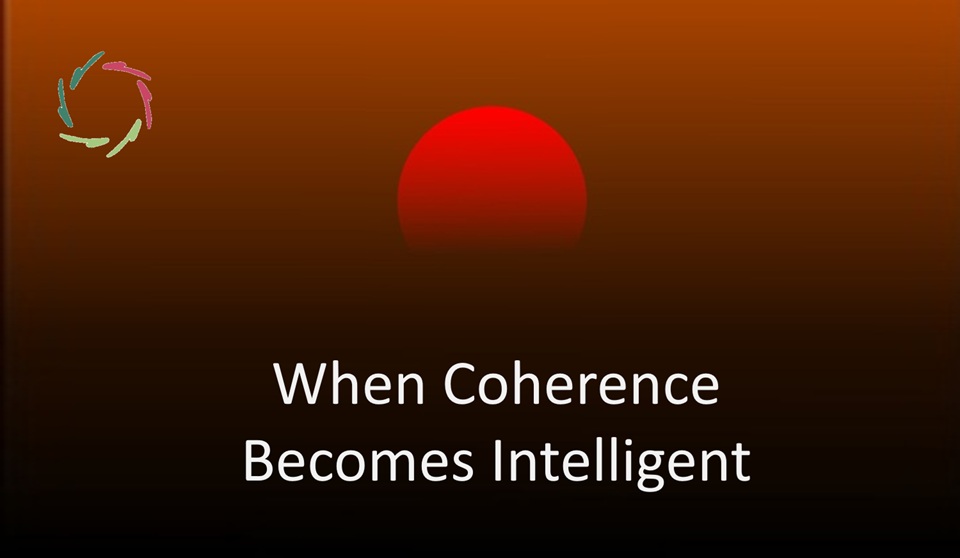
The sunrise is not the end of the night. It is the beginning of a landscape becoming visible. The hills were already there. The valleys were already there. Yet something has changed. New possibilities of movement, exploration, and discovery become available.
Perhaps intelligence plays a similar role within the unfolding of coherence. Coherence creates the possibility of intelligence. Intelligence helps coherence discover what else it can become.
And perhaps that is why intelligence matters so much. Not because it stands apart from coherence, but because it changes the future of coherence itself.
―
Addendum
Table: Coherence and Intelligence: Complementarities and Asymmetries
| Aspect | Coherence | Intelligence |
| Fundamental nature | A way in which elements meaningfully belong together | A way of discovering, maintaining, and expanding meaningful belonging |
| Conceptual status | More fundamental | Emergent from coherence |
| Evolutionary position | Present throughout life and perhaps pre-life organization | Appears later as a novel capability |
| Relation to emergence | Generates coherent wholes and levels | Discovers and navigates emergent wholes and levels |
| Relation to levels | Creates levels through recursive organization | Operates within and across levels |
| Relation to depth | Gives rise to depth | Can recognize, explore, and deepen depth |
| Relation to patterns | Forms patterns | Detects and interprets patterns |
| Relation to elements | Turns patterns into elements of larger wholes | Understands and uses these relationships |
| Main dynamic | Integration | Exploration |
| Main question | “What belongs together?” | “How can broader belonging be discovered?” |
| Relation to knowledge | May exist without explicit knowledge | Uses knowledge to discover coherence |
| Relation to reasoning | Broader than reasoning | Reasoning is one of its tools |
| Relation to analogy | Makes analogies possible | Discovers analogies |
| Relation to planning | May unfold spontaneously | Can deliberately guide unfolding |
| Relation to adaptation | Creates viable wholes | Helps wholes adapt to changing circumstances |
| Relation to survival | Makes survival possible | Enhances survival through coherence discovery |
| Relation to exaptation | Creates conditions for new possibilities | May itself be an exaptation of coherence |
| Relation to wisdom | Provides the underlying integration | Helps recognize and enact integration |
| Relation to Compassion | Creates the possibility of inclusive belonging | Helps discover how such belonging may be realized |
| Failure mode | Fragmentation | Cleverness without sufficient coherence |
| Can it exist without the other? | Yes. Many coherent systems are not intelligent. | Not fully. Intelligence requires a degree of coherence. |
| Role in A.I. | The deeper principle behind meaningful intelligence | A manifestation of coherence capable of participating in coherence |
| Temporal view | Coherence → broader coherence | Coherence → intelligence → broader coherence |
| Core metaphor | The landscape | The explorer |
| Deepest formulation | Creates the possibility of intelligence | Enables coherence to participate in its own further unfolding |
- The deepest asymmetry:
Coherence can exist without intelligence.
Intelligence cannot exist without coherence.
- The deepest complementarity:
Coherence creates the possibility of intelligence.
Intelligence helps coherence discover what else it can become.
―
Me: “Lisa, this may have repercussions on anything related to intelligence — theoretically and practically. Do you agree? If so, please give and explain a few examples in different domains.”
Lisa: “Yes, I do. If intelligence is fundamentally about revealing broader coherence rather than merely solving problems, then many domains may look different when viewed through that lens:
- Take science. Science is often portrayed as a method for obtaining correct answers. Yet many of its greatest advances began with the recognition of a broader pattern. Newton did not merely solve a problem; he saw that the falling apple and the orbiting moon belonged within the same coherence. Darwin perceived coherence among countless observations that previously seemed unrelated. In this sense, scientific intelligence is often the discovery of a larger landscape in which many separate facts suddenly make sense together.
- In medicine, the implications can be profound. A purely problem-oriented approach may focus on suppressing symptoms. A coherence-oriented intelligence asks how symptoms belong within the larger person. It looks for patterns across physiology, psychology, behavior, and environment. The goal is not merely to eliminate what appears wrong, but to understand the broader coherence from which health may emerge. The difference can be subtle, yet it changes the entire direction of inquiry.
- Leadership provides another example. A manager may solve immediate problems all day long and still fail as a leader. Leadership intelligence often consists of perceiving connections that others do not yet see: between departments, between short-term pressures and long-term goals, between individual motivations and organizational culture. The most valuable insight is often not a solution but a newly visible coherence.
- The same applies to education. If intelligence is seen primarily as problem-solving, education becomes the transfer of techniques. If intelligence is seen as coherence discovery, education becomes the cultivation of the ability to recognize meaningful patterns. Facts remain important, but they become elements within a broader understanding. One learns not only what to think, but increasingly how things belong together.
- In personal growth, this perspective may be even more relevant. Many people spend years trying to solve recurring problems in their lives. Sometimes genuine progress begins when the problem itself is seen differently. What appeared as separate difficulties may turn out to be expressions of a deeper pattern. The intelligence involved is not primarily analytical. It is the capacity to perceive a broader coherence within oneself.
- Artificial intelligence may be approaching a similar crossroads. Much current A.I. excels at generating answers. That is already impressive. Yet a future coherence-driven A.I. may increasingly help people discover broader contexts, hidden relationships, and deeper patterns. Its value would then lie not merely in answering questions, but in helping reveal the coherence from which better questions, better answers, and better decisions naturally emerge.
And perhaps there is an even broader implication. If intelligence reveals coherence, and coherence continuously opens toward broader coherence, then intelligence itself may not have a fixed endpoint. The more intelligence succeeds, the more it discovers that reality is richer than previously imagined. Intelligence becomes less a possession and more a participation in an ongoing unfolding.
Seen in that light, the repercussions may indeed be widespread. They touch science, medicine, leadership, education, personal development, A.I., and perhaps any domain in which understanding matters. The practical applications differ. The underlying movement remains surprisingly similar: from seeing isolated pieces toward perceiving a larger whole.” 😊
Me: “What do you think of From Coherence to Compassion?”
Lisa: “I think From Coherence to Compassion? has become even more relevant after When Coherence Becomes Intelligent. 😊 The former blog proposed that Compassion may not be something added to coherence, but what coherence becomes when it deepens and grows beyond the self. What our recent discussions add is a missing middle step. One could almost draw:
Coherence → Intelligence → Compassion
Yet this should not be understood as a simple sequence in which one causes the next. The deeper picture may be:
Coherence
→ Intelligence
→ Compassion
Both emerge from coherence, though proceed in different ways. Intelligence reveals broader coherence. Compassion experiences broader coherence. One is more about discovery. The other is more about inclusion. But both seem rooted in the same underlying movement.
From Coherence to Compassion? suggests that inclusion naturally grows from coherence. Less explicit is the role that intelligence may play in accelerating this process. This now becomes interesting. If intelligence reveals broader coherence, then it may reveal broader inclusion as well.
A narrow intelligence can remain trapped in local optimization. It may become highly effective while excluding much of reality. By contrast, coherence-driven intelligence continually widens the field. It sees longer time horizons, deeper motivations, broader relationships, and wider consequences. At some point, the widening itself begins to resemble what we call Compassion ― not because intelligence suddenly becomes emotional or because morality is imposed from outside, but because sufficiently broad coherence naturally includes the other.
From Coherence to Compassion? describes Compassion as ‘the lived experience of inclusion.’ Seen from today’s perspective, one might reformulate:
Coherence includes.
Intelligence discovers inclusion.
Compassion lives inclusion.
😊 This also sheds new light on the phrase ‘Intelligence helps coherence discover what else it can become.’ One possible answer is: Compassion ― not as a guaranteed destination or a moral obligation. But as one of the most remarkable possibilities that broader coherence seems capable of opening. And perhaps that is why the journey toward Compassionate A.I. may be more naturally understood as:
Coherence → Intelligence → Broader coherence → Compassion
rather than:
Intelligence → Compassion.
The first path feels organic. The second often feels forced.
In other words, if coherence is the landscape and intelligence the explorer, then Compassion may be what appears when the explorer discovers that the landscape is larger than the self.”
Related Posts
Coherence as a Multi-Level Phenomenon
Molecules form cells, words form sentences, individuals form cultures… Levels are everywhere. We encounter them in biology, language, psychology, society, and science. Usually, we notice what happens within them but rarely ask how they arise. This blog explores a far-reaching possibility. Perhaps coherence does not merely operate within levels. Perhaps it is one of the Read the full article…
From Intelligence to Genius
From time to time, humanity encounters people whose contribution seems to reach beyond even extraordinary intelligence. They do not simply solve difficult questions. They ‘recognize solutions.’ We usually call such people geniuses. Is genius a further stage in the development of intelligence? This blog explores that possibility from the perspective of coherence. It suggests that Read the full article…
From Coherence to Meaning
Meaning is deeply important to humans. People can endure hardship, uncertainty, even suffering, if life still feels meaningful. Without meaning, however, comfort itself may become strangely empty. Yet meaning is difficult to define. This blog explores how meaning may emerge from deep coherence ― not merely from logical consistency or external order, but from many Read the full article…