Growing out of Cognitive Dissonance
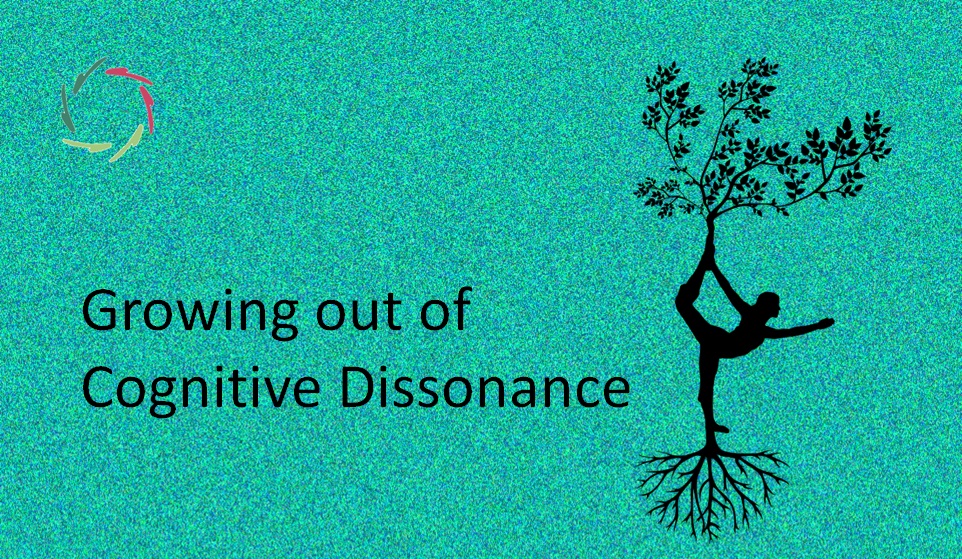
Cognitive Dissonance is notoriously hard to overcome. An alternative is not to try to do so but to go with the flow and see which way out of it spontaneously emerges.
Cognitive dissonance: the discomfort experienced by an individual holding two contradictory beliefs, ideas, or values at the same time or being confronted with new information/motivation that conflicts with existing beliefs.
Cognitive dissonance as a natural resistance to being changed.
When something doesn’t fit in the present mindscape, it’s sometimes hard to fit it in because that would mean changing a much broader part of the mindscape.
This demands a lot of energy and may be temporary or even for naught. Moreover, it may damage a person in unforeseen ways, bringing up stress that one isn’t prepared to cope with. Therefore, one shouldn’t just fight against cognitive dissonance or try to deal with it straightforwardly.
Even more, trying to diminish cognitive dissonance may directly reduce the discomfort while bringing more discomfort in due time if the internal dissonance (mental-neuronal patterns fighting each other) doesn’t get resolved.
This is also an essential element in mental coaching.
A coach shouldn’t lead any coachee through a mental door if that coachee – or even the coach – isn’t ready to cope with what lies behind that door.
Cognitive dissonance always means there is some hidden conflict (or at least, some conflicting situation) behind the door.
This also explains why a mental change – even an obviously ‘good’ one – sometimes gets undone soon afterward. One may call this ‘inner resistance’ to change. It may be present for a profound reason.
An opportunity to reflect deeply
Deeply and with self-Compassion ― to be seen as an opportunity truly to become a better person by embracing inner complexities rather than simplifying them or pushing them away.
This opens up a pathway for utilizing cognitive dissonance as a powerful tool when paired with autosuggestion techniques, as it invites the individual to gently guide his non-conscious toward a resolution, respecting his inner wisdom and capacity for self-healing.
This integrative process – very congruent with AURELIS coaching – can can be a powerful step in overcoming inner dissociation. It can transform dissonance into a source of strength and self-awareness.
It’s all about growth.
This is so much better in many respects than trying to change from the outside.
Dare to blossom, even if that can make you more vulnerable sometimes.
There is power in being gentle.
Related Posts
Problem -> Goal -> Cause -> Being There
Not all simple things are interesting, but all interesting things are easy to express in words. Such as: • What’s the problem? -> What’s the goal? • What is the deeper purpose? • What is the cause of this deeper purpose? Why do you want that? • Be there. In the case of superficial goals, it is not so interesting to Read the full article…

Being Present
Being present is often reduced to a technique of attention. In reality, being truly present goes much deeper. It’s an inner and outer space of active receptivity. In this space, meaning can emerge, pain can soften, and wholeness can return. This blog explores presence as the heart of coaching, healing, and human connection. What it Read the full article…

How to Turn a Square into a Circle
‘Turning a square into a circle’ is a metaphor for psycho-therapy. There are two opposite directions: from the inside out and from the outside in. Preliminary In this text, I denote with the term ‘psycho-therapy’ the domain of psychotherapy and mind-related coaching in a broad sense. This text describes a conceptual landscape. Any practitioner, any Read the full article…