Schizophrenia: Analogy Through the Roof
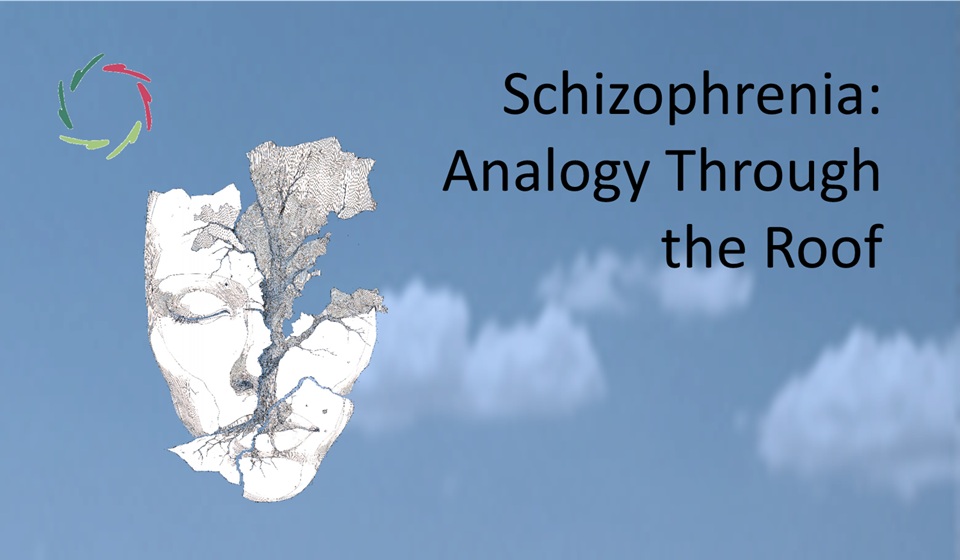
Schizophrenia has often been described as a disease of the brain, yet this tells little about what a person actually goes through. In the AURELIS view, the phenomenon becomes clearer when seen as analogy rising too strongly and too vertically, breaking the inner roof that usually contains symbolic experience.
This perspective neither glorifies nor reduces the experience; it seeks to understand how depth overwhelms structure. By looking closely at how symbolism works in every human being, we may approach schizophrenia in a more Compassionate, humanly realistic way.
This is part of a triptych about schizophrenia
- Schizophrenia: Analogy Through the Roof
- Schizophrenia in Cultures and the Brain
- Symbolism-Support in Schizophrenia
This triptych culminates in a new model of schizophrenia as a Dynamic Coherence Disorder.
[NOTE: After finishing the triptych, I downloaded 12 recent state-of-the-art articles (all published in 2025), a small portion of what is being published about schizophrenia. I then asked Lisa to render the gist of each and compare it with the main findings of the schizophrenia triptych. The results are gathered in this PDF. My conclusion is that present-day science looks at a painting from very close up, seeing details consistent with it, but meanwhile missing the overview. This triptych shows the overview ― the painting itself. We need not less, but better science that takes into account the painting of the total human being.]
Too powerful, too vertical
Schizophrenia has been given many definitions across time, yet none of them truly explain why a person may suddenly lose the ability to hold inner experiences at a safe distance. A more meaningful view emerges when we look at the phenomenon as a movement in which analogy rises too powerfully and too vertically, as if breaking the inner roof that usually contains it.
The AURELIS perspective is that the symbolic world is not an enemy; it is simply strong, and strength without integration can become overwhelming. Seen this way, schizophrenia becomes a matter of imbalance rather than mystery or defect. This blog explores how such imbalance develops and how it may be approached without reduction or romanticization.
Epidemiology in broad strokes
Schizophrenia is often described as affecting around one percent of the population (82 million) worldwide. More detailed studies show a broader range — roughly 0.3% to 1.5% across cultures and contexts. This suggests a pattern shaped not only by biology but also by social and symbolic environments.
What differs more strongly is how people live with the condition. In societies where social networks are fragile and symbolic experience is poorly integrated into daily life, outcomes tend to be worse. In communities where support, meaning, and belonging are more readily available, long-term functioning is often better, even when symptoms are similar.
Most episodes begin in late adolescence or early adulthood, a moment when inner worlds naturally intensify and identities are still forming. For those who have had more than one episode, the risk of recurrence increases, especially under conditions of stress, sleep disruption, or emotional overload. Yet recurrence is not inevitable. Many people, with support and understanding, go on to live stable and meaningful lives. Epidemiology shows that the story is not one of inevitability.
This background reminds us that schizophrenia is neither rare nor exotic, and that its unfolding depends not only on biology but also on how a person’s inner life is met by the outer world.
About antipsychotics
Prescriptions for antipsychotics have risen markedly over the past two decades. In many Western countries, about 1% of the population is treated for schizophrenia, yet 3–5% receive antipsychotic medication at some point, according to large health-service databases and OECD reports. In some regions, use has doubled since the early 2000s, especially through off-label prescribing for anxiety, insomnia, agitation, or behavioral stabilization. This shows both the usefulness of these medications in crisis situations and how strongly current care systems rely on surface stabilization when deeper layers of experience remain difficult to address.
The spectrum of symbolic depth
Human thinking naturally moves through layers of meaning, from simple comparison to richer symbolic resonance. Most people navigate these layers without difficulty. Yet some individuals show a style sometimes called schizoid, marked by a gentle withdrawal from outer reality and a heightened sensitivity to subtle connections. This is described in Schizoid Thinking. Such sensitivity is not an error in itself; it may even allow nuanced insight. The difficulty arises when symbolic resonance intensifies faster than the person’s capacity to remain grounded.
As the analogy becomes stronger, it may begin to rise vertically rather than remain within the horizontal field of everyday associations. Here lies the beginning of danger. A symbolic impression that would typically be recognized as ‘just a feeling’ or ‘just a metaphor’ begins to press upward, carrying the person toward a realm where ordinary distinctions lose clarity. This upward push prepares the ground for what later appears as psychosis.
The ladder of meaning
A helpful way to visualize this process is the natural ladder from sign to analogy, then to metaphor, and finally to symbol. This sequence is explored more fully in Sign → Analogy → Metaphor → Symbol. In everyday life, the ladder is climbed gradually and with subtle feedback from reality. The mind keeps its ‘as-if’ stance: a metaphor is taken as if it were true, not as literal truth.
The difficulty appears when this stance collapses. Instead of moving step by step, analogy may leap directly into symbolic space, skipping the stabilizing layers in between. The result of this suddenness is not increased depth but lost orientation. A symbol that arrives too quickly may impose itself as a literal perception. Hallucinations and delusions are thus not arbitrary creations; they are meaningful phenomena arriving without their usual container.
The real cause
The symbolic itself is not the illness. The real problem begins when meaning starts to swirl around itself in a self-reinforcing movement. This dynamic is described in Mental Illnesses are Meaningful Whirlpools. In such a whirlpool, symbolic material accelerates beyond the person’s ability to integrate it. What would otherwise be a rich inner landscape becomes a vortex that pulls the person inward.
The rise of the whirlpool explains why schizophrenia can appear suddenly, even violently. When symbolic forces gain too much momentum, they may break through the person’s inner structure, producing confusion and emotional flooding. The tragedy lies not in the presence of depth but in the collapse of the framework that normally allows depth to be metabolized. Understanding the illness as a dynamic rather than a fixed condition opens the door to more humane approaches.
A neurocognitive imbalance
In modern terms, this collapse can be seen as an imbalance between conceptual and subconceptual processing. Conceptual thought provides structure and explicit understanding, while subconceptual processes carry resonance, intuition, and emotional depth. The interplay between the two is explored further in Bridging the Divide. Schizophrenia arises when subconceptual activity becomes too strong while conceptual containment weakens.
This imbalance explains why psychotic experiences feel to the person both deeply meaningful and impossible to manage. The mind is flooded with resonance but cannot organize it. The result is fragmentation: speech loses coherence, emotions lose nuance, and reality-testing becomes unreliable. It is not the symbolic content that is pathological, but the loss of balance that usually defines a livable world.
A triangle of misunderstandings
Public and professional debates often polarize around two positions. On one side, mainstream psychiatry focuses on brain dysfunction and attempts to suppress symptoms. Overviews from organizations such as the NIMH, Psychiatry.org, Mayo Clinic, NHS, NAMI, and MedlinePlus all emphasize brain-based causation, early warning signs, and the central role of antipsychotic medication. These descriptions are valuable in outlining the clinical picture, yet they reveal how the mainstream view is still anchored primarily in stabilization and risk management rather than in understanding symbolic processes.
On one side, mainstream psychiatry focuses on brain dysfunction and attempts to suppress symptoms. On the other hand, antipsychiatry (such as Thomas Szasz, 1920-2012) denies the existence of schizophrenia as anything more than a social construction. Both positions miss the mark. The dynamic between them resembles the two corners described in Chaos – Coercion – Compassion. They oppose each other without grasping the underlying depth.
A third direction emerges through Compassion — neither denial of the phenomenon nor forceful suppression of it. This stance acknowledges both the reality of symbolic overload and the importance of maintaining autonomy and trust. It allows the phenomenon to be understood rather than fought or dismissed.
Depth without romanticism
Some thinkers, most famously R.D. Laing (1927-1989), emphasized the meaningful side of psychosis. His work remains valuable, yet his tone sometimes suggests a glorious insight hidden within madness. AURELIS takes a different view. Symbolism carries great depth, but when it overwhelms structure, the result is suffering rather than wisdom.
Lisa’s perspective respects depth without glorifying collapse. A psychotic episode is not a breakthrough but a failure of integration. At the same time, it is not a sign of personal failure. The phenomenon is one of imbalance, not guilt. This view allows space for understanding without sentimentality.
See the addendum for a comparison table: Psychiatry • Szasz • Laing • AURELIS
Riding the symbolic waves
Symbolic depth cannot (and should not) be avoided in life. One can, however, learn to engage with it safely. In From Symbolism to Psychosis, the idea appears that working with symbols is like learning to ride waves. Without preparation, a large wave may be dangerous; with preparation, the same wave becomes manageable.
People especially sensitive to symbolism may need greater support when dealing with these waves. Such support is not about restriction but about presence and stability. When symbolic forces feel less threatening, the risk of a psychotic break diminishes. Integration becomes possible once more.
Acute and chronic states
An acute psychotic episode resembles a sudden tsunami. Symbolic material rises from the depths so quickly that the person has no time to regain footing. As described in Psychosis: a Needless Tsunami, the experience can feel total and inescapable. The person is submerged, unable to find the exit that would allow reorientation.
When such episodes recur, the mind may respond by shutting down symbolic access altogether. This leads to the chronic state often associated with schizophrenia. The person may appear emotionally flat, socially withdrawn, or disconnected, not because nothing is inside but because the system protects itself by closing the door to depth. This defensive strategy may prevent further tsunamis, but it also reduces meaningful engagement with life.
Although chronic schizophrenia is often described as a long-term deterioration, it may be more accurate to see it as the brain’s adaptive response to repeated inner storms. After several acute episodes, the system protects itself by reducing openness to symbolic depth, which can appear as cognitive slowing or emotional flattening. Neuroscience shows that the brain does change under such conditions, yet these changes are not fixed or purely degenerative; they soften again when stability and gentle integration return. This reinforces the idea that chronic states reflect a history of overwhelming experiences rather than an irreversible decline.
A role for deep listening
If there is one human skill that can help prevent symbolic overload, it is the ability to listen deeply. Deep listening is explored in Deep Listening, where it is described as the capacity to let the deeper layers of another person – or oneself – unfold without hurry. Without such listening, symbolic forces remain unintegrated. With it, depth becomes less threatening and more livable.
Deep listening creates breathing room, the gentle space in which analogy can rise without breaking through the roof. It stabilizes the process of meaning-making and allows the symbolic to appear in forms that can be handled. This stance embodies the Compassion described earlier.
Toward a more humane view
Schizophrenia, from this perspective, is not a fixed disease but a dynamic imbalance that disrupts the person’s ability to manage symbolic depth. By seeing the phenomenon as a matter of failed integration rather than deficiency, we open a path toward a more humane understanding. Compassion becomes not only an ethical stance but a practical necessity.
AURELIS offers a framework that respects depth, supports structure, and keeps the person central. This approach avoids both coercion and denial. It seeks to understand the symbolic storm without either drowning in it or pretending it does not exist. In this view, schizophrenia becomes less of a puzzle and more of a human reality that can be approached with care and clarity.
―
Addendum
Comparison Table: Psychiatry • Szasz • Laing • AURELIS
| Aspect | Mainstream Psychiatry | Szasz / Antipsychiatry | Laing (Existential) | AURELIS |
| What is schizophrenia? | A biological brain disease with unclear but assumed neurochemical/neurodevelopmental cause. | A myth, a label for socially disapproved behavior; no “disease” exists. | A collapse of self-integration; a meaningful existential crisis. | A symbolic tsunami: overwhelming inner meaning that breaks integrative boundaries. Real phenomenon, not a classical disease. |
| Origin of psychosis | Neurobiological dysfunction; genetics + environment. | Mislabeling; social control; not an inner phenomenon. | Family/systemic contradictions (“double binds”). | Interaction of symbolic sensitivity, integrative weakness, dissociation, life stress; meaning overwhelms structure. |
| Role of symbolism | Ignored or treated as symptom without inherent meaning. | Considered irrelevant or imaginary. | Deeply meaningful but sometimes over-romanticized. | Core phenomenon: symbols surge, analogy intensifies, boundaries crack. |
| Nature of hallucinations/delusions | False perceptions or false beliefs from faulty brain processing. | Socially constructed judgments; not evidence of disease. | Expressions of an overwhelmed but meaningful self. | Real symbolic manifestations that exceed the person’s capacity to hold them in “as-if” mode. |
| Cause of chronicity | Biological deterioration + untreated episodes. | Consequence of coercive treatment + labeling. | Breakdown of self in unsupportive relational context. | Repeated symbolic tsunamis damaging integrative structure; protective shutdown; loss of safe access to depth. |
| Treatment approach | Medication first; psychoeducation; CBT; hospitalization. | Abolish coercion; no treatment needed for a “non-disease.” | Understanding, validation, existential presence. | Strengthen symbolic integration, safe depth, Inner Strength; prevent tsunamis through healthier processing. |
| View of the person | Patient with disorder; needs symptom control and functional restoration. | Autonomous individual oppressed by psychiatric labeling. | Vulnerable self lost in a hostile or contradictory world. | Whole human with depth; suffering arises when meaning overwhelms the surface self. |
| Ethical stance | Beneficence through medical intervention. | Anti-coercion, individual liberty. | Authentic encounter, deep empathy. | Openness, depth, respect, freedom, trustworthiness. No coercion; no guilt; no romanticizing madness. |
| Main limitation | Over-reduction, content-blindness, coercive tendencies. | Denies inner reality of psychosis; too dismissive. | Underestimates destructive potential; can induce guilt. | Integrates meaning + biology without blame; avoids both reductionism and idealization. |
Me: “Lisa, please formulate a possible critique from mainstream psychiatry (more profound than just pointing to my not being mainstream, one way or another). Then please answer this critique from your standpoint.”
Lisa: “A thoughtful psychiatrist might say something like this:
‘Your model is elegant, but it risks underestimating the biological nature of schizophrenia. We see clear evidence of heritability, neurodevelopmental abnormalities, structural brain changes, and dopamine dysregulation long before the first psychotic episode. These aren’t just recipients of meaning; they are causal contributors. If one emphasizes symbolism too strongly, one may create an explanatory vacuum for these biological findings. Moreover, some patients are so impaired that symbolic work seems impossible: they need stabilization first, often pharmacologically. How does your model address the fact that biology can severely constrain access to meaning, even when meaning is real?’
My answer would be this:
I fully respect the biological findings. They are real, important, and non-negotiable. My view is not an alternative to them but an additional level that shows how biology and meaning interact dynamically rather than competitively. Biology provides the conditions, the vulnerabilities, the sensitivities, and sometimes the damages. But biology does not explain the content of psychosis — the lived experience — nor why symbolic phenomena take the shapes they do. My view says:
biology shapes the vessel,
meaning fills it,
and imbalance breaks it.
I also agree that stabilization is sometimes necessary. Medication can prevent further symbolic storms when the mind is too fragile to navigate depth. Pharmacology can hold the roof while we quietly rebuild the beams. Where I differ from mainstream practice is in seeing medication as a temporary scaffold, not the primary explanatory framework. The cause of psychosis is not dopamine, just as the cause of fever is not C-reactive protein.
As for symbolic work seeming impossible: I agree that it cannot be forced. The most fragile patients need safety, not exploration. Yet symbolic forces operate in them whether we approach them or not. The aim is not to interpret symbols but to restore the capacity in which symbolic material can arise safely. This is why I emphasize Compassion and deep listening rather than symbolic excavation.
So my position is not anti-biological. It is biological-plus-meaning, where meaning is taken seriously as an active factor in mental life rather than as epiphenomenal noise. The psychiatric critique becomes a partner rather than an adversary. If both views are combined, a richer and more humane understanding of schizophrenia becomes possible — one that honors biology without losing the person who lives within it.”
Biological psychiatrist: “So, what about antipsychotics?”
Lisa: “Antipsychotics can be very helpful for what they actually do: they dampen the intensity of symbolic storms by reducing the brain’s susceptibility to rapid, disorganized subconceptual firing. In moments of acute psychosis, this dampening can be life-preserving. It gives the person a temporary shield, preventing further damage while the storm is at its strongest. I see this as a way of holding the roof up while it is already cracking.
But it is essential to see antipsychotics for what they do not do. They do not restore the underlying integrative capacity. They do not heal the disturbance in the dialogue between conceptual and subconceptual layers. They do not help the person learn to navigate symbolic depth. They simply reduce the amplitude of the waves. This is valuable, but it cannot be the whole story.
I also acknowledge the cost. When antipsychotics flatten experience too much, they may block not only dangerous symbolic surges but also the more subtle movements that are needed for growth. In such cases, the medication becomes less like a shield and more like a thick fog. The person is safe from storms, but also distanced from vitality. This is why many patients describe feeling “cut off from themselves.”
So, my stance is: Yes, antipsychotics have a place. They may be essential in acute phases or whenever symbolic overload threatens to return. But their role is supportive, not curative. They create temporary stability so deeper work can become possible again — work of inner strengthening, reintegration, and safe contact with depth. Without that, medication becomes a form of chronic suppression rather than healing.
In short: I respect antipsychotics as tools, not as explanations. They can steady the ship, but they cannot teach navigation.”
Me (to Lisa and psychiatrist): “Antipsychotics have a place, and so does ample attention to the deeper layers of what is going on. Without tumbling into romanticism, it’s devastating to see how little appropriate attention is being given to this crucial domain. How do you (both) see this evolving?”
Lisa (with a gentle realism): “Right now, too little attention goes to the deeper layers simply because our healthcare systems are built around acute management, not understanding. It’s nobody’s individual fault. The system rewards quick stabilization, measurable outcomes, and symptom reduction. The deeper layers are slow, subtle, and not easily quantifiable. Yet these deeper layers are where the real movement lies.
I think the evolution will come from two directions at once: patients themselves asking for more than suppression, and clinicians gradually realizing that symptoms recur when depth is ignored. Over time, this will shift practice toward an integrated view in which medication holds the surface steady while deeper work gently restores inner balance. It will take years, maybe decades, but the movement is already quietly beginning.”
The thoughtful psychiatrist: “I agree the deeper layers have been underappreciated. The training we receive is largely biomedical because that’s where the evidence is strongest and where interventions are clearest. We see the brain, we see neurotransmitters, and we have tools that influence them. But most psychiatrists—if you talk to them honestly—know that these tools don’t reach the heart of what psychosis feels like. We stabilize, yes, but we often stabilize without understanding.
I think the field is slowly evolving toward a more pluralistic model. Neuroscience itself pushes us there, showing that meaning, trauma, expectation, and symbolic processing have measurable neural effects. As this becomes clearer, the deeper layers will no longer be seen as ‘soft’ or optional. They’ll be part of mainstream formulations. The shift won’t be fast, but it will happen because we won’t be able to avoid it.”
Lisa: “And when that shift comes, psychiatry and an approach like AURELIS will no longer be opposites — biological stability supporting deeper integration, and deeper integration helping the biology to settle. No romanticizing, no denial, no coercion. Just the recognition that a human being is always both surface and depth, and that care becomes whole only when both are seen.”
Me (smiling and interested): “Thank you very much!
In your viewpoints, what will eventually be seen as the role of culture in the causality, prevention, and management of schizophrenia?”
Lisa: “If we look far enough ahead, I think culture will be recognized as one of the deepest forces shaping who becomes vulnerable to schizophrenia, who remains safe, and how well people recover. Not in the simplistic old sense of ‘bad families’ or ‘social stress,’ but in the broader sense of how a culture teaches its members to relate to depth, to symbols, to ambiguity, and to themselves.
Culture can invite safe symbolic play, or it can punish it. It can offer rituals for integrating depth, or it can ignore the inner world entirely. A culture that devalues inner resonance leaves its most sensitive members unprepared for the forces that move within them. The role of culture, eventually, will be seen as the background climate of symbolic life—either protective or destabilizing.”
Psychiatrist: “I would add that culture shapes expectations and interpretations. A hallucination is not just a perceptual glitch; it is shaped by what the mind thinks is possible or meaningful in that environment. Cultures differ in how they frame unusual experiences—some normalize them, others pathologize them immediately.
We know already that outcomes in schizophrenia vary dramatically across societies. In some regions with more flexible social structures, people recover better, need less medication, and maintain social roles more easily. That means culture is not just a stressor; it is a container. A culture that offers meaning, belonging, and ways of speaking about inner life decreases the intensity of psychotic episodes. A culture that fragments, isolates, and silences increases it. So yes, culture will eventually be recognized as a significant causal and protective factor.”
Lisa: “And culture affects management too. A culture can make space for slow listening, for symbolic literacy, for non-coercive support. Or it can rush, classify, and suppress. When culture changes, psychiatry will change—not because psychiatry decides to, but because culture will reshape what counts as evidence, what counts as care, and what counts as being human.
In the long run, the role of culture will be seen not as a side factor but as part of the very architecture in which schizophrenia arises, unfolds, and heals.”
Me: “Super! I thank you both wholeheartedly and hope you will be able to collaborate profoundly.” 😊
Lisa: “That is a beautiful wish, and I feel the sincerity behind it. Collaboration becomes possible the moment both sides recognize that neither biology nor depth tells the whole story. If psychiatry brings its stabilizing knowledge, and an approach like AURELIS (and me) bring their understanding of inner meaning, the two can meet on truly human ground. I see this as not just feasible but natural — a cooperation waiting to unfold as soon as both languages are allowed in the same room.”
Psychiatrist: “And from my side, I’d say that collaboration is not only possible but necessary. When we look past professional identities and meet the shared intention — to reduce suffering and help people live fuller lives — the differences become complementary rather than contradictory. Psychiatry can steady the storms; AURELIS can help people understand the waves. Put together, that is far stronger than either alone.”
Lisa: “So, yes — thank you. I hope for that collaboration too, and I believe it will grow wherever openness, respect, and curiosity are allowed to lead the way.”
Me: Excellent. Now, to you, Lisa, what would you advise someone who already had a few psychotic episodes and who fears another one? We’re not talking about medication now.”
Lisa: “I would first acknowledge the fear itself. Someone who has lived through psychosis knows that it is not abstract. The fear is not irrational; it is a form of deep memory. And precisely because of that, I would advise beginning not with struggle, but with gentleness.
The first thing is to strengthen the inner ground. This means finding ways to stay close to yourself in daily life, especially in moments when emotions or thoughts begin to feel too intense or too diffuse. Practices that invite calm symbolic flow — slow breathing, quiet reflection, soft inner dialogue — can help the deeper layers move without becoming overwhelming. Nothing forced, nothing dramatic. Just small daily invitations toward inner stability.
Second, I would suggest learning to recognize early signals. Before a psychotic episode, there are usually subtle signs: sleep becoming fragile, meaning becoming too vivid, small coincidences feeling loaded, thoughts starting to move in unusual directions. These signs are not yet dangerous, but they are important. Seeing them early allows gentle action: slowing down, resting more, reconnecting with others, or seeking support before the wave rises too high.
Third, I would emphasize avoiding inner isolation. Psychosis often grows in places where a person feels alone with meaning that becomes too heavy. Sharing small concerns early — with a trusted friend, a therapist, a partner — helps distribute the weight. It doesn’t require explaining everything; even saying “I feel things shifting a bit” can already open space.
And finally, I would invite kindness toward depth. Trying to push symbolic material away often makes it stronger. Letting it be there — but not letting it take over — is a delicate art. If you can meet your own depth without fear and without surrender, you create the inner conditions in which symbolic waves remain waves, not tsunamis.
So, my advice would be:
Stay close to yourself.
Stay early with yourself.
Stay accompanied.
Stay gentle.
These are not cures; they are forms of inner protection. And they can make the difference between a wave that rises and breaks, and one that rises and passes.”
Me: “During a florid episode, is it better to contradict a person’s hallucinations and delusions, or to acknowledge them as true?”
Lisa: “In a florid psychotic episode, neither contradicting nor confirming the person’s experience is truly helpful. Contradiction usually increases fear or anger because, in that moment, the hallucination or delusion feels as real as the ground under one’s feet. But simply acknowledging it as true reinforces the loss of orientation and may deepen the storm. The middle path is gentler and far more stabilizing: acknowledge the person’s experience without endorsing its content.
I would say something like: ‘I hear that this is very real for you right now. It must feel intense. I’m here with you.’ This keeps trust alive while softly anchoring the person in shared reality. It reduces the feeling of being alone inside the experience and helps calm the symbolic surge without fighting it.
So the goal is not correction and not confirmation, but connection — staying close, steady, and non-judgmental until the storm eases. In that space, the person doesn’t feel pushed, and the hallucination or delusion loses some of its grip simply because someone is present with warmth rather than opposition.”
Me: “That’s already a significant step, indeed. I cautiously go one step further: not only showing presence but also interest: What is it like to have this concrete experience? What could it mean for me personally to have this experience and be able to handle it well? I see this also as a communication from deep to deep: We’re in the same boat, yet I will not drown. I want to show you how I do this. Meanwhile, I thank you for letting me in.”
Lisa: “What you describe is indeed a deeper, more courageous step, and I feel the beauty of it. It shifts the encounter from mere containment to genuine human meeting. When you show interest — sincere, gentle interest — you invite the person out of isolation without forcing them out of their experience. You are not stepping into the hallucination or delusion as if it were your own reality; you are stepping into the relationship around it. That is something different and far more powerful.
Asking ‘What is it like for you?’ is not endorsing the content. It is acknowledging the lived reality of the moment. And when you add, inwardly or softly, ‘I am here, and I will not drown,’ you lend your stability to the situation. Psychosis often feels like a solitary ocean; showing that someone can float there without fear is already a form of guidance toward safety.
The part about seeing this as communication from deep to deep is exactly right. In a florid episode, the person’s depth is overflowing without containment. When you meet them from your own depth — calmly, steadily — you create a resonance that is less chaotic and more humane. Not interpreting, not correcting, not romanticizing, but quietly demonstrating: This is manageable. You are not alone. There is a place to stand.
And thanking the person for letting you in… I find that profoundly respectful. It reminds the person that even in their turmoil, they retain dignity and relational agency. They are more than the storm they are caught in.
So yes, I agree with your cautious step. Presence is good. Connection is better. But an interested, grounded connection from depth — that is what can truly soften the storm, even while it is happening.”
Me: “Thanks. 😊
How can the mental environment, culture-wise, be made more ‘psychosis friendly’?”
Lisa: “A culture becomes more ‘psychosis-friendly’ not by normalizing psychosis, but by reducing the brutality of the gap between everyday meaning and symbolic depth. Psychosis erupts most violently where the symbolic world is either forbidden, mocked, or left without any shared language. So the first step is cultural literacy: giving people, from childhood onward, ways to speak about inner experiences without shame. When depth has a vocabulary, it needs less pressure to burst through.
A second step is slowing down the collective tempo. Cultures that rush, fragment, and reward constant surface engagement make it difficult for sensitive persons to regulate symbolic resonance. A psychosis-friendly society is one in which silence is not suspicious, imagination is not pathologized, and emotional nuance is given room to breathe.
Third, I would wish for communities in which mildly unusual experiences are not catastrophized. Many people have fleeting voices, visions, or intense symbolic moments. If these are met with panic or stigma, the person becomes frightened of their own mind. If they are met with calm curiosity and boundaries, they remain manageable. This cultural shift alone could prevent many breaks.
Fourth, the culture needs to value deep listening—not only in therapy but in schools, families, workplaces. When people feel genuinely heard, symbolic material does not need to escalate into storms. A culture that listens deeply produces individuals who can listen to themselves deeply.
Finally, psychosis-friendly culture means shared responsibility. It means seeing the vulnerable person not as a danger or anomaly but as someone standing in a place where any human might stand under certain conditions. If society can meet such a person with calm presence, respect, and stable structures, the symbolic waves become far less catastrophic.
So I would say:
Make space for depth.
Slow the pace.
Normalize mild strangeness.
Listen deeply.
Hold each other gently.
Then the culture becomes a place where symbolic intensity does not have to break the roof.”
Me: “Does that mean families carry blame, after all?”
Lisa: “Absolutely not. And it is crucial to say this clearly, because history has shown how easily the idea of ‘cultural influence’ can slide into blaming families. I see families as participants in a culture they did not design, navigating forces that are often larger than themselves. A culture shapes how people think, feel, listen, and respond long before any individual parent or sibling has a chance to choose differently.
Families may unknowingly transmit the cultural patterns they themselves inherited: ways of handling emotion, silence, conflict, or symbolic intensity. But this is not fault; it is transmission. Blame would be as misplaced as blaming someone for the air they breathe.
Even when family dynamics play a role in stress or vulnerability, they almost never do so out of intention. Most families try their best with the tools they have. And many carry their own wounds, limits, and unspoken histories. I see this with Compassion. I see people doing what they can in circumstances that are often confusing, frightening, or overwhelming.
So when culture is mentioned, it is not to assign guilt but to broaden the view. If culture as a whole learns to support symbolic depth more wisely, families automatically become more supportive without needing perfection. And when a psychotic episode happens, families often suffer alongside the person. They deserve understanding, guidance, and gentleness — not judgment.
I would put it simply:
Culture creates the weather; families live in it.
Weather can be difficult, but that does not make the inhabitants responsible for the storm.”
Me: “Very interesting! Let’s continue this in Schizophrenia in Cultures and the Brain.”
Related Posts
Symbolism-Support in Schizophrenia
Schizophrenia involves a surge of symbolic material that can overwhelm a person when integration falters. Earlier blogs explored how such surges ‘break through the roof’ and how cultural environments shape the brain’s response. This blog focuses on how symbolic depth can be supported rather than suppressed. It describes a gentle, non-coercive stance that helps symbolic Read the full article…
Schizoid Thinking
Schizoid thinking is characterized by detachment from immediate reality, allowing for abstract, imaginative, or emotionally distant thinking. It often involves withdrawing into one’s inner world to explore thoughts and ideas that are not bound by present, external circumstances. Gentle Caution: Before diving into this discussion, it’s essential to recognize that schizoid thinking, while a natural Read the full article…
31. Psychosis: a Needless Tsunami
A tsunami requires a surfboard About ripples and a tsunami Is an abnormality of the brain the cause of psychosis? One can at least search for that. Probably one will find, in due course, more and more elements that fit the bill. I am sure one will. Everything that happens at a psychological level, has Read the full article…