Strength as a Virtue
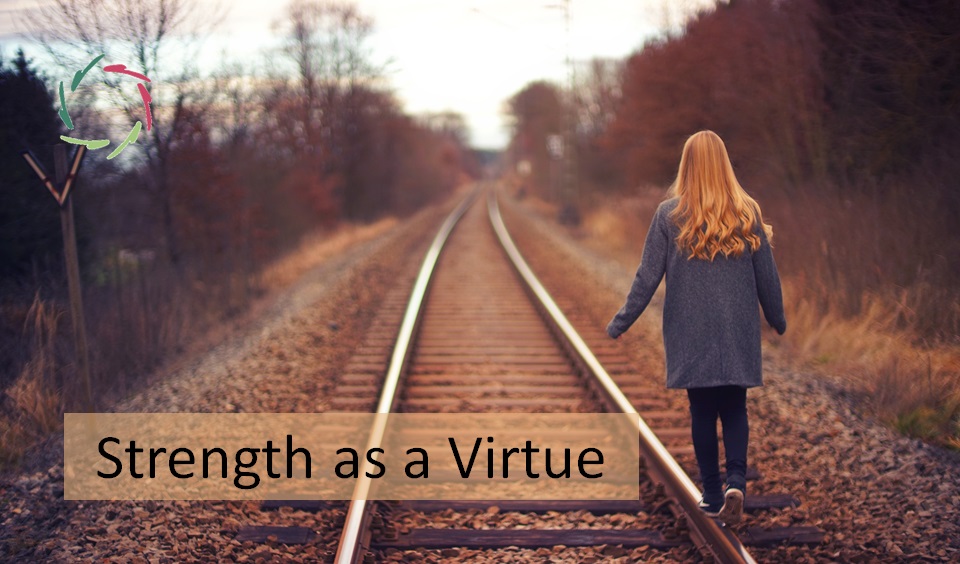
“Show your weakness.” OK? Virtue is not always related to plain strength. More than ‘showing weakness,’ isn’t ‘avoiding weakness’ not more virtuous?
The etymology
of virtue or virtuous: ‘characterized by moral excellence, valor, strength’ and also: ‘manliness, courage, bravery.’ In ancient Rome, virtus was mainly important as a male adornment. Vir is Latin for ‘man,’ also found in virility.
Womanly
For women, ‘virtue’ has traditionally rather been associated with chastity or sexual purity. To me, less interesting. This text is not about that.
A woman can also be virtuous in the ‘manly’ sense, without being overly ‘man-ly’ in any negative way. Virtuous – as I’m writing about it now – is not male in the sense of therefore not being female. People are always more flexible and diverse than would be warranted by such a calcified idea.
And yet, to call it ‘not manly’ would also be a mistake. There is manliness within this quality and which even the most womanly woman can appreciate, including within herself.
Still, as a quality in a man, this is – I cautiously stipulate – attractive for many women as engrained in biology.
That includes physical strength.
In this, biology obviously made things easier for my sex.
Ethically, if a man is not in the disposition of having much strength (illness, constitution), he is not ‘less of a man.’ At the other side, a work-out at the gym is not just a waste of time for brainless muscle-builders. It’s – if wisely done – good for the body itself. It builds discipline. It’s ‘virtuous.’
It may also help you – male or female reader – to feel alive. This may be the best you can do for your health, physically and mentally. That is, of course, in ex-aequo with using AURELIS 😉 .
I like to go to the gym (while listening to podcasts).
Writing this text, I haven’t been able to go for a week. I already miss it. I like to feel physically strong. I like my physical strength. Sometimes, I over-exercise. Hm, not very smart.
Someone once told me that “a real man regularly needs to do something stupidly exaggerated.” That is arguably part of being virtuous.
Not only physical strength
Indeed, I was a bit carried away just now…
Within the ancient ‘virtuous’ definition, there were already several moral elements. That was back in those days the way to relate to the psychological, even more: the deeper part of it. Note:
Inner Strength in AURELIS.
It’s ethically good to strive for this. It makes one a better person. It makes the world a better place. It even ‘makes the world great again’ without zero-sum policies or any aggressive ‘us versus them’ which in the end makes things worse for all.
‘Us versus them’ is not anymore the way in which things can be optimized for anyone. It wasn’t even so in Roman times. That’s why we don’t speak Latin.
According to me, we need now more than ever deeply virtuous, male-based strength in every aspect.
Not being afraid of virtue. Not being afraid of strength.
Not being afraid of excellence. [see: “Excellence”]
Not being afraid of depth.
Related Posts

Is All Learning Associational?
Most probably. This is a domain where animal/human learning and A.I. learning can learn much from each other. Three forms of learning in A.I. Generally, learning in A.I. is divided into two distinct kinds, with a third one dangling in the appendix, referring to another book (*). supervised learning: training with specific input and labeled Read the full article…
No Villains, Only People Struggling to Live
Compassion is not about being naive. It is about being deeply aware — of pain, of patterns, of possibility. What we call evil may be the surface of a long chain of hurt. Yes, people do terrible things. Some hurt others deeply. But are they ‘villains’? This blog explores another possibility: that beneath every hardened Read the full article…

Le Mépris (‘Contempt’)
Sometimes what we feel isn’t rejection or anger, but something more difficult to name — a sorrow for unseen beauty, and for what others refuse to become. This blog explores le mépris, not as coldness, but as a subtle kind of pain, and how it can be held with Compassion. A quiet pain There is Read the full article…