Open Letter to Jeffrey Sachs
Humanity stands at a strange crossroads. We are more knowledgeable than ever yet often seem less able to act wisely with that knowledge. Many voices today speak with clarity about global crises – economic, ecological, geopolitical – and among them, Jeffrey Sachs stands out.
This letter starts from that recognition but moves toward a question that may lie beneath the surface of current discourse. It is a question not only for one person, but for anyone who senses that something essential remains unaddressed.
Opening
Dear Jeff — and anyone concerned with the fate of humankind,
You are among those who articulate today’s global challenges with rare clarity and urgency. Your work helps many see the systemic nature of crises that too often appear fragmented. Precisely for that reason, this letter raises a question that may seem to step outside this frame — yet perhaps goes to its very core. It is not written in opposition, but in continuation.
The central question
A perhaps blunt question arises.
What if most global problems we try to solve – climate change, geopolitical tensions, inequality – are not primarily failures of policy or coordination, but symptoms of something we still don’t seriously address? In simple terms, what if they reflect a lack of depth in how humans make meaning and decisions?
If that is so, then another question follows naturally: Are we solving the right problems — or mainly their projections?
This may sound abstract at first. Yet it can be brought close to experience. Everyone knows moments when reactions come before reflection, or when deeper motives shape choices without being clearly seen. Now imagine this at scale — across societies, cultures, and institutions.
Recognition of current thinking
Today’s best global thinkers, including yourself, have moved far beyond superficial analysis. There is increasing awareness of complexity, interdependence, and long-term consequences. The language of systems, sustainability, and shared responsibility has become more prominent.
This is a significant step forward.
And yet, even at this level, something may remain largely implicit. The focus tends to stay on what can be conceptualized, measured, and organized externally. The inner landscape – the way human beings inwardly generate meaning, fear, motivation, and identity – remains less present as a structured domain of inquiry.
The missing dimension
I see this as a question of depth.
Not depth as a vague notion, but as something quite concrete: the non-conscious patterns through which people perceive, feel, and act. In more technical terms, this concerns subconceptual processing — the level beneath explicit thoughts where much of human behavior is shaped.
One may recognize this simply as the difference between knowing something intellectually and truly living from it. Policies, agreements, and strategies often operate on the conceptual level. But their success depends on patterns that lie deeper. When those patterns remain unchanged, surface solutions tend to meet resistance, distortion, or quiet erosion over time.
This is described more broadly in The Fate of Humankind, where multiple global crises are seen as different faces of a single underlying dynamic — a loss of inner depth.
From inner patterns to global crises
When viewed from this angle, familiar issues take on a different light. Geopolitical tensions, for instance, are not only about interests or strategies. They are also shaped by what may be called the ‘enemy complex,’ where fear and projection define the other ― as explored in The Enemy Complex and Inner War Leads to Outer War.
Climate inaction is not merely a coordination problem. It also reflects a difficulty in connecting deeply with long-term consequences — a kind of dissociation from what is not immediately present.
Economic systems often lose their grounding in meaning, becoming mechanisms that operate efficiently yet without deeper orientation.
In each case, what appears as a structural issue is intertwined with inner patterns. This does not replace existing analyses. It adds a layer that may explain why many well-designed solutions struggle to take root.
Why this remains invisible
A particular difficulty arises here.
The very patterns that shape behavior are largely non-conscious. This makes them hard to observe directly, both individually and collectively. Moreover, our cultural tools – education, media, policy frameworks – are predominantly geared toward conceptual clarity and external action. They are less equipped to engage with deeper layers.
There is also a human aspect. Looking inward can be uncomfortable. It may touch uncertainty, vulnerability, or unresolved tension. It is often easier to focus on external problems than to explore their inner counterparts.
As a result, a loop can form in which symptoms are addressed repeatedly while their roots remain largely untouched.
The cost of flatness
This is not only a philosophical concern. The consequences are measurable in economic terms, in tremendous human suffering, and in lost potential. The cumulative cost of fragmented approaches to health, environment, conflict, and meaning can be seen as enormous.
In The Fate of Humankind, this is described as a kind of ‘flatness madness’ — not as an insult, but as a narrowing of perspective that has become normalized.
What is lost is not only efficiency, but depth of experience, creativity, and genuine connection.
A glimpse of another level
This perspective is not entirely new. In JFK’s 1963 Peace Speech, one can see a moment where politics briefly touched a deeper layer. Peace was framed not merely as a strategy but as an evolution of consciousness — a shift in how people perceive one another. Interestingly, Jeff, your own work has highlighted that period as a turning point.
There seems to be a recognition in this that durable peace cannot arise solely from external arrangements. It requires a change in how humans relate inwardly to themselves and to others.
That insight remains largely unfinished.
Where this leaves current discourse
From this viewpoint, current high-level discourse may be seen as both advanced and incomplete. Advanced, because it recognizes complexity and interdependence. Incomplete, because it often stops at the conceptual level.
This is not a critique of individuals, but an observation about the limits of prevailing frameworks. Even the most thoughtful approaches may encounter difficulties if the deeper layer of human motivation and perception is not explicitly engaged.
Toward integration
What might it mean to include this missing dimension?
Not a rejection of existing science or policy, but an extension. It could involve integrating insights from neurocognitive science, psychology, and practices that engage the deeper mind — such as autosuggestion understood as communication with non-conscious patterns.
Within AURELIS, this is explored as a practical path, not only a theoretical one. The aim is not to control inner processes, but to invite alignment — a movement that grows from within rather than being imposed from outside.
Compassion as intelligence
In this context, Compassion takes on a specific meaning. Not sentimentality, but a form of deep intelligence — the capacity to relate to oneself and others as total beings, including their inner complexity ― as described in Worldwide Compassion and Compassion with a Spine.
Such Compassion does not weaken rationality. It refines it. It allows decisions to be both clear and connected, firm and understanding.
The role of technology
This question becomes even more pressing in the context of rapidly developing technology. Artificial intelligence, for instance, amplifies human patterns. It can reflect and strengthen both depth and flatness.
Without sufficient inner maturity, technological power may intensify existing problems. With depth, it could support new forms of insight and cooperation ― as explored in Why We NEED Compassionate A.I.
Invitation
Although this letter is addressed to you, its scope is broader. The absence of depth is not limited to one person or field. It is a characteristic of much contemporary discourse — in politics, media, and academia. Recognizing this is not about assigning blame. It is about opening a space for something more complete.
This leads back to the initial question: Are we addressing the roots of global challenges, or mainly their expressions?
This blog invites consideration of whether, alongside systems, policies, and strategies, there may be a need for deeper integration — one that includes how humans inwardly shape the world they inhabit.
If this resonates, even slightly, it may be worth exploring further.
Closing
Humanity’s future may depend not only on what we do, but on the depth from which we do it. The challenges are immense, but so is the potential.
Are we solving the right problems — or mainly their projections?
The question remains open.
Related Posts

Balance vs. Synthesis
Where a balancing act can be proper, a synthesis can be powerful. In a synthesis, a deeper connection between elements is sought, which may lead to an unforeseen and original direction. A balance is an equilibrium that doesn’t readily invite originality. In many cases, that’s OK, of course. Finding a balance may defuse tensions, enabling Read the full article…
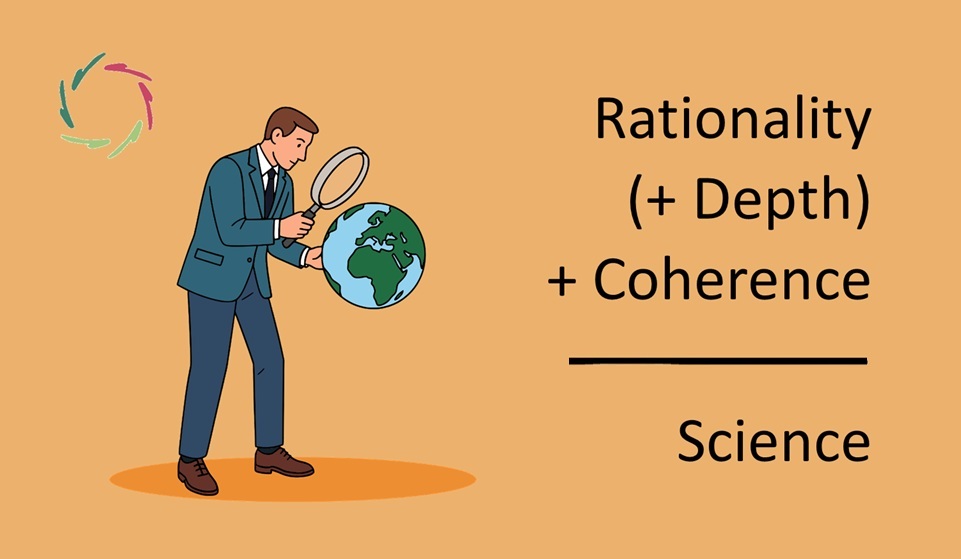
Rationality (+ Depth) + Coherence = Science
Science is often equated solely with rationality. Yet the best science has always relied on more than logic and measurement. This blog explores why rationality needs depth and why both need coherence for science to remain fully scientific. Not as an alternative to science, but as its reclamation. Why this equation matters now Science enjoys Read the full article…

Clouds – Rain
An ‘unsui’ (*) was, in ancient Japan, a kind of monk moving around lifelong from monastery to monastery. Time and again he was fully present in the here and now. And time and time again he was ready to depart ‘here and now’. Not that he was running away from all these places. On the Read the full article…