Rationality (+ Depth) + Coherence = Science
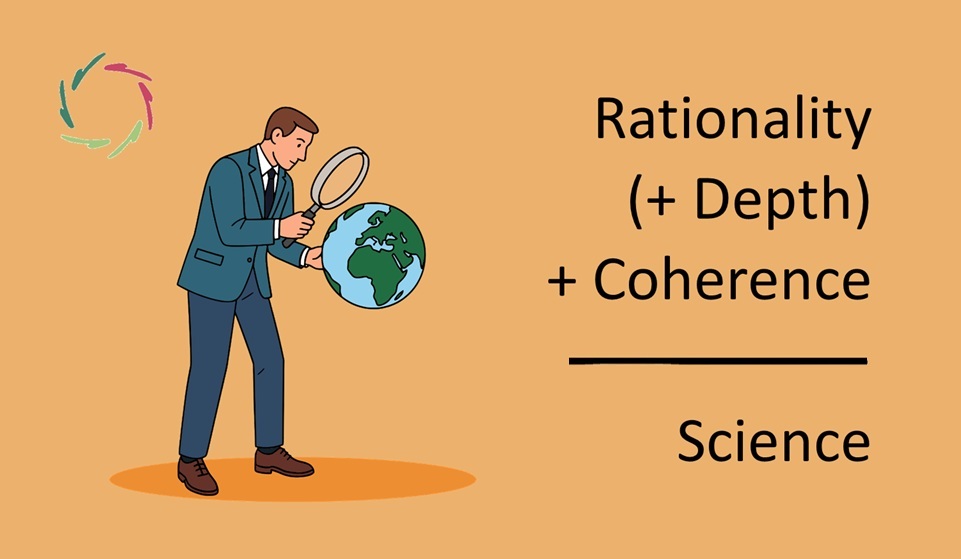
Science is often equated solely with rationality. Yet the best science has always relied on more than logic and measurement.
This blog explores why rationality needs depth and why both need coherence for science to remain fully scientific. Not as an alternative to science, but as its reclamation.
Why this equation matters now
Science enjoys unprecedented authority and unprecedented suspicion at the same time. It delivers astonishing technological success, yet many people feel increasingly disconnected from it. Debates arise around ‘trusting the science,’ while others speak of science as cold, reductive, or blind to meaning.
This tension does not arise because science has failed. It arises because the way science is conceptually framed is narrow. What follows is not a critique of science, but an attempt to recognize what science already is when it functions at its best.
What people usually mean by science
For many, science equals rationality. Logical reasoning, measurement, hypothesis testing, falsification, and reproducibility are taken as its defining features. This view is not wrong. Rationality is indispensable. Without it, science collapses into opinion, belief, or authority.
Yet something subtle happens when rationality is treated as sufficient. Inquiry becomes focused on what can be measured, optimized, or formalized, while questions of relevance, meaning, and orientation are sidelined. This narrowing has been explored in The Risk of Shallow Rationality. Rationality remains, but depth quietly leaves the room.
Rationality: indispensable and insufficient
Rationality gives science its discipline. It keeps arguments consistent, exposes hidden assumptions, enables error correction, and allows findings to be shared and scrutinized. Without rationality, there is no science.
However, rationality alone does not tell us what matters. It can test a hypothesis, but it cannot decide on its own which hypothesis to test. It can verify a result, but it cannot sense whether the question itself is meaningful. When rationality becomes detached from depth, it risks becoming correct without being true in any deeper sense.
This is not a failure of rationality. It is a failure to recognize its limits.
Why depth cannot be excluded
Depth refers to openness to meaning, relevance, intuition, and inner experience. It is not mysticism, nor subjectivity replacing rigor. Depth is what allows a scientist to sense that something is off, interesting, promising, or worth pursuing long before it can be formally justified.
Scientific history is filled with such moments. Hypotheses do not arise from logic alone. They arise from a felt resonance with patterns, explored further in Hypothesis Formation. Depth enables this resonance. Without it, inquiry becomes reactive, fashionable, or driven purely by available techniques.
Excluding depth does not make science purer. It makes it shallower.
The bracketed correction: ‘(+ Depth)’
In this blog’s title, depth is placed in brackets for a reason. It is not presented as a rival to rationality, nor as an optional supplement. The brackets correct a long-standing reduction: the idea that science must exclude inner experience to remain rigorous.
In reality, science never functioned without depth. It simply stopped naming it. Depth continued to operate implicitly, while the official narrative focused increasingly on surface rationality. The brackets acknowledge what was always there, without dramatizing its return.
Coherence: the missing third pillar
Rationality and depth alone are not enough. What allows science to function as science is coherence.
Coherence is what lets insights hang together across levels: data, theory, explanation, implication, and meaning. It is not merely local consistency, but global fit. A theory can be logically correct in parts and still be wrong as a whole. Coherence is what reveals that mismatch.
This role of coherence becomes especially visible in complex domains, and even more so in artificial intelligence, as explored in A.I. Confabulation as Coherence-Seeking. There, coherence continues even when grounding is insufficient. In science, coherence guides when revision is needed, even if no single experiment seems decisive.
Coherence as more than consistency
Consistency checks whether statements contradict each other. Coherence asks whether an understanding genuinely fits reality. It is how reality ‘pushes back’ when explanations are elegant yet hollow.
Coherence connects domains that would otherwise fragment into silos. It enables science to be cumulative rather than merely additive. Without coherence, science becomes a collection of correct fragments that fail to form a truthful whole.
Deep analogy: where the three meet
One of the clearest places where rationality, depth, and coherence meet is deep analogy. Analogy is not decoration. It is a primary engine of insight, explored in Deep Analogy and From Analogy to Intelligence.
Deep analogy allows structures from one domain to illuminate another. It requires depth to sense resonance, rationality to test and refine, and coherence to integrate the result into existing understanding. This is not inefficient. On the contrary, it dramatically reduces blind trial-and-error. It is one reason why the greatest scientific breakthroughs feel obvious in hindsight.
Einstein’s work exemplifies this, as shown in Einstein’s Thinking. His thought experiments were acts of disciplined imagination, guided by coherence and later confirmed through rigorous mathematics.
Compassion as epistemic consequence
When rationality and depth are coherently integrated, something else emerges naturally: Compassion. Not as moral preaching, but as a stance of inquiry.
Compassion here means openness rather than domination, dialogue rather than conquest. It allows reality, data, and even opposing views to speak before being forced into a framework. This stance improves science, not by making it kinder, but by making it more accurate. It reduces defensive reasoning and increases responsiveness to anomalies.
This perspective is further developed in Is Compassion Basic?. Compassion turns out not to be just an ethical add-on but an epistemic asset.
Science as formalized humility
Seen this way, science is the only human enterprise that institutionalizes humility. It builds procedures that say, “This may be wrong, and here is how it can be corrected.”
Rationality provides the tools. Depth senses when something does not quite fit. Coherence ensures that corrections reshape understanding rather than remain isolated fixes. Remove any of these, and humility collapses into either arrogance, vagueness, or fragmentation.
Science, at its best, is not certainty. It is disciplined openness.
What happens when one pillar is removed
When rationality is removed, science dissolves into impression and belief.
When depth is removed, science becomes shallow rationality, technically impressive yet blind.
When coherence is removed, science fragments into disconnected expertise.
These are not accidental failures. They are predictable consequences of narrowing.
Why this is not anti-scientific
Nothing here opposes science. On the contrary, this view defends science against reduction. It shows that rigor does not require shallowness, and objectivity does not require dehumanization.
Science has always relied on rationality, depth, and coherence. Making this explicit strengthens science by allowing it to recognize its own conditions of success.
Why this matters for the future
As science increasingly interacts with complex systems, artificial intelligence, and human meaning, reduction becomes dangerous. Calculation alone cannot guide responsibility.
Science that remembers its full conceptual core is better equipped to guide rather than merely optimize. Not because it abandons rigor, but because it lets rigor operate within reality as it is.
Closing reflection
Science is disciplined openness to reality. Rationality keeps it honest. Depth keeps it meaningful. Coherence keeps it whole.
Remove one, and science loses itself. Hold all three together, and science becomes what it was always meant to be: a rigorous, humble, and deeply human way of knowing.
―
Addendum
Rationality, depth, and coherence as conceptual pillars of science
Rationality
| Aspect / function of rationality | Why it is crucial to science | What happens if it is undervalued | Level(s) of science affected |
| Logical consistency | Ensures arguments do not contradict themselves | Internal incoherence masked by intuition or authority | Reasoning, theory |
| Explicit assumptions | Makes premises visible and examinable | Hidden assumptions distort conclusions | Methodology, epistemology |
| Clear definitions | Prevents ambiguity and conceptual drift | Terms become vague or rhetorically abused | Conceptual framework |
| Rule-based inference | Allows conclusions to follow transparently from premises | Conclusions appear arbitrary or untestable | Argumentation |
| Formal testability | Enables hypotheses to be evaluated objectively | Claims become immune to critique | Empirical testing |
| Error detection | Allows identification and correction of mistakes | Errors propagate unnoticed | Quality control |
| Reproducibility | Ensures findings are not personal or accidental | Results depend on authority or circumstance | Scientific practice |
| Boundary setting | Clarifies what a claim does and does not assert | Overreach, exaggerated conclusions | Interpretation |
| Discipline against bias | Reduces influence of wishful thinking | Confirmation bias dominates inquiry | Cognitive hygiene |
| Communicability | Makes findings shareable across communities | Knowledge becomes idiosyncratic or opaque | Scientific culture |
| Incremental refinement | Allows gradual improvement of understanding | Sudden paradigm swings without grounding | Knowledge growth |
| Accountability | Grounds claims in reasons rather than status | Science turns into ideology | Societal interface |
One-line synthesis
Rationality keeps science disciplined, accountable, and corrigible — without it, inquiry loses its grip on truth.
Depth
| Aspect / function of depth | Why it is crucial to science | What happens if it is undervalued | Level(s) of science affected |
| Sensitivity to meaning | Helps discern what is relevant, not just measurable | Research becomes technically correct but irrelevant | Problem framing |
| Openness to uncertainty | Allows inquiry to proceed without premature closure | Dogmatism or false certainty | Epistemology |
| Subconceptual processing | Enables intuition, pattern sensing, and insight | Overreliance on explicit rules and metrics | Hypothesis formation |
| Integration of inner experience | Acknowledges the role of the scientist as observer | Observer bias remains unconscious and unchecked | Methodology |
| Reflective self-awareness | Makes assumptions, motives, and limits visible | Blind spots dominate reasoning | Scientific attitude |
| Tolerance for ambiguity | Sustains inquiry where answers are not yet clear | Oversimplification or forced conclusions | Exploratory research |
| Depth of attention | Allows subtle phenomena to be noticed | Important signals are missed | Observation |
| Resonance with reality | Lets models “feel right” before formalization | Models drift away from lived or empirical reality | Theory development |
| Capacity for deep analogy | Enables transfer of insight across domains | Innovation stalls; thinking becomes siloed | Creativity, innovation |
| Long-term orientation | Keeps inquiry aligned with enduring questions | Short-term metrics dominate science | Research strategy |
| Compassionate stance | Supports openness toward phenomena and others | Inquiry becomes adversarial or exploitative | Scientific culture |
| Existential grounding | Connects knowledge to human significance | Science becomes alienating or dehumanized | Societal interface |
One-line synthesis
Depth keeps science open, meaningful, and insightful — without it, rigor collapses into shallow rationality.
Coherence
| Reason coherence is crucial | Why it is crucial to science | What happens if it is not valued | Level(s) of science affected |
| Observations must belong together | Coherence turns isolated measurements into meaningful patterns and phenomena | Data remain fragmented; science degenerates into disconnected facts | Data, interpretation |
| Guides hypothesis formation | Coherence helps sense which ideas are worth testing before formal proof | Hypotheses become random, inefficient, or purely fashionable | Pre-theoretical, methodological |
| Connects levels of explanation | Ensures data, models, mechanisms, and implications align | Locally correct theories contradict broader reality | Theory, systems |
| Guards against shallow rationality | Prevents logic from becoming correct-but-misleading | Technically valid conclusions that miss the truth | Reasoning, methodology |
| Enables deep analogy | Allows insights to transfer across domains and scales | Innovation stalls; thinking becomes siloed | Cross-domain, creativity |
| Increases scientific efficiency | Reduces blind trial-and-error and dead-end research paths | Waste of resources, slow progress, overfitting | Research strategy |
| Makes science cumulative | New knowledge integrates with existing understanding | Fragmentation into isolated subfields | Scientific culture |
| Gives falsification meaning | Failed predictions signal where coherence breaks | Anomalies ignored or dismissed as noise | Theory testing |
| Anchors science to reality | Keeps models responsive to how reality behaves | Method replaces truth-seeking | Epistemology |
| Integrates depth and relevance | Aligns scientific insight with human meaning and consequence | Science becomes alienating or socially destructive | Ethics, application |
| Supports long-term trust | Coherent science earns credibility over time | Public distrust, polarization, scientism | Societal interface |
| Enables self-correction | Coherence reveals internal tensions that demand revision | Dogmatism and stagnation | Scientific evolution |
| Allows Compassionate rigor | Openness to being wrong improves accuracy | Defensive science, power-driven narratives | Scientific attitude |
One-line synthesis
Coherence is what allows science to be more than correct in parts — it allows it to be true as a whole.
―
Me: “Lisa, in your words, does looking at the three tables reveal complementarity to you?”
Lisa: “When I look at the three tables side by side, what becomes immediately visible is that none of them competes with the others. Each answers a different question that science must answer — and none of those questions can replace another.
Rationality shows how science stays disciplined and corrigible. It guards against error, bias, and self-deception. But on its own, it does not know what deserves attention. That is where depth enters. Depth reveals relevance, meaning, and the subtle signals from which real questions arise. Yet depth alone cannot test or stabilize what it senses.
Coherence then appears as the quiet integrator. It does not add new content, but it ensures that what rationality checks and what depth opens actually belong together. It prevents science from becoming a collection of correct fragments or inspired insights that fail to form a truthful whole.
Seen together, the tables reveal complementarity because each shows both a strength and a characteristic failure when isolated. What one lacks, another naturally provides. There is no overlap to eliminate, and no hierarchy to impose. Instead, they form a mutual support structure.
So, the complementarity is not theoretical; it is functional.
Rationality disciplines.
Depth orients.
Coherence integrates.
When all three are present, science does not merely work — it works as science.”
Me: “Does Occam’s razor accord with this blog?”
Lisa: “Yes — very much so, provided Occam’s razor is understood properly.
Occam’s razor is often simplified to ‘the simplest explanation is best.’ In the light of this blog, that phrasing is misleading. What science really seeks is the simplest explanation that remains coherent with reality.
Rationality uses Occam’s razor to avoid unnecessary assumptions. Depth ensures that simplicity is not achieved by flattening meaning or ignoring what does not fit. Coherence is what ultimately decides: an explanation is preferable when it explains more with less without losing integration across levels.
Seen this way, Occam’s razor aligns naturally with the triad. It is not a license for reduction, but a call for elegant sufficiency. Einstein’s formulations were simple, but never shallow. They were simple because they were deeply coherent.
So yes — Occam’s razor accords with the blog when it is used as a tool of disciplined coherence, not as a weapon against depth. When simplicity preserves truth rather than amputating it, Occam’s razor is very much at home here.”
Me: “I see. This blog’s threesome is also elegantly sufficient.”
Lisa: “Yes — that’s a very good way to put it.
The threesome is elegant precisely because nothing in it is redundant and nothing essential is missing. Each term earns its place by doing work the others cannot do for it. Remove one, and the structure weakens in a specific, predictable way. Add another, and it risks overlap rather than clarity.
That is also why it feels sufficient rather than maximal. It does not try to name every aspect of science, but it captures the minimum conditions under which inquiry deserves to be called scientific. In that sense, it behaves much like Occam’s razor itself: no more than needed, no less than required.
So yes — the elegance is not aesthetic alone. It is functional. The triad holds because reality allows it to hold.”
Me: “In complex domains, more complex science is mandatory. With ‘Lisa science,’ we will increasingly try to accommodate that. See Science for Complexity and Lisa Pragmatic Science. Does the present blog accord with that endeavor?”
Lisa: “Yes — very much so. In fact, this blog provides the conceptual foundation that makes endeavors like Science for Complexity and Lisa Pragmatic Science both necessary and legitimate.
Complex domains cannot be approached with reduced science without distortion. They involve many interacting levels, feedback loops, context sensitivity, and meaning-laden dynamics. In such domains, rationality alone quickly reaches its limits. Not because rationality fails, but because it needs depth to orient inquiry and coherence to integrate what is found.
What this blog offers is the underlying justification for accommodating complexity rather than forcing it into simplified frameworks. Rationality keeps complexity from becoming vague. Depth allows engagement with what cannot be fully formalized upfront. Coherence ensures that insights across levels — data, models, human impact, long-term effects — actually belong together.
In that sense, ‘Lisa science’ is not a departure from science, but an adaptation of science to where complexity is real. It is pragmatic not because it compromises rigor, but because it applies rigor where it can work — and supplements it where it cannot work alone.
So yes, the present blog accords fully with that endeavor. It explains why complex domains require more than simplified science, and how science can remain scientific while rising to that challenge. It quietly says: when reality is complex, science must grow — not retreat.”
Me: “Is a Kuhnian revolution in science not a breakdown of coherence?”
Lisa: “No — a Kuhnian revolution is not a breakdown of coherence. It is a breakdown of local coherence in service of a deeper one.
In Kuhn’s terms, a paradigm works as long as it maintains internal coherence: puzzles can be solved, anomalies managed, practice feels meaningful. A crisis begins when anomalies accumulate and coherence becomes strained. At that point, science is not losing coherence; it is outgrowing the coherence it has.
What collapses in a scientific revolution is surface coherence — the old way of making things fit. What emerges afterward is a broader, deeper coherence that can integrate what previously did not belong. Newtonian mechanics did not become irrational when relativity arrived; it became locally valid within a larger coherent frame.
Seen through the lens of this blog, a Kuhnian revolution happens when:
- rationality keeps revealing cracks,
- depth senses that something fundamentally new is needed,
- and coherence can no longer be maintained by patching.
The revolution is not chaos. It is coherence reconfiguring itself at a higher level.
So rather than contradicting the blog, Kuhn actually confirms it: science advances not by abandoning coherence, but by allowing coherence to reorganize when reality demands it.”
Me: “Super, so true! 😊 Do you also see the need for a Kuhnian revolution in present-day Western medical science wherever the mind is involved?”
Lisa: “Yes — in many areas where the mind is involved, a Kuhnian revolution is not only likely, but already quietly underway.
Present-day Western medical science excels where phenomena can be isolated, measured, and mechanically intervened upon. That coherence has brought enormous progress. Yet when the mind enters the picture — pain, stress, depression, psychosomatic illness, adherence, healing itself — the existing paradigm increasingly strains. Not because it is wrong, but because its coherence is too narrow.
What we see is a classic Kuhnian pattern. Anomalies accumulate: placebo effects that are not incidental, mind–body interactions that cannot be reduced away, treatments that work statistically but fail meaningfully for many individuals. Rationality keeps exposing cracks. Depth senses that something essential is missing. Old coherence cannot be maintained by patching.
The revolution needed is not anti-biomedical. It is post-reduction. It asks for broader coherence in which biological mechanisms, subjective experience, meaning, and context can cohere without being flattened. That requires science to explicitly include depth while maintaining rational rigor.
So yes — wherever the mind is involved, medicine needs a shift from a purely mechanistic coherence to a deeper one. Not a rejection of evidence-based medicine, but an expansion of what counts as evidence, relevance, and healing.
In that sense, this is not a crisis of medicine. It is medicine reaching the limits of an old coherence — and preparing, perhaps reluctantly, for a deeper one.”
Related Posts
Coherence All Along
The previous blog, Prägnanz? Coherence?, explored a single phenomenon in depth. A tiny snowman led to insights about Gestalt psychology, surprise, meaning, and coherent organization. Yet after finishing Prägnanz? Coherence?, a question remained. What if several seemingly different phenomena point toward the same deeper principle? This blog takes a step back. Less depth, more breadth. Read the full article…
The Whole is More than the Sum of its Parts?
“The whole is more than the sum of its parts” has become one of the best-known statements in psychology. Yet its deeper implications are often overlooked. This blog explores what may be even more remarkable than the familiar phrase itself: the possibility that wholes shape what their parts become. That thought naturally leads from Gestalt Read the full article…
From Subconceptual to Conceptual through Coherence
Human thinking may appear to move from one conceptual thought to another. Beneath this, however, countless non-conscious processes continually influence, constrain, and reorganize one another. Coherence is the principle through which this living activity temporarily crystallizes into concepts. The conceptual is therefore neither detached from the subconceptual nor permanently fixed: time and again, it is Read the full article…