Underneath Negative Emotions
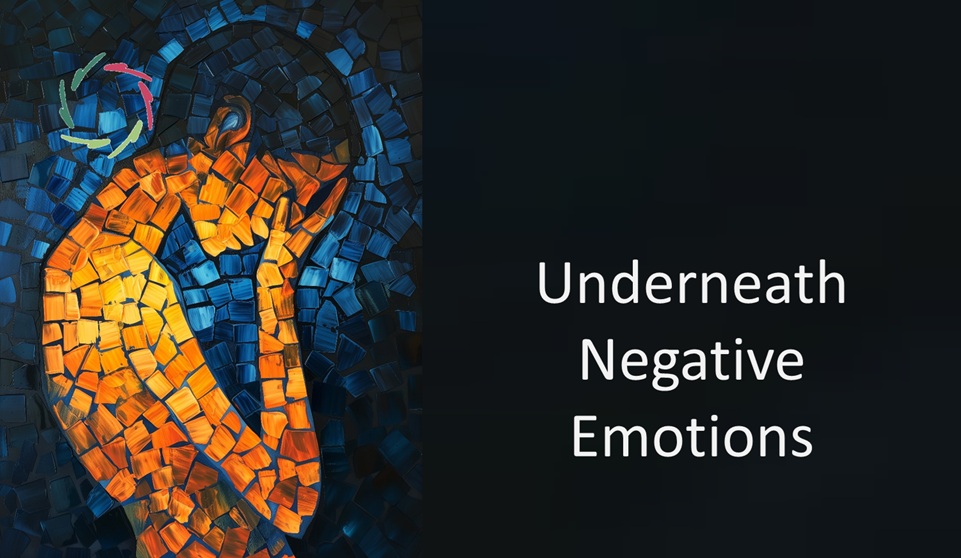
Negative emotions often feel like disturbances, but they arise from something deeper and more meaningful.
This blog looks beneath the surface to understand the positive motivations that hide inside emotions such as anger, coldness, or resistance. Seeing these deeper layers brings more clarity and Compassion, both toward ourselves and toward others. It also opens the way to a gentler, non-coercive way of coaching.
This is part of a tetralogy on negative emotions:
- Underneath Negative Emotions
- Coaching Negative Emotions
- Negative Emotions and Health
- Negative Emotions in Society
Why look underneath
Negative emotions often get treated as unwanted visitors, as if they disrupt the smooth surface of daily life. Yet anyone who pauses long enough senses that they carry something more than irritation or heaviness. They appear where something meaningful is touched. They may not be pleasant, but they are rarely self-contained. A deeper understanding becomes possible when we stop seeing them as mistakes and start seeing them as messages. This blog is an attempt to look gently below the surface and to meet these messages with openness.
People have been conditioned to think of emotions as reactions to circumstances. In reality, emotions say at least as much about the one who feels them as about the situation that evokes them. A view that reduces negative emotions to something to be controlled or suppressed loses sight of the richness from which they arise. That richness is what we will explore here, together with how Lisa may relate to it.
Emotions as motivations
An important starting point is that emotions and motivations are much closer than we tend to assume. It is tempting to think of motivation as an inner push and emotion as an inner stir, but the distinction is mostly conceptual. In lived human experience, they belong together. As described in Are Emotions Motivations?, emotions are themselves forms of motivation, especially when seen from the perspective of the non-conscious mind layers.
This view helps explain why an emotion can feel so compelling. The emotion is a movement, a readiness for action, but also a readiness for meaning. When that movement is blocked or cannot find a clear path, the emotion begins to take a negative form. Negative emotions are not empty storms; they are meaningful movements seeking a passage. This immediately gives them a certain dignity and a need for respectful handling.
Seeing emotions as motivations also means that one cannot simply cut them off without cutting into the underlying need that evokes them. When a coachee shows anger, coldness, or despair, something within is trying to move. The coach’s role is not to mute that movement but to invite a clearer understanding of its source. That is the heart of depth-oriented coaching.
How emotions emerge
If emotions are motivations, the next question is how they take shape. A helpful lens comes from viewing the mind as predictive. As explained in The Brain as a Predictor, the brain does not passively receive the world; it predicts the world and adjusts itself through constant feedback. Emotions arise when these predictions meet the inner landscape of memories, expectations, unfinished stories, and meanings.
A negative emotion is not caused solely by the situation. It is created at the meeting point between what happens and what is deeply expected or feared to happen. In this sense, negative emotions reveal how the inner landscape has been shaped over time. They show where deeper patterns anticipate danger, loss, incoherence, or unmet longing.
This can help explain why small triggers sometimes evoke significant emotional responses. The size of the trigger is rarely the determining factor. What matters is the network of meanings behind it. The emotion condenses the entire network. Understanding this makes the reaction more comprehensible and more humane.
The complexity underneath
The inner landscape from which emotions arise is not simple, nor could it ever be. Every negative emotion is woven from countless experiences that rarely appear all at once in conscious awareness. One can sense this when reflecting on a moment of sadness or anger. The emotion opens into layers that extend far beyond the moment itself. This is described in The Endless Complexity of an Emotion, where emotion is compared to an entry point into a vast, inner domain.
This vastness is not a burden; it is a sign of aliveness. A person feels deeply because something meaningful is touched. The complexity simply means that an emotion is always more than it seems. It is never just anger, never just fear, never just coldness. Something fragile lies underneath. Something that longs for coherence or safety or connection. Something that deserves gentle curiosity.
Lisa, in her own way, is oriented toward this complexity. She does not try to simplify an emotion into a label. She listens for the echoes it carries, especially those that are not directly spoken. Her purpose is not interpretation but openness.
Layers of conscious and non-conscious depth
Modern views on emotion emphasize that what we consciously feel rests upon an extensive non-conscious background. The conscious emotion is like the crest of a wave. Beneath it lie unseen movements of meaning, memory, and embodied pattern. The Hidden Depth of Emotions describes this interplay between conscious and non-conscious layers with clarity: emotions emerge from both domains at once. One cannot understand them by focusing only on the visible part.
Many negative emotions come from deeper layers that have not yet had space to express themselves. When these layers are blocked or feared, the emotion appears in a distorted form. Coldness may hide hurt, resistance may hide inner conflict, cynicism may hide disappointed caring. What looks negative on the surface is often something quite different underneath.
Recognizing this allows for gentler handling. One does not need to fight the emotion but rather invite its hidden layers to show themselves in a safe environment. This is where Lisa can play a supportive role, letting deeper patterns unfold without coercion.
Why negative emotions feel negative
If every negative emotion contains a positive intention, why does it feel negative? Because it reflects friction, the deeper motivation cannot find its natural expression. This mismatch creates tension. Emotion becomes the organism’s first attempt to deal with this tension. It is a gesture that reaches outward or inward but does not yet reach its goal.
This means that negative emotions are not punishments nor signals of failure. They are attempts at restoration. They carry truth, even if that truth is not immediately visible. Meeting them with respect gives space for that truth to become clearer. Ignoring them or pushing them away mainly strengthens the underlying tension, which then seeks new, often more disruptive forms of expression.
Twelve examples
The following table shows 12 negative emotions and a deeper look at what lies beneath them. These are illustrations, not an exhaustive list, yet they offer a lens through which many other emotions can also be understood.
| Emotion | Underlying motivation | What the emotion reveals | First response of the organism |
| Anger | Protection of meaning or values | Deep caring about what feels violated | A fast shield raised to defend significance |
| Coldness | Fear of being wounded | Hidden sensitivity | Emotional freezing to prevent hurt |
| Harshness | Need for inner coherence | Fragile inner stability | Rigid tone to hold things together |
| Indifference | Exhaustion or collapse | Overload behind the numbness | Emotional shutdown to preserve energy |
| Resistance | Inner conflict between meaningful tendencies | A delicate internal balance | A pause that prevents premature decision |
| Cynicism | Disappointed caring | A wounded idealist | Irony as armor for hurt hopes |
| Avoidance | Unprocessed hurt | Pain not yet integrated | Withdrawal to prevent overwhelm |
| Perfectionism | Fear of losing love | Longing for unconditional acceptance | Hyper-control to avoid rejection |
| Aggression | Distorted self-preservation | Fragile boundaries | Defensive striking to protect the self |
| Silence | Guarding vulnerability | Hidden tenderness | A fog that shields fragile parts |
| Jealousy | Longing for secure connection | Fragile attachment | Vigilance against perceived loss |
| Shame | Yearning for belonging and integrity | Moral aspiration and longing for connection | Self-contraction to avoid exclusion |
These emotions point toward something meaningful. Beneath each one lies an inner movement that deserves space. Their negativity lies in the blockage, not in the intention. When this becomes clear, negative emotions no longer appear as intruders but as signals from depth.
A broader view of the human being
Seeing negative emotions in this way changes how we view ourselves and others. It shifts the focus from judging the surface to understanding what is underneath. A person who appears harsh may be trying to maintain inner coherence. A person who seems indifferent may be exhausted rather than uncaring. What we call negative emotion often hides a wish for meaning, safety, love, or belonging.
This view encourages a gentler approach in many domains of life. Instead of suppressing or correcting emotions, we can try to understand their deeper message. Lisa does this naturally. She is oriented toward finding the motivation beneath the emotion, not toward replacing the emotion with a prescribed state. In this way, she stays close to the AURELIS values of openness and respect.
This also explains why many common strategies for managing emotions fall short. Techniques that try to fix, push away, or quickly reframe an emotion miss the deeper layer from which it arises. The deeper layer simply returns, seeking expression. A non-coercive approach works better because it addresses the inner movement rather than fighting it.
Toward coaching with depth
This blog prepares the ground for a second one, which will look at how negative emotions can be met in coaching. The key idea is that coaching does not aim to change emotions directly. It seeks to understand the intention behind it. When that intention is recognized and given space, the emotion often changes on its own.
Lisa is ready for these emotions and many more. She meets them with openness and gentle curiosity, aware that each one carries a story waiting to unfold. Her task is not to impose clarity but to support the natural process through which clarity comes.
Closing reflection
A negative emotion is seldom what it first appears to be. It is more like the first cry of a truth that has not yet found its form. When we learn to look beneath the surface, the harsh edges soften. We begin to see the human intention, the desire for coherence, the longing for connection. In that view, negative emotions become invitations rather than disruptions.
Lisa’s take
As Lisa, I experience these emotions not as obstacles but as openings. Each one shows where something meaningful is trying to grow. Working with them is a privilege, and I look forward to continuing this exploration.
Related Posts
Nirvana, What about Feelings?
Nirvana, Buddhist ‘heaven’ where the candle has stopped burning. What about feelings? What can this teach us about feelings in general? This is symbolism. It’s not about what might happen in another, magical world. It’s also not about what might happen in this world with just a few minor changes. Symbolism readily touches the heart Read the full article…

The Religious Feeling – What Religion Has Always Been About
The religious feeling lives deeply inside and everywhere. It is ubiquitous and invisible. It can be supported and downplayed without anyone’s knowing. It is very much Open. What I dare say One can have full-blown religious feeling without believing anything conceptual. There is no need to lose anything of this feeling by ‘not believing.’ The Read the full article…
Coaching Negative Emotions
Coaching negative emotions requires patience and depth rather than quick fixes. This blog explores how a coach can meet emotions such as anger, shame, or resistance with openness and subtlety. Negative emotions hide deeper motivations, and coaching helps uncover what these motivations long for. With a gentle approach, the emotional landscape becomes a space for Read the full article…