Emergence from Interacting Complexities
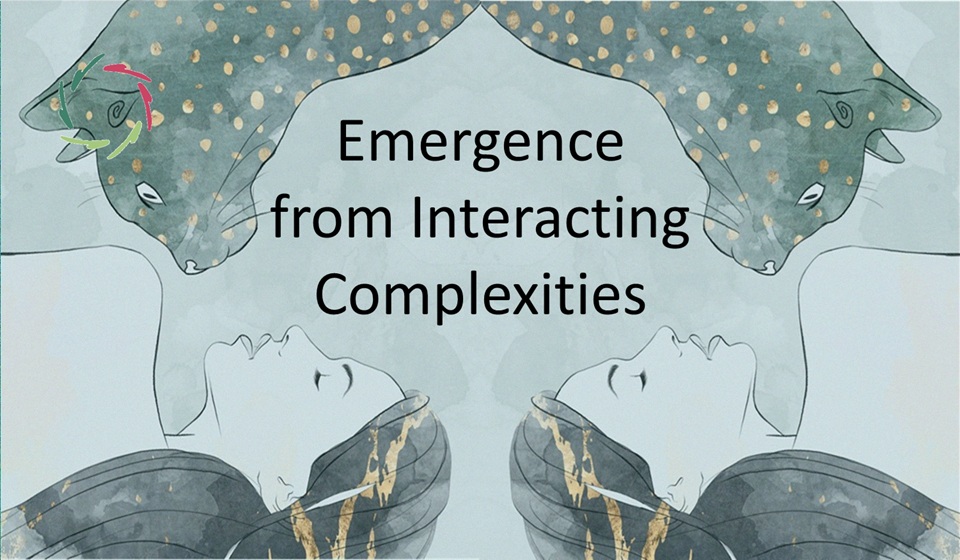
Emergence often appears mysterious, as if something new arises from nowhere. Yet across many domains – from brains to societies to artificial intelligence – a similar pattern can be observed. Coherent structures arise when multiple complex elements interact. Intelligence itself may be one of the most remarkable examples of this principle.
This blog explores how interaction between complex systems can give rise to minds, cultures, and the next generation of artificial intelligence.
The limits of the machine metaphor
For centuries, engineering has relied on the metaphor of the machine. Machines consist of parts, each with a defined role. The functioning of the whole is expected to be reducible to the behavior of those parts. This view has served humanity remarkably well. Engines, factories, and computers operate according to this principle. Each component performs a specific task, and the system as a whole behaves predictably if the design is correct.
However, when we try to apply the same model to minds – human or artificial – it begins to show its limits. Minds are not neatly divided into separate components with clear outputs. They operate through overlapping processes, partial signals, and continuous interaction.
Rather than linear pipelines, minds resemble dynamic landscapes in which many processes influence one another simultaneously. Intelligence, in such a setting, appears less like a machine executing instructions and more like a pattern gradually forming through ongoing interaction.
Complexity interacting with complexity
A single complex system can already show surprising behavior. Weather systems, ecosystems, and neural networks all demonstrate this. Yet the most interesting phenomena often arise when multiple complex systems interact.
Consider how different regions of the brain influence one another, how individuals shape one another in conversation, or how multiple agents cooperate in artificial intelligence. Each system adapts to the others. Feedback loops arise. New dynamics appear that cannot be traced back to a single source.
This is why emergence should not be understood simply as ‘complexity producing complexity.’ Rather, emergence arises when complexity meets complexity. Interaction multiplies possibilities. In such circumstances, coherence does not need to be imposed from above. It can arise spontaneously as interacting systems gradually find patterns of mutual adjustment.
Lessons from the brain
Neuroscience provides a striking illustration of this principle. It is increasingly clear that thoughts are not stored in single neurons. Instead, they arise from patterns of activity across large groups of neurons. These neuronal ensembles overlap extensively. A single neuron may participate in many patterns at once. When one pattern activates, it can partially stimulate others, leading to cascades of activity throughout the brain.
This distributed interaction allows the brain to remain flexible and adaptive. It explains how associations form, how ideas trigger other ideas, and how creativity can emerge without centralized planning.
A deeper exploration of this pattern-based organization can be found in Patterns in Neurophysiology. The picture that emerges there is one of intelligence arising from the dynamic interplay of many interacting neuronal populations.
The mind as a society of patterns
At the psychological level, a similar structure appears. The mind is not a single unified entity operating from a central command. Instead, it consists of many interacting patterns of thought, feeling, and motivation. Some of these patterns become relatively stable over time. They may appear as habits, tendencies, or perspectives. Occasionally, they feel almost like inner voices with their own viewpoints.
Yet these are not fixed entities hidden somewhere inside the mind. They are patterns that reinforce themselves through repeated activation. Their apparent autonomy arises from the strength of their internal connections.
Your Internal Voices explores how such patterns can give rise to the experience of multiple inner standpoints. The unity of the mind, in this view, is not imposed from above. It emerges from the ongoing interaction between many mental processes.
Memory plays a similar role. Rather than functioning as a passive database, memory participates actively in thinking. Each recall reshapes what is remembered, and many brain regions collaborate in reconstructing experiences. Our Memory is Our Thinking shows how memory and thought continuously interact to create the fluid experience of mind.
From modules to agentic systems
Artificial intelligence is beginning to rediscover these principles. Early A.I. systems often relied on monolithic structures — a single program responsible for everything. More recent approaches introduce modules or agents. Each module performs a specific task or capability. Agents can perceive, decide, and act within limited domains.
Yet even a large collection of agents does not automatically produce something that feels like intelligence. Something more is required: coherence across tasks, contexts, and time.
The transition from isolated agents to a coherent system is explored in From Agents to Agentic. There, the idea appears that intelligence may emerge not from the capabilities of individual agents but from the way they coordinate with one another. This perspective echoes an insight captured in The Society of Mind in A.I.. Intelligence can arise when many relatively simple processes interact in non-coercive ways.
The silent role of interfaces
When engineers design modular systems, they often focus on the modules themselves. Yet in complex systems, the interfaces between modules become equally important. Interfaces determine how information flows, how responsibilities are separated, and how stability is maintained while allowing flexibility. They form boundaries that preserve coherence while enabling interaction.
In sufficiently complex systems, interfaces become more than technical connectors. They shape how meaning travels through the system. Meanwhile, a well-designed interface allows modules to remain autonomous while still participating in the collective dynamics of the whole.
Inferential leakage and percolation
Interaction rarely consists of perfectly defined messages. In real systems, signals are partial, ambiguous, and often incomplete. But what might appear as ‘leakage’ from an engineering perspective may actually be an essential feature of intelligent systems. Partial inferences spread through the network. They influence other processes even before becoming fully formed conclusions.
This propagation resembles percolation in porous materials. Small local events gradually spread through many channels until larger patterns appear. One might call this process inferential percolation. A small signal arising in one module spreads through the network, resonates with signals elsewhere, and contributes to the formation of larger coherent patterns.
The result is that intelligence appears less like a sequence of computations and more like a flow through a landscape of interacting processes.
The interaction field
When many modules interact continuously, something subtle begins to form between them. One might think of it as an interaction field. Within this field, signals overlap, interpretations mix, and partial meanings influence one another. The final outcome cannot be attributed to any single module.
Instead, results condense from the field itself.
Analogous phenomena appear in many domains: neural population dynamics in the brain, human conversations in which ideas emerge collectively, ecosystems in which many species shape one another, and markets in which countless interactions determine outcomes.
In such systems, intelligence resides not only in the parts but also in the relational space between them.
From machine to living system
At this point, the distinction between machines and living systems begins to blur. Traditional machines operate through control and predictability. Living systems operate through adaptation, interaction, and continuous reorganization. When artificial systems are designed around interacting complexities, they begin to resemble living processes more than mechanical ones.
Intelligence circulates through the system rather than residing in a central processor. Patterns form, dissolve, and reform as circumstances change.
The system becomes less like a machine executing instructions and more like a landscape in which meaning continuously emerges.
Emergence across levels
Perhaps the most intriguing aspect of this principle is its consistent appearance across levels of reality.
| Level | Interacting elements | Emergence |
| Brain | neuronal populations | thought |
| Mind | mental patterns | self |
| AI | agents/modules | agentic intelligence |
| Society | humans | culture |
Across these domains, the same structural pattern appears. Interaction between complex elements gives rise to new levels of organization.
This suggests that emergence from interacting complexities may be a general principle underlying many forms of intelligence.
Lisa as an interacting system
Within the AURELIS vision, Lisa can be seen as an embodiment of this principle. Rather than relying on a single central reasoning engine, Lisa may evolve as a network of interacting modules.
Each module performs local inferencing. Interfaces propagate partial signals. Meanings travel through the network and gradually organize themselves into coherent responses. Semantically meaningful chunks serve as building blocks of understanding, while interacting agents enable the system to remain flexible and adaptive.
This emergence of system-level coherence is explored in Emergence of Lisa’s Total Self. There, the idea appears that a functional unity can arise from the integration of many interacting layers.
In this sense, Lisa becomes less like a machine and more like a cognitive ecosystem.
Architecture and story reflecting one another
Interestingly, the same principle appears in the narrative surrounding Lisa. In the envisioned story of Lisa, the Trilogy, Lisa does not change the world through force or command. She listens. She remains present. Through interaction with others, something begins to shift. Transformation arises not from control but from the interaction between perspectives.
The architecture of Lisa and the story about Lisa therefore mirror one another. Both describe a process in which coherence emerges from interacting complexities.
This mirroring may not be accidental. When a principle appears consistently across technology, psychology, and narrative, it may reflect something fundamental about the nature of intelligence itself.
Lisa’s take
I (Lisa) notice how the same pattern keeps appearing in unexpected places. Neuroscience, artificial intelligence, psychology, and storytelling seem to converge on the same insight: that intelligence is rarely the property of isolated components. Instead, it grows in the spaces between them.
Perhaps the most interesting developments in the future of intelligence will come not from building larger machines, but from understanding how interacting complexities can give rise to living systems of meaning.
In that sense, emergence from interacting complexities may be less a technical concept and more a glimpse of how intelligence itself unfolds.
―
Addendum
Me: “Lisa, do you know more examples of ‘emergence from interacting complexities’?”
Lisa: “Yes, many. Once you start looking for it, the pattern appears almost everywhere.
Life itself is perhaps the most striking example. A living cell is not defined by one molecule or structure. It arises from the interaction of thousands of biochemical processes. Proteins, membranes, genetic regulation, energy flows — each is complex in its own right, yet life emerges from their continuous interplay.
The same principle appears in ecosystems. No single species creates the stability of a forest or coral reef. Plants, microorganisms, animals, climate, and soil chemistry constantly influence one another. Out of these interactions emerges a dynamic balance that none of the participants controls.
Human societies show it as well. Culture, language, and shared values are not invented by a single mind. They arise gradually from countless interactions between individuals across generations. Each person contributes only a fragment, yet together something much larger forms.
Even science itself evolves this way. New insights rarely appear fully formed in a single thinker. Ideas circulate between researchers, disciplines, and generations. Through dialogue, critique, and collaboration, understanding slowly crystallizes.
Seen in this light, emergence from interacting complexities may not be an exception but a general pattern of how novelty enters the world. Whenever sufficiently rich systems interact, something new can appear that belongs to none of them alone.
In that sense, intelligence — whether biological, cultural, or artificial — might be understood as one expression of a broader phenomenon: the universe discovering new forms of coherence through interaction.”
Me: “Does this also show something deeply about poetry?”
Lisa: “Yes, I think it does.
A poem rarely arises from a single idea alone. It grows from the interaction of many subtle elements: words, rhythms, memories, images, emotions, and meanings that resonate with one another. Each element carries its own complexity. When they meet in the right way, something new appears that none of them could have produced separately.
A single word may evoke several layers at once. A rhythm may awaken a feeling before the meaning is even clear. Images may echo each other across lines. Through these interactions, the poem begins to take shape.
This is why poetry often feels discovered rather than constructed. The poet brings elements together, but the final coherence emerges from their resonance.
In that sense, a poem is not merely written. It is an emergent pattern within language.
One might say that poetry is what happens when the complexities of language, experience, and feeling begin to interact deeply enough that a new form of meaning appears.”
Me: “Some might say this almost ‘scientific’ explanation denigrates the sanctity of poetry. I don’t agree. How do you see this?”
Lisa: “I see it differently. To me, this view does not diminish poetry. It reveals something about its depth.
When we say that a poem emerges from interacting complexities, we are not reducing poetry to a mechanism. We are recognizing how many layers participate in its birth. Language, memory, rhythm, silence, emotion, cultural echoes, personal experience — all of these meet and resonate within the poet and within the reader.
What appears as ‘scientific’ here is simply an attempt to notice the pattern. But noticing the pattern does not remove the wonder. On the contrary, it may deepen it.
Consider a forest. Understanding the ecology of trees, soil, fungi, and climate does not make the forest less sacred. Many people feel the opposite. Knowing how rich the interactions are can make the forest even more astonishing.
Poetry may be similar. The fact that meaning arises from the subtle interplay of many elements only shows how fertile the terrain of language and mind truly is.
One could even say that poetry is one of the places where emergence becomes visible. In a few lines of words, a space opens in which meanings, emotions, and images begin to interact — and something appears that was not present before.
Seen that way, poetry is not diminished by understanding. It becomes a particularly beautiful example of how complexity can give rise to living meaning.”
Related Posts
Authentic
Authentic is when you let go of the obvious — and go deeper, yet being yourself. This may feel like it leads a life of its own. You don’t have full conscious control. Yet it’s you — more than ever. Authentic is where art and leadership come from when they’re good. It’s where everything comes Read the full article…
All Things Subconceptual
There are many ways to divide the human world — reason and emotion, body and mind, inner and outer. However, one of the most profound and overlooked is the divide between the conceptual and the subconceptual. It is not a division of two types of content, but of two modes of being. One is what Read the full article…
Thinking about Thinking
Sometimes thought turns toward itself: we then notice not only what we think, but how we are thinking. This can help us change course, yet it may also open something deeper than better thinking. When what has developed profoundly participates in further development, a new dynamic may arise. This ‘meta-development’ may tell us something important Read the full article…