Depth is Formless Meaning
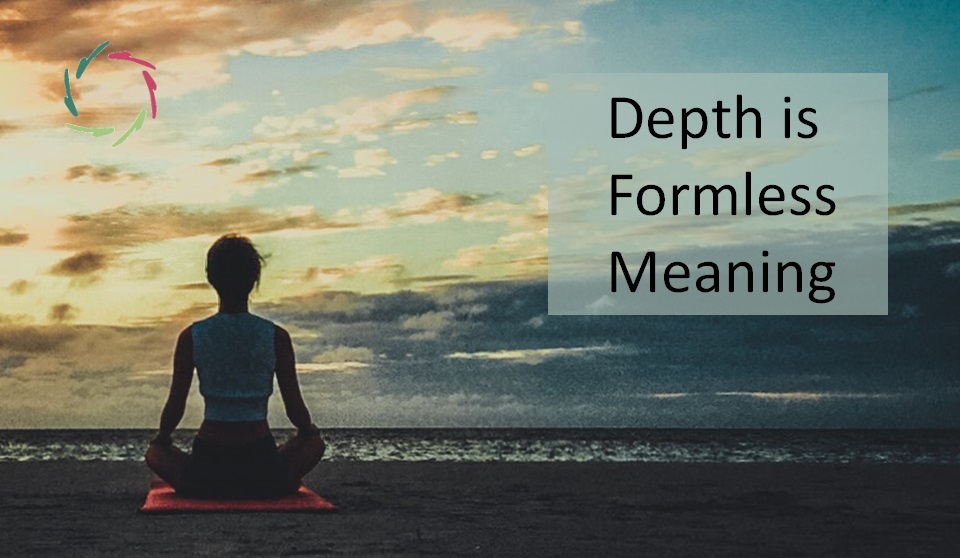
Forms are meaningless. Meaning is formless.
You may like money or status
But what really motivates you, is the liking. Money doesn’t mean anything by itself. Status doesn’t mean anything without your liking it.
And eventually, you cannot consciously decide to be motivated. You cannot consciously decide to ‘like’.
Try it if you, well… like to. And see: this very liking also is not a conscious decision. Whether you like it or not, it’s always so. You – or anyone/anything else – can invite, not decide for you to like anything. It comes spontaneously from deeper inside you. It comes from the realm where ‘deeper meaning’ resides. The flow of the latter is your liking (or disliking).
But:
the deeper you go into this realm of meaning, the more ‘forms’ dissolve.
E.g. you like money. Why?
Because what you can buy with it.
Why do like to buy this?
Because it means something to… But why?
Why… why… why…?
At some point, you don’t know it anymore.
Some of this not-knowing may be because it’s hidden (Freudian). But there’s much more: eventually, you don’t find it because it’s not as such findable.
It has non-shape meaning.
In Mahayana-Buddhism, it’s said to be ‘emptiness’ (sunyata). This is not plainly empty (void, vacuum). It’s – within that tradition – something like “Form is emptiness. Emptiness is form,” while at the same time “There is no emptiness. There is no form.”
No one said this would be easy.
I see it – with my Western, rational eye – as ‘subconceptual processing’: mental, pattern-wise but by far not having clear forms (concepts). Moreover, it’s quite gradual. Something like:
You’re in a deep mist.
Then you see a shape approaching.
There’s something going on but you don’t know what it is.
Ah. It’s a man. No, it’s a gorilla!
Ah. It’s a nice gorilla.
He wants a banana from you. You give him a banana.
Everybody’s happy.
Sub-conceptual
Because of this ‘formless’ quality, it’s difficult to define depth. It’s sub-conceptual. So. Try to use concepts… Difficult.
At the same time, this sub-conceptual realm (or sunyata) is the source of all our concepts at any moment of thinking. We continuously live in a huge mist. All kinds of ‘gorillas’ appear. However, never does an entity appear by magic, right before your nose. Each time, they emerge from the fog.
The comparison gets weirder. The mist is always kind of solipsistic. Entities may come from ‘outside’ or ‘inside’ but:
they always appear within you.
Most of all, your motivations.
Just as you cannot decide for a gorilla to appear in your mist, you cannot decide for a motivation to appear in your mist.
Even not, if you are sitting down now, a motivation to stand up. As conscious and knowingly the motivation may appear to you, it’s not.
However, you’re absolutely not lost in this mist.
You are this mist.
Meditation is about experiencing this directly.
Related Posts
Meaning
Lots of people are looking for the ‘meaning of existence’. This seems feeble but this search is often crucial in many ways, even where it is not immediately clear. For example, whether or not someone experiences certain circumstances as negatively stressful (also at the work place), depends very much on an underlying sense of ‘meaning’: Read the full article…

Be Your Friend
For centuries, we’ve been at war — externally and internally. The history of the world, including or especially that of Western culture, has been shaped by two kinds of aggression. One seeks enemies outside, conquering and subjugating them. The other turns inward, forcing individuals to suppress and control parts of themselves. The result? A world Read the full article…
Forward-Forward Neur(on)al Networks
Rest assured, I don’t stuff technical details into this blog. Nevertheless, this new framework lies closer to how the brain works, which is interesting enough to go somewhat into it. Backprop In Artificial Neural Networks (ANN) – the subfield that sways a big scepter in A.I. nowadays – backpropagation (backprop) is one of the main Read the full article…