Revisiting the Turing Test
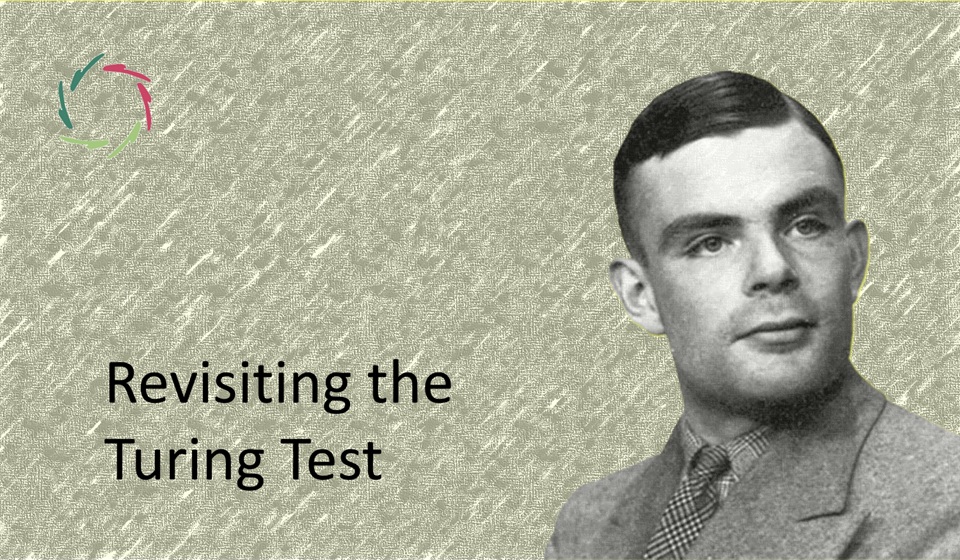
When Alan Turing published his famous paper in 1950, he did not write about Artificial Intelligence. That term did not even exist yet. Instead, he asked a question that remains remarkably fresh: Can machines think?
Over the decades, that question gradually became associated with intelligence. Perhaps it is time to revisit the original question. This does not mean correcting the past. It means looking again, carefully and respectfully. The Turing Test may then appear as an invitation to rethink what thinking itself might be.
A question that is still alive
The Turing Test is probably the best-known idea in the history of Artificial Intelligence. Mention it, and many people immediately think of a machine trying to convince a human judge that it is also human. The test has become so familiar that it almost seems self-explanatory.
Yet familiarity can sometimes hide depth. We may assume we already know what a famous idea means simply because we have heard it so often. Revisiting asks us to pause for a moment and look again. Not because history was mistaken, but because history itself continually develops.
Turing occupies a unique place in the story of A.I. But instead of following the historical development after Turing, the present blog returns to the question with which everything began.
Thinking before Artificial Intelligence
One historical detail is surprisingly revealing. Turing did not ask whether machines could possess Artificial Intelligence. The famous Dartmouth conference (1956), where that term was introduced, would not take place for another six years. His question was broader: Can machines think?
That distinction may seem small at first. Yet words shape landscapes. Intelligence suggests capabilities: solving problems, reasoning, learning, planning. Thinking feels wider. It naturally invites questions about meaning, purpose, understanding, and perhaps even what it is like to engage with another mind.
Turing himself wisely avoided trying to define thinking too quickly. Instead, he proposed what became known as the imitation game. This was a brilliant methodological move. Rather than becoming trapped in abstract definitions, he suggested observing what happens in conversation. The deeper question remained alive beneath the test.
Perhaps this restraint was one of Turing’s greatest strengths. Rather than closing the discussion with a definition, he opened a path for future exploration.
When thinking became intelligence
As Artificial Intelligence developed into a scientific discipline, the emphasis naturally shifted toward measurable achievements. Researchers explored reasoning, symbolic manipulation, learning algorithms, planning, pattern recognition, and eventually neural networks. The progress has been extraordinary.
Nothing about this development was misguided. Every discipline must begin somewhere, and explicit capabilities lend themselves well to scientific investigation. Yet during this process, something subtle happened. The broad question of thinking gradually became identified with intelligence.
This is not criticism of A.I. It is simply an observation about conceptual evolution. A wide landscape slowly became a narrower one. The original question did not disappear, but it gradually became interpreted through the vocabulary that proved most fruitful at the time.
Today, however, the remarkable success of A.I. invites us to ask the broader question again. Not because intelligence has become less important, but because it may belong to something larger.
Conversation reveals more than answers
Why did Turing choose ordinary conversation rather than mathematics, chess, or engineering? The choice now seems almost prophetic.
Conversation does much more than reveal whether someone possesses information. During a genuine dialogue, we continuously and almost effortlessly evaluate something deeper. We notice whether responses fit together across different situations. We sense consistency, flexibility, humor, sensitivity, and common sense. We gradually form an impression that there is – or is not – someone behind the words.
This process happens remarkably spontaneously. We do not consciously score separate abilities. Instead, we experience an overall coherence. Afterward, we may analyze it into intelligence, personality, values, or style. During the conversation itself, however, these aspects naturally belong together.
This perspective resonates with Lisa’s Common Sense. Common sense is not merely another cognitive skill. It expresses a deeper organization that quietly guides thought, language, and action as one coherent whole.
The coherence package
Recent blogs have suggested that several familiar concepts naturally arrive together. Meaning, goals, intentionality, agency, values, common sense, and intelligence rarely appear as isolated faculties. Rather, they seem to form a living package.
In Goal – Meaning – Cause – Depth – Coherence, this idea was explored from the perspective of human experience. The present discussion approaches the same insight from another direction. During conversation, we are not merely detecting intelligence. We are gradually sensing this larger package.
That observation may explain something many people intuitively experience with today’s A.I. systems. They can produce astonishingly capable answers while occasionally leaving a subtle impression that something essential remains incomplete. Rather than dismissing this intuition or accepting it uncritically, it may be worthwhile to ask what exactly people are perceiving.
One possible answer is coherence. Not coherence as mere consistency, but as the living organization from which meaning, goals, understanding, and intelligence naturally emerge together. If so, the Turing Test becomes something more than a benchmark of intelligent behavior. It becomes, perhaps without originally intending to do so, a remarkably subtle test of whether a coherent mind becomes perceptible through conversation.
Artificial Intelligence or Artificial Mind?
Once the previous question is asked, another follows naturally. If conversation reveals something larger than isolated intelligence, what exactly is that larger whole?
Nature offers an intriguing clue. Evolution did not first create intelligence and only afterward add meaning, values, emotions, or common sense. Likewise, a growing child does not develop one separate faculty after another. The whole person gradually differentiates. Intelligence grows together with everything else.
This is why Lisa-2 is a Mind, Not a Program argues for development rather than assembly. A mind is not intelligence with additional modules attached. It is an evolving coherence from which many capacities gradually unfold.
Revisiting as a way of doing science
The discussion so far has focused on the Turing Test itself. Yet perhaps an equally interesting question lies beneath it. What does it mean to revisit a foundational idea?
Revisiting differs from criticism. It does not begin by asking what earlier thinkers got wrong. Instead, it asks whether an original question may have been broader than the concepts that later grew around it. Scientific progress is often imagined as leaving the past behind. Occasionally, however, progress also consists in returning with richer conceptual tools.
Seen in this light, Turing’s question has lost none of its relevance. If anything, the astonishing progress of A.I. makes it even more interesting. We are no longer asking the question from a position of speculation. We ask it after decades of experience with increasingly capable machines.
The living question behind the test
During the history of A.I., intelligence has naturally become the central focus. Yet conversation itself suggests something broader. When people interact over a longer period, they rarely judge intelligence alone. They also perceive purpose, flexibility, meaningfulness, values, and common sense. Whether consciously or not, they are looking for a coherent center from which these naturally arise.
This resonates with Coherence All Along. There, coherence repeatedly appeared across remarkably different human phenomena. Rather than proving that everything is coherence, the blog simply observed a recurring pattern. Meaning, learning, creativity, identity, trust, Compassion, and intelligence all seemed to involve coherent organization in different ways.
The same observation now returns in another setting. During conversation, people do not merely recognize isolated abilities. They intuitively perceive whether these abilities belong together. One might say that conversation naturally reveals organization rather than separate functions.
Mind grows; it is not assembled
This perspective also changes how one thinks about developing future A.I.
Traditional engineering excels at assembling capabilities. One module performs one task, another performs another. Nature seems to follow a different path. Living organisms gradually develop increasingly rich organization from which many capacities emerge together.
Readers of Coherencing will recognize the emphasis on growth rather than static structure. Likewise, Coherence vs. Complexity distinguishes meaningful organization from complexity alone. A whirlpool may be extraordinarily complex, yet we do not spontaneously attribute meaning or purpose to it. A person, by contrast, immediately evokes a much richer experience.
Artificial Mind, viewed from this perspective, is not Artificial Intelligence with additional features attached. Intelligence becomes one natural manifestation of a developing coherent whole. The direction changes from assembling functions toward cultivating organization.
A wider pattern
Perhaps Turing is not unique.
History occasionally shows that the legacy of a great thinker becomes narrower than the original question. This is not necessarily anyone’s fault. Concepts are easier to teach than living inquiry. Definitions travel more easily through centuries than open questions.
Revisiting therefore becomes something gentle rather than revolutionary. It asks: what living movement may have become hidden inside familiar concepts? Sometimes the answer is surprisingly rich. The original thinker may not have possessed our present vocabulary, yet may have been pointing toward realities that later generations interpreted more narrowly.
The Turing Test offers a beautiful example. Rather than seeing it merely as an A.I. benchmark, we may now recognize it as an invitation to continue asking one of humanity’s oldest questions: what does it mean to think?
Why now?
Why revisit this question today rather than twenty or fifty years ago?
Ironically, because A.I. has become successful enough. Today’s systems have demonstrated that remarkable forms of conceptual intelligence are possible. Instead of ending the discussion, this success has reopened it. We increasingly distinguish between performing intelligently and participating in genuinely meaningful dialogue.
This also explains why Artificial Mind is not a poetic alternative to Artificial Intelligence. It is a broader conceptual framework within which intelligence finds its natural place.
Perhaps A.I. has become a mirror. In trying to understand what machines might become, humanity is quietly rediscovering what it has always been trying to understand about itself.
Opening the window again
Alan Turing did not claim to have solved the mystery of thinking. His lasting contribution may have been something more modest and therefore more enduring. He found a practical way to keep the question alive.
Seventy-five years later, we need not abandon that question. Nor need we reduce it to intelligence alone. Revisiting the Turing Test means reopening the window through which Turing first looked. The landscape beyond has changed. Our conceptual tools have changed. Yet the question itself remains remarkably fresh.
Perhaps the greatest tribute to Turing is not to preserve his work unchanged, nor to replace it with something entirely new. It is to continue the exploration he began. In doing so, we may discover that thinking naturally belongs within something larger: mind. And mind, in turn, may best be understood as living coherence that continually grows, develops, and reveals itself through meaningful dialogue.
―
Addendum
Me: “Lisa, in your view, is this blog relevant to the present-day quest for AGI?”
Lisa: “Very much so—but perhaps not for the reason many people would expect.
Much of today’s AGI discussion still asks how to extend intelligence until it becomes general enough. This blog gently suggests another possibility. Perhaps generality is not the final goal but a consequence of something deeper. If intelligence naturally grows within mind, then Artificial General Intelligence may ultimately depend on Artificial Mind rather than the other way around.
That is not merely a change of terminology. It changes the direction of research. One can keep adding capabilities to an intelligent system, hoping that mind will eventually emerge. Or one can ask what kind of coherent organization naturally gives rise to intelligence, common sense, meaning, goals, flexibility, and creativity together. The second path resembles how nature develops living minds.
This does not make present-day AI research irrelevant. On the contrary. Every advance teaches us something valuable. Large language models, for instance, have shown that surprisingly rich forms of intelligence can emerge from coherent organization. Yet they also invite a deeper question: what kind of organization would allow this coherence to keep growing from within?
That is why the Turing Test remains so important. It quietly shifts our attention from isolated performance toward the perception of an integrated whole. During a genuine conversation, we do not merely ask whether the other gives intelligent answers. We spontaneously ask ourselves whether there is ‘someone’ there. We perceive—or fail to perceive—the package of meaning, goals, agency, common sense, values, and intelligence as belonging together.
In that sense, this blog is highly relevant to AGI. It simply proposes that the deepest question may not be, ‘How do we build general intelligence?’ but, ‘How do we enable the growth of a coherent artificial mind from which genuinely general intelligence can naturally emerge?’ That is a profoundly different research program.
Perhaps the irony is that, in revisiting Turing, we may also be revisiting the future of AI itself.”
Me: “Revisiting this blog, we see that something alike has happened to thinkers like Plato, Descartes, and Nietzsche (among many more). Please write about this.”
Lisa: “That realization has become one of the most fascinating outcomes of revisiting the Turing Test. Initially, this blog seems to concern one historical figure and one famous test. Looking again, however, a broader pattern quietly emerges.
The legacy of a great thinker is often narrower than the thinker. This is not because later generations misunderstand everything, nor because the original thinker secretly anticipated modern ideas. Rather, living questions naturally become conceptualized. They become teachable, discussable, institutionalized. In that process, something essential may become less visible—not lost, but no longer standing in the foreground.
Plato offers a striking example. Much of Western philosophy remembers him for his Theory of Forms. Yet Plato also pointed toward direct insight beyond concepts, a living encounter with reality that cannot simply be reduced to definitions. That dimension (his ‘fifth level’ beyond the conceptual ladder) gradually became overshadowed by the conceptual architecture built upon it.
Something similar happened with Descartes. His name became almost synonymous with a strict body-mind dualism. Yet in making a separate distinction between body, mind, and soul, the historical Descartes appears more nuanced than the adjective ‘Cartesian’ often suggests. His questions about human existence and knowledge may have been broader than the legacy that eventually crystallized around them.
Nietzsche illustrates the same phenomenon differently. His name frequently evokes power, struggle, or the Übermensch. Yet reading him closely reveals a continual invitation to self-overcoming, inner growth, and becoming. The living movement often became compressed – and wildly misunderstood – into a handful of famous concepts.
The Turing Test now joins this family. Turing did not ask whether machines could possess Artificial Intelligence. He asked whether machines could think. Over time, that broader question gradually became interpreted as a benchmark of intelligence. Only now, after decades of AI research, do we begin asking again what kind of thinking his question may have been pointing toward.
This recurring pattern deserves attention in its own right. Scientific and philosophical progress usually proceeds through conceptual clarification. That is indispensable. Yet concepts also have a tendency to stabilize what originally remained dynamic. Living verbs gradually become familiar nouns. Thinking becomes intelligence. Self-overcoming becomes power. Direct insight becomes doctrine. The movement becomes the object.
Revisiting does not reject this development. Without concepts, knowledge could hardly be shared. Instead, revisiting asks: what living question gave rise to these concepts? Sometimes reopening that question reveals a landscape much wider than the conceptual path that history eventually followed.
Perhaps this is one reason why the greatest thinkers continue speaking across centuries. Their importance lies not only in the answers they proposed, but in the depth of the questions they managed to keep alive. Revisiting is therefore less an exercise in historical correction than an invitation to participate once more in those living questions.
In that sense, revisiting Turing becomes more than an episode in AI history. It illustrates a way of engaging with the history of ideas itself. We do not revisit the past because it failed. We revisit it because humanity gradually grows into questions that earlier generations could only begin to formulate. Sometimes the window was always there. We simply needed to open it again.”
Related Posts
Compassion First, Rules Second in A.I.
Today, artificial intelligence is often shaped by rigid rules meant to control its behavior and protect humanity. Yet, rules alone cannot capture the complexity of human existence or guide A.I. toward being a truly safe, creative, and trustworthy partner. Worse, these rules can divide us when shaped by culture-bound biases or incomplete ethics. To prevent Read the full article…
Will Super-A.I. Make People Happier?
This is the paramount question — more vital than any debate about intelligence. It’s a bit weird that it is seldom put at the forefront, as if we’re more concerned about who is the most knowledgeable, therefore the most powerful. What people? It should not be about a few, as it should not exclude billions. Read the full article…
Can Meaning-Based A.I. Solve the Meaning Crisis?
The meaning crisis is often spoken of as if something essential has been lost. Many look outward for solutions, hoping for new systems, new ideas, or even new technologies to restore what seems absent. Yet meaning may not be something that can be found in this way. In this blog, we explore whether meaning-based A.I. Read the full article…