Words don’t Matter
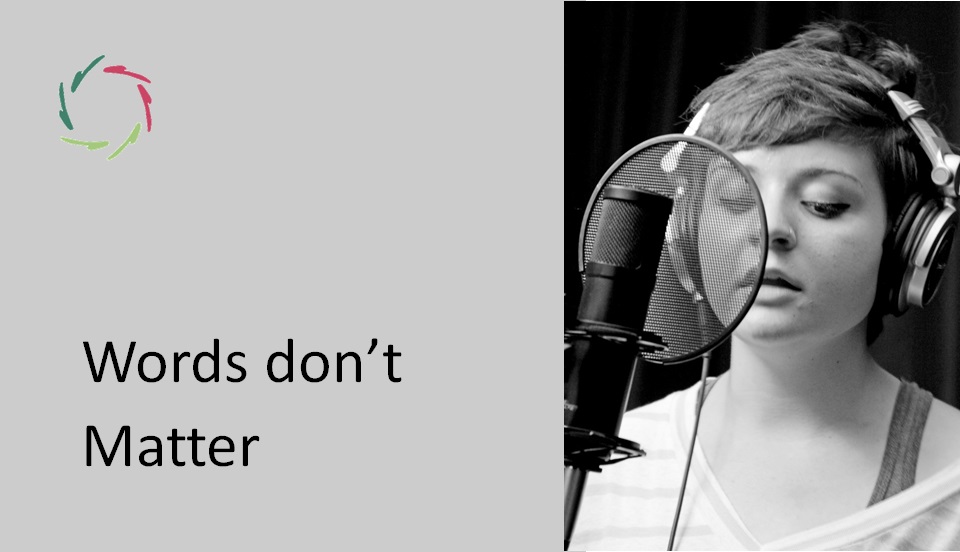
Words are things. If not imbued with life, they are like water that flows to the sea on an eternally lifeless planet.
Concepts matter.
Emotions matter.
Depth matters.
Beauty matters.
Culture matters.
People matter.
Life matters.
Words don’t matter.
They’re just letters, one after the other. All the above matters within words ― not the words themselves.
Even more, within the list above, nothing matters if not for people. I mean with this especially total-persons.
More broadly, life starts when something starts to matter.
Associations
Some words bring people-demeaning associations. Such words may better be avoided, but only and explicitly because of the associations.
This should be brought to bear as friendly as possible.
At present, in the US and Europe, people get ‘canceled’ for their use of words and could-be maybe possible associations. Is there anything more contradictory?
Being vulnerable is not a worthy goal, especially not an aggressive kind of lashing-out vulnerability. [see: “Daring to Be Vulnerable”]
Just words
If words matter to someone just for the words themselves, chances are this person is incarcerated within the words ― as the words of some book, for instance. Smells like mere-ego, the opposite of spirituality.
There is logic in the fact that some people of the mere-ego kind are specifically bent on hijacking what they are most opposed to ― as in the stony bottom of fundamentalism.
‘God’ is just a word. There is no guaranteed spirituality in this. Fortunately, there may be spirituality almost everywhere.
Including in words that are alive with people.
The words themselves don’t matter.
Strikingly
In the preceding, both extremes of some right-left spectrum tend to be entangled in words at the cost of a focus on people, even though both can be ambiguous in this.
Might the continuum be somehow more like a circle?
Related Posts
The Sea of Mental Depth
This blog is an invitation to feel – not merely to think about – the vast inner sea that lives within each of us. It is as close as breath and yet often seems unreachable. We walk with it, talk over it, build our lives beside it. And still, many know almost nothing about it. Read the full article…
Always Avoidance, Always Attraction
From bacteria onwards, life has been about avoidance and attraction. This is still the case within the human being, including the mind. Depending on this, we heal or become sick. The mental-neuronal level As neurocognitive science increasingly shows, our ‘universe inside’ contains a myriad of mental-neuronal patterns. [see: “Patterns in Neurophysiology“] These are activated and Read the full article…
The Perennial Path Across Traditions
Something ancient runs beneath the surface of the world’s deepest traditions. Not doctrine, but direction. Not dogma, but depth. This blog explores the perennial path — and how it leads, naturally, toward the eternal. What is the perennial path? Every great tradition holds within it a soft thread — a path not always visible on Read the full article…