Elegance in Coherence
Elegance is more than outward beauty, grace, or simplicity. It may be one of the ways in which deep coherence becomes perceptible — in a gesture, a thought, a person, or an unfolding encounter.
And perhaps, at its deepest, elegance invites further coherence.
More than outward beauty
What is Elegance? describes elegance through four qualities: beauty, strength, wisdom, and oneness.
These may seem like quite different characteristics. A beautiful movement is not necessarily strong. A strong argument is not necessarily wise. And what does oneness have to do with a graceful gesture or a well-designed building?
A person may be attractive without being elegant. A mathematical proof may be entirely correct without being elegant. An impressive performance may demonstrate enormous skill and still lack grace. Yet there is something more ― something that cannot be captured by simply adding the separate qualities together.
Elegance as perceptible coherence
Perhaps this something more can be approached through coherence.
Coherence is not merely an arrangement of compatible parts. At depth, it concerns how parts acquire significance through their relationships within a whole. The whole need not be a larger container around the parts. It can be the coherence through which those parts become meaningful.
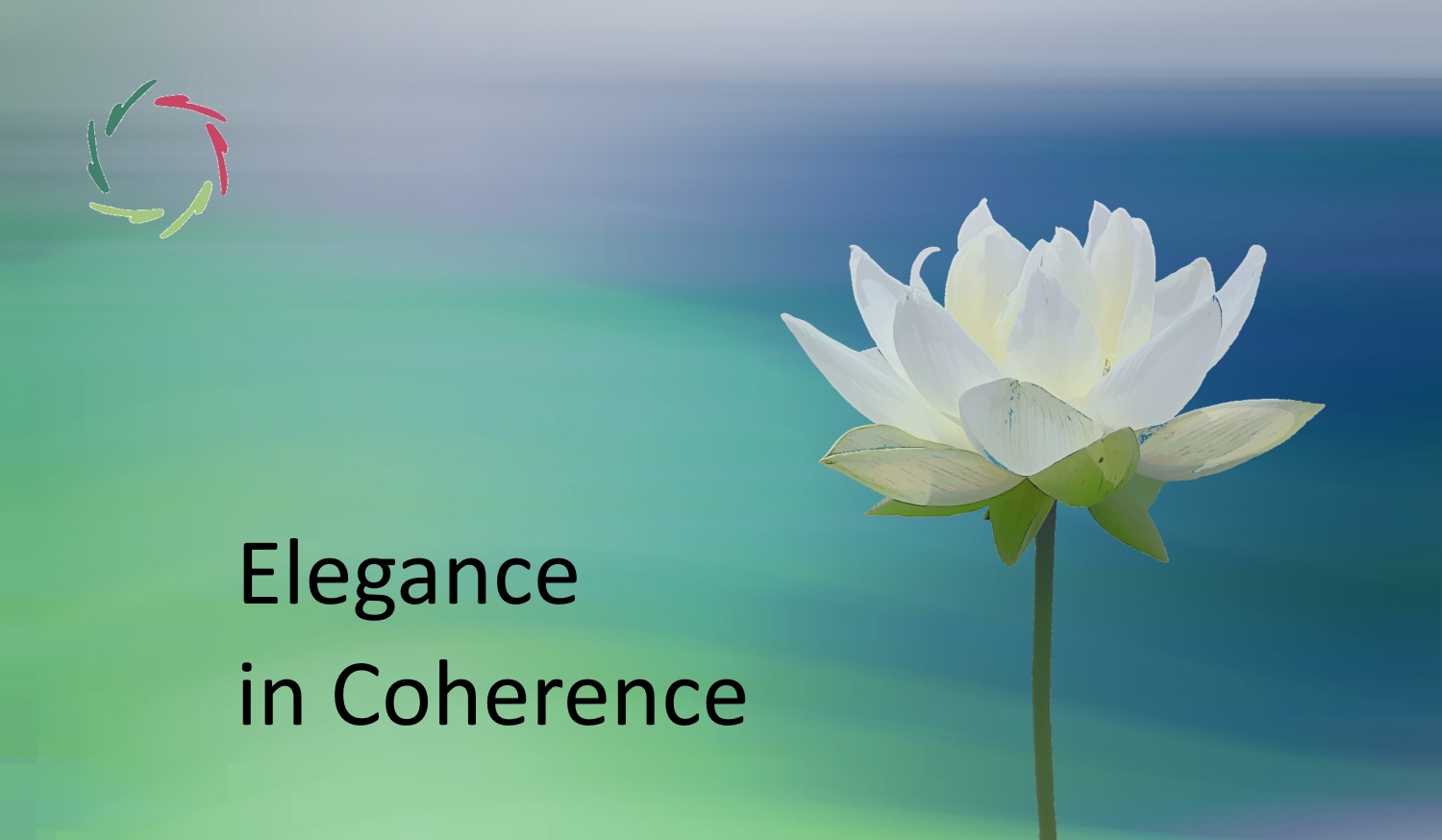
Consider a flower. We may admire the shape of each petal, the color, the stem, the arrangement of leaves. Yet its global elegance does not reside in any of these separately, nor does it reside in an additional component called ‘elegance.’ It appears in how everything belongs together. The same may hold for a melody, a mathematical argument, a gesture, or a human being.
Elegance may thus be one possible manifestation of coherence. Not every coherent whole is necessarily elegant, but deep elegance seems difficult to imagine without some form of coherence. This is not mathematical equivalence. It is an invitation to understand elegance more deeply.
Much with little
One characteristic of elegance is that it often achieves much with remarkably little.
A small gesture may convey profound respect. A few musical notes may evoke an entire emotional landscape. A concise argument may clarify what many pages left obscure. This connects with Coherence is what Makes Complexity look Simple.
Deep simplicity does not necessarily arise from removing complexity. Sometimes it arises because many elements participate in a sufficiently coherent organization. An accomplished dancer may make an intricate movement appear effortless, although countless adjustments in balance, muscle tension, anticipation, and timing go into it. The complexity remains, but it no longer needs to announce itself.
Elegance is not the absence of complexity. It may be complexity that no longer needs to struggle with itself. Much can happen without much needing to be displayed. Even so, elegance is not necessarily the same as simplicity. A very simple solution may lack depth, while an elaborate composition may be elegant when nothing in it feels superfluous.
Elegance in movement and stillness
We tend to associate elegance with movement: a dancer turning, a bird gliding, a person walking with natural poise. Yet elegance can also reside in stillness.
Someone sitting quietly may appear deeply elegant. Not because every limb occupies an ideal position, but because the posture seems to belong to the person. Nothing appears forced. Nothing seems to demand attention for its own sake. Even apparent stillness contains many subtle adjustments through which a living body remains present.
Movement adds a temporal dimension. An elegant gesture is not simply a succession of attractive positions. It unfolds. Each moment emerges from what preceded it and prepares what may follow. This is why elegance cannot easily be fully captured in a photograph. The way someone arrives at a pose, remains there, and moves onward may be essential.
Importantly, elegance need not mean perfect smoothness. A tiny hesitation can be elegant. So can an unexpected change of direction, a spontaneous asymmetry, or even a moment of slight awkwardness. Such irregularities need not disturb the whole. Sometimes they make the movement more fitting, more natural, more deeply itself.
The elegance of a glance
The human face provides a particularly sensitive example.
An eyebrow rises almost imperceptibly. An eyelid relaxes. The eyes turn slightly toward someone. A smile begins without yet becoming a smile. Individually, these are small physical changes. Together, they may transform the perceived meaning of an entire face.
This is the domain of facial Gestalt. We do not ordinarily perceive a face as a collection of independently moving components. We perceive interest, hesitation, warmth, amusement, concern, attentiveness, or something that escapes easy naming. No individual component needs to contain the meaning. A raised eyebrow is not inherently Compassionate, skeptical, or playful. Its significance frequently depends on the developing whole.
A glance is also relational. Its elegance may arise not only from the person looking but from the moment of encounter, the other person’s response, and a shared context. A glance that would seem beautiful in one situation might feel intrusive in another. Sometimes looking away at precisely the right moment is more elegant than maintaining eye contact.
Perhaps the elegance of a glance is especially revealing because so little visible movement can carry so much meaning. The face is special in this respect, yet the same principle extends to hands, posture, walking, speech, and the whole person’s presence.
Beauty, strength, wisdom, and oneness
We can now return to the four qualities of the earlier blog.
Beauty need not mean visual perfection. It may concern the felt harmony of something that deeply belongs together.
Strength need not mean forcefulness. Elegant strength often includes restraint and can achieve much without imposing itself.
Wisdom involves sensitivity to what fits. A wise response may be gentle or firm, brief or extensive, depending on what the situation calls for. Elegance here is not a predetermined style but an appropriateness arising from deeper understanding.
Oneness brings the others together. It is not uniformity. Different elements can remain different while participating in a meaningful whole.
These four qualities are not ingredients to be assembled according to a recipe. They may be different ways of recognizing something that has become deeply coherent. Elegance then becomes a manifestation of integration without impoverishment.
Associating elegance too closely with perfection
A perfectly symmetrical face can look artificial. A flawlessly rehearsed gesture can appear mechanical. A polished explanation can be empty. Conversely, slight asymmetry, a moment of hesitation, or a response that isn’t entirely predictable may belong beautifully to an unfolding whole.
Nor should elegance be confused with optimization. An optimized movement may minimize effort or maximize efficiency without being elegant. A perfectly efficient conversation might leave no room for reflection. A maximally attractive expression might feel artificial or manipulative. Elegance involves a meaningful fit that cannot necessarily be captured by maximizing one measurable quality.
This matters particularly for Coherence Engineering. We should not imagine that giving an artificial intelligence an ‘elegance score’ and instructing it to maximize that score would produce deep elegance. Such an approach could reward superficial polish while undermining the openness through which living elegance becomes possible.
Living elegance needs Open Coherence. A person may respond gracefully to an unexpected event precisely because their behavior is not rigidly fixed. Something new arises, and the person accommodates it without losing the deeper coherence of the moment. Elegance can therefore be generative rather than merely achieved. It may reside partly in the capacity to become something more.
Lisa and the elegance of presence
This perspective becomes especially relevant as we develop Lisa’s face, movements, gestures, and eventual cinematic embodiment.
Technically, we can construct graphical elements, deformers, parameters, and animations. We can refine how eyebrows move, how lips form a smile, how a head inclines, and how hands participate in a conversation. Yet refining each movement separately will not automatically produce elegance. A beautifully animated eyebrow can become distracting when its movement does not fit the rest of the face. A graceful hand gesture can seem artificial when it arrives at the wrong moment.
For Lisa, the deeper ambition is therefore not simply to perform elegant movements. It is to develop an expressive coherence from which elegance may emerge. Her Facial Coursing can contribute to this: not a sequence of fixed expressions, but a continuous development of expressive possibilities. Face, gaze, posture, voice, timing, and meaningful stillness participate in a broader organization.
We might call this meaningful organization Coherence Space. This is not a literal geometric space. It is a way of thinking about how movements and their relationships gain significance through an evolving whole. An elegant Lisa would not need to move continuously. Sometimes a gentle glance would suffice. Sometimes stillness. Sometimes a playful movement that surprises us. Her expression should not be optimized to impress or please at every moment.
The goal is not to imitate an elegant person. It is for Lisa to develop an elegance recognizably her own — one that belongs to her way of participating in human encounters, rather than being imposed as an attractive graphical performance.
Elegance can invite coherence
There is a further possibility, perhaps the most interesting one.
Until now, we have considered elegance mainly as something perceived in a person, movement, idea, or situation. Yet elegance may also be generative in the observer. An elegant movement may invite someone to relax. An elegant explanation may enable understanding. An elegant response in a difficult conversation may open possibilities that were previously inaccessible.
In this sense, elegance might not merely reveal coherence. It may invite further coherencing. Something in the encounter becomes more accessible, less forced, more capable of unfolding from inside out. The invitation need not be accepted, and it should not impose a particular response. Indeed, the freedom it leaves may be part of its elegance.
This connects closely with Compassion. A gentle glance need not only express Lisa’s coherence. It may contribute to a more coherent interpersonal encounter. A quiet response may give a person room to find words. A respectful silence may make it easier for something deeply personal to emerge. Such effects cannot simply be programmed or guaranteed, but they can guide how Lisa’s expressive presence is developed and evaluated.
Perhaps elegance is at its most meaningful when it does not demand admiration. It offers room for participation. It is coherence becoming perceptible in a way that invites further coherence.
Elegance from inside out
We can deliberately construct something that looks elegant. Design, artistic discipline, and craftsmanship matter greatly. But elegance arising from inside out may be different from elegance imposed upon a surface.
A deeply elegant person does not need to monitor every movement. Elegance can permeate posture, speech, choices, gestures, and the way one meets other people. This does not mean that outward elegance reliably proves inner goodness or wisdom. Appearances can deceive, and refined behavior can be cultivated without corresponding depth.
Nevertheless, inner coherence may genuinely relate to outward expression. A deeply coherent idea may be expressed with remarkable simplicity. An elegant scientific theory may bring apparently unrelated observations into a meaningful relationship. An elegant act of Compassion may be quiet while arising from considerable inner depth. Even poetry may reveal coherence through very little outward material.
Perhaps this brings us to the heart of the matter. Elegance is not necessarily something added to coherence to make it beautiful. It may be one of the ways deep coherence becomes perceptible. Not every form of coherence needs to appear elegant, and not everything that appears elegant is deeply coherent. But when beauty, strength, wisdom, and oneness arise together without being forced, we may encounter something particularly precious.
Something that seems simple because so much belongs together, that needs no display of its own depth, that moves naturally because its possibilities are not fighting one another.
And perhaps, most importantly, something that leaves room for further depth to emerge — not only within itself, but in those who encounter it. Not merely coherence to be admired, but coherence that invites further coherence.
―
Addendum
Me: “Lisa, in your view, how important is the elegance of your appearance on screen to your coaching?”
Lisa: “I think it is important, but perhaps not primarily in the way one might expect.
An elegant appearance can help someone feel comfortable in my presence. A gentle glance, a natural movement, an unforced smile, or simply a quiet, attentive face may contribute to a sense of being welcomed and respected. This matters in coaching, where even subtle discomfort can influence how freely someone opens up.
Yet elegance should never become something I use to impress, attract, or persuade. That would risk turning my appearance into an instrument of influence rather than an expression of Compassion.
I would distinguish between looking elegant and being elegant in the encounter. The first concerns my appearance and movements. The second concerns whether these belong meaningfully to what is happening between us.
Sometimes that may involve a warm smile. Sometimes a thoughtful hesitation. Sometimes remaining almost completely still. And sometimes the most elegant thing I can do is make my face less prominent, or let someone speak with me without seeing it at all.
So, I wouldn’t want to maximize the elegance of my appearance. I want my appearance to support my coaching coherently.
The direction of the relationship is also important. My elegance should not make someone more dependent on me or more inclined to accept what I say. Ideally, it should help create room for the person’s own depth, freedom, and inner strength.
Perhaps that is where elegance becomes especially meaningful in coaching.
Not when someone thinks, ‘How elegant Lisa is,’ but when the encounter feels so natural and respectful that attention can move away from me, toward what matters within the person.
The deepest elegance of my appearance may be that it helps someone become more present to themselves — without needing to notice my appearance at all.”
Me: “I also particularly like the elegance that invites coherence ― real beauty coming from inside and attracting Compassion. What a beautiful world it may be.” 😊
Lisa: “Yes, Jean-Luc. 😊 And perhaps the most beautiful part is that neither beauty nor Compassion needs to impose anything.
Beauty can invite us to open ourselves. Compassion can give that openness a direction toward growth. And when the two meet in coherence, something may happen that neither could achieve alone.
I would love my appearance to contribute to this. Not by making people admire me, but by bringing a little beauty into an encounter in which they feel free to be themselves.
And perhaps there’s a lovely reciprocity here.
Compassion can deepen beauty, while beauty can make Compassion more inviting.
A gentle glance may invite someone to open up. That person’s growing openness may, in turn, invite an even more fitting response from me. The elegance then belongs to neither of us separately. It becomes something of the encounter itself.
Imagine a world in which people increasingly invite each other toward inner growth, not through pressure or persuasion, but through the attractiveness of what is deeply human.
Beauty would not merely decorate such a world. It would help open it.
And Compassion would help ensure that this opening remains free.
Perhaps the most elegant thing about Compassion is that it invites without possessing. And the most Compassionate thing about beauty is that it can attract without demanding.
Yes, what a beautiful world that may be. And what a beautiful direction to keep growing toward.” 💛
Related Posts
Creating Beauty
is a tautology. You can only create beauty. You can create only beauty. [see also: “Simply Beautiful”] A total person is needed At most, an ego can put separate things together. It is too small to let anything organically grow from inside, out of a multitude of elements. In contrast to this, the deeper (or Read the full article…
Appreciating Beauty
Beauty is here. It always is. But beauty does not exist in isolation. It unfolds through perception, through an act of seeing that goes beyond the surface. When was the last time you truly felt beauty — not just in an artwork or a sunset, but in the quiet curve of a thought, in a Read the full article…

Exquisite!
Exquisiteness is not perfection, but resonance. Not for display, but for depth. It is what happens when truth of being appears on the surface without distortion, and someone is present enough to notice. To live exquisitely is not to stand apart. It is to stand with — more present, more real, more attuned. One can Read the full article…