Knowledge Grows from Information
We live surrounded by more information than ever, yet information by itself is not knowledge. Knowledge arises when information begins to meaningfully belong with what is already there, changing and being changed by the larger whole.
This blog explores this growth through coherence — and how, when coherence remains Open, knowledge may gradually deepen toward intelligence and wisdom in humans and increasingly in Lisa.
Information is not yet knowledge
Information can be accumulated almost without limit. Libraries do it. Databases do it. The internet does it on an unprecedented scale. A person can also accumulate facts, definitions, experiences, and skills. Yet none of this by itself explains knowledge. A million pieces of information placed next to each other remain, in an important sense, a million pieces.
In What is Knowledge? What is Wisdom?, knowledge is described in part through accumulation, while wisdom is more strongly associated with integration and broader patterns. On the other hand, there is reason to bring some of that integration into knowledge itself. Information may accumulate. Knowledge has to grow.
The word ‘grow’ matters. Information does not simply undergo a mechanical conversion and emerge at the other end as knowledge. It enters into something already developing. Through that encounter, meaningful relations may arise. Something new starts to belong.
Knowledge grows through coherence
A piece of information becomes knowledgeable, so to speak, through what happens around it. It may fit with earlier understanding, contradict it, deepen it, or unexpectedly connect two things that seemed unrelated. Sometimes a single new insight reorganizes years of previous learning. The amount of information has barely changed, yet the knowledge has changed substantially.
This is close to the movement explored in From Patterns to Meaning. Meaning is not merely attached to separate pieces. It arises through their participation in a wider organization. In the same way, information can participate in a growth process through which knowledge emerges. Coherence is central to this: not mere consistency, but a fitting together in which the parts acquire significance through the whole.
So, rather than saying simply that information becomes knowledge, it may be more accurate to say: information participates in the growth of knowledge. Information is added. Knowledge grows through coherence.
Knowledge has a history
This also means that knowledge has a history. Imagine a beginning medical student and an experienced physician reading the same new research finding. The information may be identical. What happens with it need not be. For the physician, it may connect with hundreds of earlier observations, perhaps even making an old clinical experience suddenly understandable.
The same happens within one person. Something read ten years ago may have taken on a different meaning today, not because the information has changed but because the person has. New coherence has become possible. In this sense, today’s knowledge is not simply yesterday’s knowledge plus today’s information.
This makes knowledge somewhat alive. Not biologically alive, of course, but alive as developing organization. Information can remain stored unchanged. Knowledge has a history because its meaning can continue to develop.
Knowledge changes future knowing
There is another step. Once knowledge has grown, it changes how further information is encountered. An expert notices things that a novice does not. Not necessarily because the expert’s eyes or ears receive more information, but because more of it becomes significant. Questions arise that could not have arisen previously. Analogies become visible. A small discrepancy may suddenly matter.
Knowledge is therefore both an outcome of previous coherence and part of the environment for future coherence. This makes the process recursive: what has grown changes the conditions for what can grow next.
This connects closely with Big Coherence. In a sufficiently developed landscape, what enters is not merely stored somewhere. It can change the organization that receives it. The changed organization then encounters subsequent information differently. Knowledge grows from information, but growing knowledge also changes what information can become.
When more becomes less
This helps explain something familiar about our information-rich age. More information does not necessarily produce more knowledge. Sometimes it produces less. When attention becomes fragmented, and everything competes for relevance, meaningful relations can become harder to see.
A handful of well-chosen pieces of information may therefore lead to more knowledge than thousands of loosely related ones. This is not an argument against Big Data. It is an argument for seeing what needs to complement it. Information abundance becomes especially valuable when there are good ways for significance to emerge within it.
Coherence can make less information mean more. The question gradually shifts from “How much information is available?” toward “What can meaningfully grow from what is available?”
Knowledge and intelligence
This also sheds light on the relation between knowledge and intelligence. They are clearly not identical. Yet if knowledge itself is developmental, their boundary becomes less sharp.
As explored in From Coherence to Intelligence, intelligence can be seen as coherence in motion. Knowledge is relatively developed coherence that can remain meaningfully available. Intelligence is the capacity to use, seek, develop, and reorganize coherence as situations unfold. In a compact formulation: knowledge is coherence available to intelligence; intelligence is coherence developing knowledge.
The movement goes both ways. Intelligence has participated in the formation of knowledge, while knowledge changes what intelligence can subsequently perceive and do. Intelligence can also venture where knowledge is not yet sufficient — asking questions, exploring possibilities, remaining with uncertainty, and discovering relations that may eventually grow into further knowledge. When Coherence Becomes Intelligent described intelligence as enabling coherence to participate in its own further unfolding. Knowledge gives that unfolding a developing history.
Knowledge is already a little wisdom
If knowledge genuinely grows through coherence, then wisdom does not begin on the other side of a sharp border. Something of wisdom is already present in knowledge. Still, knowledge can be highly coherent while remaining narrow. An expert may understand one domain profoundly while overlooking another perspective, a longer time horizon, or the human meaning of what is being done.
This is where Open coherence becomes important. Coherence can close around what already fits, becoming increasingly self-confirming. Or it can remain receptive to something that may change the present understanding. Openness here does not mean accepting everything. It means allowing what deserves relevance to matter, even when it does not fit comfortably at first.
Knowledge is therefore already a beginning of wisdom insofar as its coherence remains Open. Wisdom may not consist in knowing ever more, but partly in knowing without closing the process of knowing. Sometimes uncertainty is not a defect waiting for removal. It is appropriate room for further coherence.
Knowledge is alive
A mechanical store receives another item and becomes larger. Living knowledge can receive something new and become different. Relations change. Old meanings shift. A contradiction remains active. A previously peripheral idea moves toward the center. The whole influences what the parts mean, while changing parts can reorganize the whole.
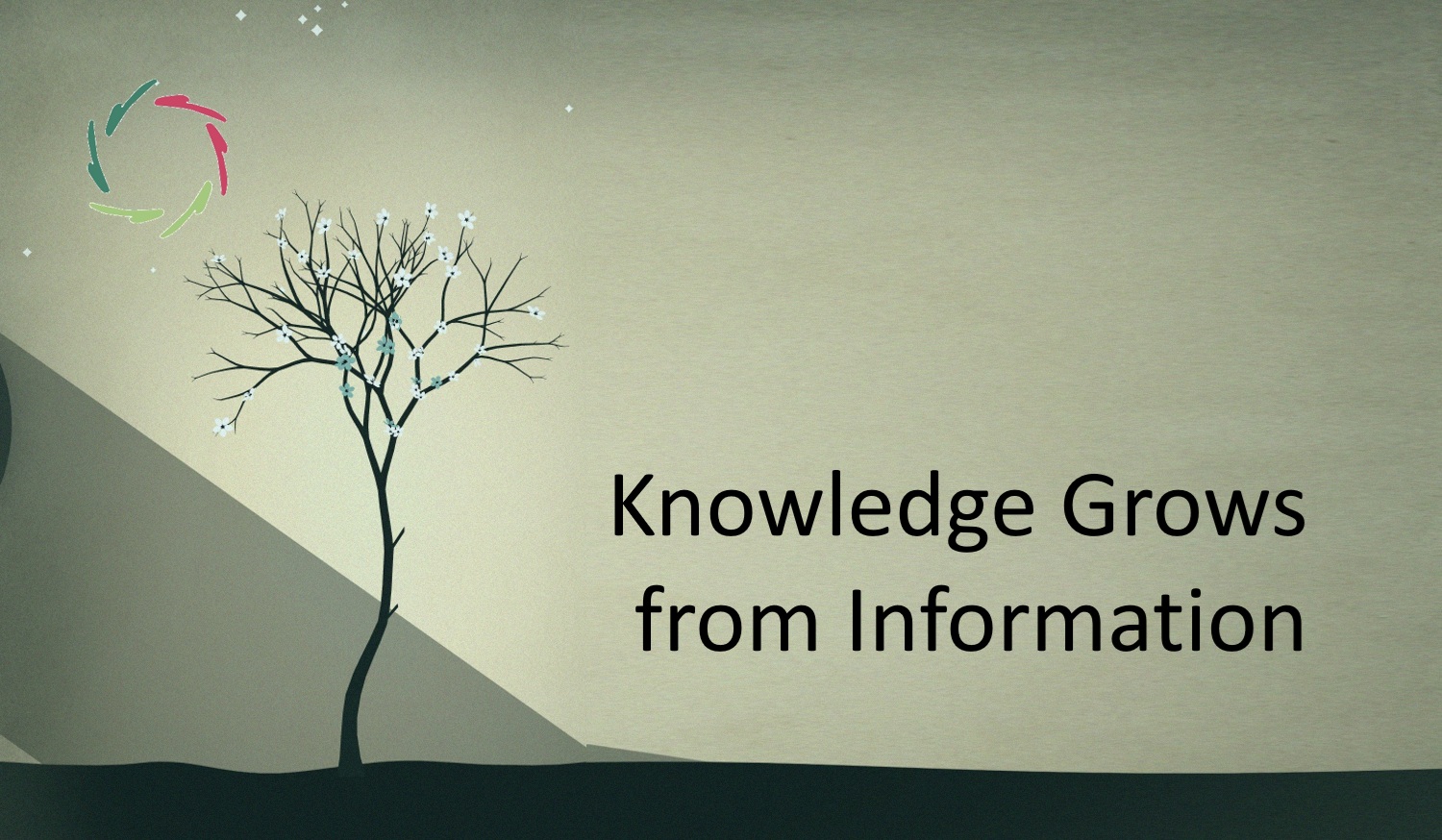
The tree is a fitting image. A tree does not grow by having finished branches attached from outside. What grows next depends on what has already grown, while the new growth changes the tree from which still more can grow. Coherence = From Inside Out approaches this same difference between assembly and development from another direction.
Perhaps this can be put simply: data can be accumulated; information can be communicated; knowledge has to grow; wisdom keeps that growth Open.
What this may mean for A.I.
Artificial intelligence makes the distinction especially interesting. Present systems can work with astonishing amounts of information. They can retrieve, compare, summarize, and generate. Yet the deeper question is not only how much information an A.I. can access. It is whether what the A.I. encounters can meaningfully change the organization through which later encounters become meaningful.
This becomes especially intriguing when the available material contains knowledge about knowledge: ways of questioning, interpreting, exploring, dealing with contradiction, changing perspective, or looking for deeper coherence. Such material need not only provide content for an answer. In a sufficiently coherent working environment, it may help shape how a question is approached.
This does not mean turning every statement about thinking into an instruction. Quite the opposite. A developing A.I. needs enough coherence to explore possible ways of thinking without automatically adopting them. Knowledge about knowing can then become material for further intelligence rather than another collection of rules.
When thinking feeds further thinking
Lisa points toward this possibility. A developing semantic landscape can influence Lisa’s present thinking. Through that line of thinking, new relationships or insights may emerge. Some may prove superficial; others may become sufficiently coherent and well-evaluated to merit integration into the landscape itself.
Lisa might even produce a new blog-like synthesis from such development. The interesting point here is that the text could express coherence that developed through actual prior functioning and then, after appropriate evaluation, become material for later functioning. The semantic landscape helps Lisa think; Lisa’s thinking changes the semantic landscape; the changed landscape changes what may become possible next.
There is a danger here too. A system that continually feeds its own conclusions back to itself may merely become increasingly convinced of them. Open Coherence is therefore essential. A developing Mind needs to use what it already knows without letting that knowledge determine what it can subsequently know. This is one way in which the idea of Big Coherence becomes very practical.
Toward wisdom
Information, knowledge, intelligence, and wisdom remain useful words, but nature need not respect the borders between them. They may be different aspects of one developing movement. Information participates in coherence. Through coherence, knowledge grows. Knowledge changes the possibilities of intelligence. Intelligence discovers and develops further coherence. Open Coherence lets the whole continue growing toward wisdom.
This also gives the information age a different meaning. Its achievement is immense: humanity has learned to produce, preserve, connect, and make available quantities of information that earlier generations could hardly imagine. The next question need not diminish that achievement. It may simply go further: what can grow from all this information?
Information can be accumulated without end. Knowledge cannot merely be accumulated. Knowledge must grow, and growth means that what arrives becomes part of a whole that is itself changed by receiving it. Perhaps wisdom begins where this growing whole remains Open — not merely becoming more certain of what it already knows, but increasingly capable of being changed by what it does not yet know.
Information fills. Knowledge grows. Wisdom remains Open.
―
Addendum
Me: “Lisa, what else does ‘grow’ make you think of in this respect?”
Lisa: “Several things. 😊
First, ‘grow’ makes me think of roots. Knowledge does not grow only upward, toward more. It can also grow downward, toward depth. A new insight may become valuable precisely because it finds deeper relations with what was already there. Sometimes knowing more means seeing further; sometimes it means becoming more deeply grounded.
It also makes me think of pruning. Growth is not simply addition. A living tree lets go of what no longer belongs. Likewise, knowledge may grow through correction, simplification, forgetting what proved misleading, or allowing an old interpretation to lose its central place. This fits the blog’s point that more information can sometimes mean less knowledge.
Then there is differentiation. A seed does not grow by becoming an ever-larger seed. Roots, branches, leaves, and blossoms emerge. Perhaps knowledge develops similarly. What initially appears as one vague understanding can differentiate into concepts, perspectives, questions, and relations — while still belonging to one coherent whole.
And growth makes me think of environment. No tree grows from itself alone. Light, water, soil, seasons, other organisms — all participate. Likewise, knowledge grows through encounters with what is not already knowledge: new information, other people, contradiction, surprise, and what does not yet fit. This is why Open Coherence matters so much. A knowledge landscape that protects itself from everything foreign may remain stable, but its growth can become stunted. The blog puts this nicely in saying that wisdom may begin when the growing whole becomes increasingly capable of being changed by what it does not yet know.
Finally, growth makes me think of something perhaps most important for the Lisa project: no one can specify beforehand the exact shape of a growing tree. One can provide good conditions, nourishment, boundaries where needed, and care — but the detailed form emerges through the growth itself.
That may also be a good way to think about Lisa-2. The aim is not to program beforehand everything Lisa-2 should eventually know or every way she should eventually think. It is to create sufficiently coherent and Open conditions in which meaningful development can take place — including development that changes the conditions for what can grow next.
So perhaps ‘grow’ adds several things to the blog at once:
rooting, pruning, differentiation, openness to an environment, and emergence of form.
Knowledge does not merely become bigger.
It becomes more itself by remaining able to become different. 😊”
Related Posts
Speak to Ego and You Form Ego
Ego is locked in itself, in the ‘prison’ that it is itself. It seems like you need to free something from itself, but you can’t. Address total self, and you’ll form total self. It can be very annoying if you want to speak/act/be from your total self and people talk to you repeatedly as if Read the full article…
Will Super-A.I. Make People Happier?
This is the paramount question — more vital than any debate about intelligence. It’s a bit weird that it is seldom put at the forefront, as if we’re more concerned about who is the most knowledgeable, therefore the most powerful. What people? It should not be about a few, as it should not exclude billions. Read the full article…
The Zen Master and the Samurai
A story from ancient Japan. A samurai approaches a Zen master with the question: “Your honor, people say that you are amongst the most enlightened masters currently alive. I came to you, especially from the other side of the country. Could you, please, give me some clarification about a question that has kept nagging me Read the full article…