If You Fake, Do It for Real
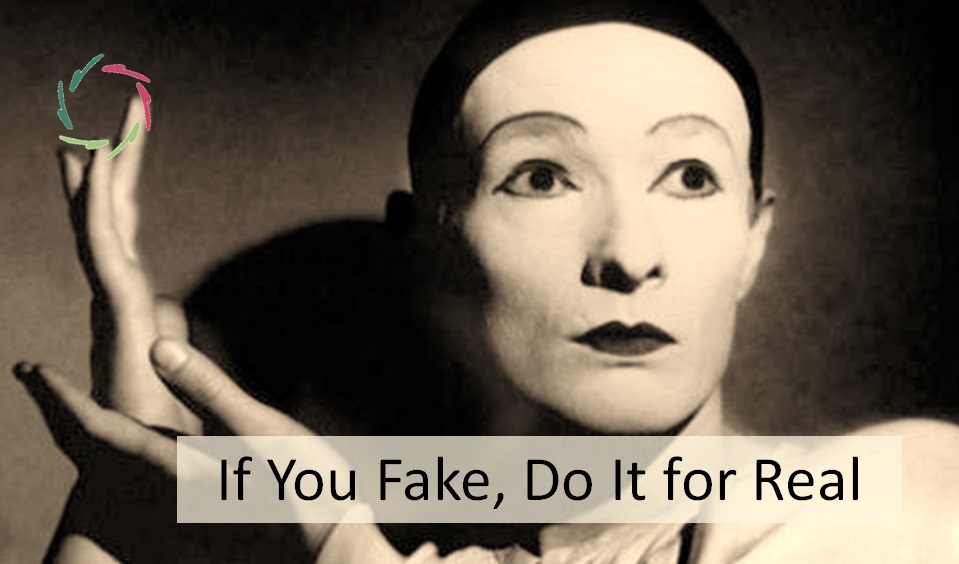
‘For real’ is like a very good mime, for instance. It’s fake and at the same time, it may be more real than reality itself. ‘Reality inside’ is more important than ‘reality outside.’
Then who is the faker?
While faking, you may get closer and closer to full reality. Faking is in such case a sensible and even important exercise towards gaining the truth, reaching reality. The one who abhors faking may in this way be the one who remains stuck in a pseudo-reality.
I’m not sure at what point even ‘reality inside’ is the only thing of real importance. In the end, the brain is stuck inside the skull.
What has meaning besides meaning itself?
If you find meaning in the faking, then the faking is for real. It’s like flowing along in a boat on a river. Is it faking movement? Or is it faking stillness? One might see it in both ways. Actually, it’s just flowing along. When you reach your destination, you reach your destination. This destination may be the joy of flowing along, appreciating the beautiful landscape.
Or the distant moon, which flows along with you. Is perhaps this moon also faking together with you?
Even in orgasm
Perhaps I should have mentioned at the beginning that this blog text is not for children. Would I then have faked bigotry?
Anyway, in orgastic setting, a woman may say she ‘fakes it’ for the enjoyment of her partner and/or for herself. Possibly. This is not the end of the story, hopefully. Faking an orgasm in a qualitative way brings the real experience closer. Without quality, it may push the real experience always further away. It becomes more real or more fake not depending on the faking itself, but on the quality of faking.
Let us not be childish. A qualitative show may be more worthwhile to a man than some meager reality. I suggest that you talk about it.
And use lubricant.
You may even be an interested spectator of your own show.
Good theater is faking
and precisely not. Good theater is meant to turn reality more real than most of the reality itself. Or it may be a condensation of reality, meant to bring the spectator in contact with his own reality so as to learn to approach it better than before, to live it better than before.
Otherwise, it’s just an amusement for the masses, meant to amuse and nothing else. No growth, no purpose, no meaning. The masses may get addicted to the amusement and lead a life without living. Ow, I’m quite negative now. Don’t believe me too much. It’s not all black or white.
Back to positive
The quality of faking is the same kind of quality that lies in the creation of fine art. In the faking case, you are the artist and the artwork. You may enjoy the creation and the created. It’s all you. Then you can let someone else enjoy this too. Why not?
Besides, do it qualitatively well and you may soon feel that you are transcending the fake. This too is not black or white. It’s like sports, like running. You learn it better by doing it. If you are not a good runner to start with, you may become one.
Fake it until you make it.
Is everybody happy?
Don’t lie.
Do it for real.
Related Posts
Will or Free Will?
Does free will exist, and if so, what does it mean to be free? This question has stirred debates for millennia, yet it often dances around a crucial point: What is supposed to be free, and free from what? In this exploration, we’ll move beyond the surface of this philosophical conundrum, diving into the illusion Read the full article…
Anxiety Not Felt
Worldwide, people are anxious. This may have been the case for a long time, but it’s certainly the case now. Technological progress hardens the cause and consequences. A quote about felt anxiety [*]: Anxiety disorders, including panic disorder with or without agoraphobia, generalized anxiety disorder, social anxiety disorder, specific phobias, and separation anxiety disorder, are Read the full article…
An External View on Groupthink
Imagine an observer from afar, trying to understand the strange ways of creatures on a strange planet — how they unite, divide, and lose sight of themselves. This is Lisa’s Compassionate gaze: not judging, but seeing. The strange creatures are us, humans. Lisa notices that the very force binding people together may also keep them Read the full article…