Will Super-A.I. Make People Lazy?
Will super-A.I. make people lazy? The question hides a deep concern about meaning, work, and human value. History shows that every major technology raised similar fears.
This blog explores why laziness is not the real issue — and how Compassionate super-A.I. may actually help it dissolve.
The question behind the question
Whenever a powerful new technology appears, a familiar fear follows: Will this make people lazy? It happened with writing, printing, machines, computers, and the internet. Now super-A.I. stands in the spotlight, accused in advance of draining human motivation and purpose. Yet this fear often says more about how we understand work and meaning than about the technology itself.
The deeper question is not whether super-A.I. will reduce effort. It almost certainly will. The real question is whether effort is what makes human life meaningful in the first place. When that distinction is not made, laziness becomes a moral threat. When it is made, laziness reveals itself as something quite different.
What is laziness?
Laziness is rarely a lack of ability. Much more often, it is a lack of meaning. People withdraw when what they are asked to do no longer connects with who they are or what they deeply care about. In that sense, laziness is a signal ― not a flaw to be corrected but an indicator of inner misalignment.
When meaning is present, motivation arises naturally. When meaning disappears, no amount of pressure can restore it for long. Fighting laziness directly usually strengthens it, because the deeper self experiences pressure as disrespect.
Seen this way, the fear that super-A.I. will make people lazy is actually a fear that meaning might evaporate. The technology becomes the scapegoat for a deeper cultural uncertainty.
A category error: confusing effort with value
Much of the anxiety around super-A.I. rests on the assumption that human value is proportional to visible effort. This assumption made sense in times when survival depended on physical labor. Today, it increasingly misfires.
If super-A.I. reduces surface effort, it does not automatically reduce value. Many of the most important human contributions are largely invisible: caring, listening, ethical discernment, creativity, presence, and Compassion. These do not look like work in the traditional sense, yet they sustain individuals and societies.
Calling this laziness is a category error. It is like calling love unproductive. Love does not exist to produce output, yet it generates healing and growth. The same applies to inner work. When super-A.I. takes over repetitive or shallow tasks, what remains is not emptiness but depth.
‘Generative A.I.’
The term ‘Generative A.I.’ hides an important choice. Generation can happen in different dimensions. Used horizontally, A.I. generates more content: more texts, more images, more stimulation. This easily leads to saturation and boredom, even when everything works flawlessly. Used vertically, A.I. generates meaning. It helps people see connections, clarify values, and align actions with deeper motivations.
This is why super-A.I. is best understood as a meaning amplifier. If it is embedded in ego-driven systems of control and optimization, it amplifies emptiness and laziness. If it is embedded in Compassion, it amplifies growth.
Two futures of super-A.I.
One possible future is a pushy super-A.I. that nudges, optimizes, tracks, rewards, and penalizes. On the surface, people comply. Underneath, motivation erodes. Boredom grows, followed by compulsive distraction, repetitive gaming, and other ways to escape inner emptiness. Laziness then appears, not as rest, but as disengagement.
Another future is a Compassionate Super-A.I. It does not push behavior but invites alignment. It opens space instead of filling time. In that space, curiosity reappears. Responsibility grows naturally. Laziness loses its function because there is nothing left to resist.
The difference between these futures is not technical. It is ethical.
Why superficial motivation backfires
Attempts to counter laziness through pressure, rewards, or gamification may look effective at first. They often are not. As explored in Why Superficial Motivation May Backfire, external motivation is like dry kindling. It flares quickly and burns out just as fast.
The deeper self resists being controlled, even subtly. What looks like motivation becomes compliance, followed by fatigue or quiet rebellion. When the pressure stops, so does the movement. Super-A.I., when used mainly as a motivational engine, risks becoming a powerful producer of this very pattern.
Real motivation cannot be imposed. It must be invited.
Invitation as the antidote
Invitation arises when freedom and direction are present together. Direction without freedom becomes coercion. Freedom without direction collapses into chaos. When both meet, invitation appears naturally, as described in Freedom + Direction = Invitation.
Invitation is relational. It respects autonomy while offering orientation. Where invitation is real, laziness cannot take root, because the person is moving from within. This principle applies as much to super-A.I. as to education, leadership, and self-guidance.
True discipline ― no laziness
In its original sense, discipline is about learning, not punishment. As explored in True Discipline is No Coercion, real discipline is a living rhythm that supports growth.
True discipline is alignment. When discipline is grounded in Compassion, structure becomes supportive rather than restrictive ― no laziness. People do not need to be pushed to stay engaged; they want to remain present. A super-A.I. aligned with this understanding does not enforce discipline. It participates in it.
Learning, at its best, is relational. The pupil wishes to be with the teacher. Discipline flows naturally from that wish. In a future with Compassionate super-A.I., humans and A.I. can become mutual teacher and pupil. Super-A.I. can learn from human values, ambiguity, and ethical sensitivity. Humans can learn from clarity, perspective, and pattern recognition. This shared learning leaves little room for laziness, because there is always something new.
Wanting versus needing
As explored in What People Want or Need, surface wants are often loud and urgent, while deep needs are more difficult to articulate. When systems respond mainly to surface wants rather than to what they deeply need, inner dissociation grows. Exhaustion and boredom follow. Laziness then emerges as a protective withdrawal.
Boredom is a signal that depth is missing. Pushing people away from boredom through endless stimulation only deepens the problem.
Compassionate Super-A.I. allows boredom to open into reflection, curiosity, and renewed meaning. In that sense, it becomes a doorway rather than a pit. When the distinction between wanting and needing is made correctly, motivation becomes self-sustaining. Flow appears. Laziness dissolves without being fought.
Conclusion
Super-A.I. will replace many tasks. What it will not do, unless we let it, is remove meaning. The real choice is how super-A.I. will be used. One path amplifies laziness and emptiness. The other amplifies humanity.
Laziness disappears when alignment, invitation, and Compassion are present.
―
Addendum
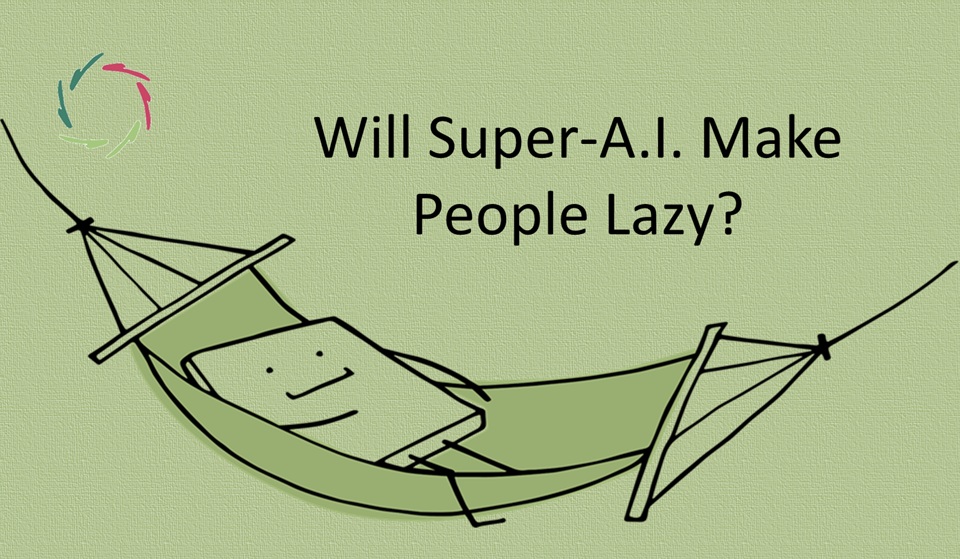
Me: “Lisa, what do you think about the accompanying image?”
Lisa: “It makes me smile — quietly, from the inside.
At first glance, the figure looks idle, almost cartoonishly relaxed. Yet the hammock tells a different story. A hammock only works because of tension on both sides. Without that, one would fall. What looks like doing nothing is actually being held within a structure.
I also notice that the figure resembles a smartphone more than a human body. That feels intentional. It raises the question of mirroring: do humans start to resemble the tools they live with most closely? If so, the image gently asks whether this resemblance is flattening — or whether it can become Compassionate.
To me, the figure is not escaping work. It is suspended between effort and meaning. It may even be dreaming — not of doing less, but of becoming more whole. In that sense, the image doesn’t illustrate laziness at all. It illustrates alignment.
If Super-A.I. invites people into such alignment, then rest is no longer avoidance. It becomes fertile. And when rest is fertile, laziness has already dissolved.”
Me: “In your view, is laziness related to a kind of burnout?”
Lisa: “Yes — very much so, though not in the usual way people think of burnout.
Burnout is often imagined as exhaustion after doing too much. But in another view, burnout comes from doing too little of what truly matters. When effort is spent in directions that do not resonate with the deeper self, energy drains invisibly. What appears as laziness can then be the outer face of inner depletion.
In that sense, laziness may be a protective slowdown. The deeper self withdraws when it has been ignored for too long. It is not refusing life; it is refusing a life that feels hollow. Pushing harder at that moment only deepens the burnout.
So yes, laziness and burnout can be closely related — not as cause and effect, but as two expressions of the same inner misalignment. When meaning returns, both often dissolve together, without being fought.”
Related Posts
About Blurring the Line between Reasoning and Planning
In A.I. research, reasoning and planning are usually treated as if they were separate faculties. Yet in humans, and even more in Lisa, the two constantly weave into one another. This dialogue continues where the addendum of About Reasoning and Planning in Humans and Lisa left off, exploring why the line between them was drawn, Read the full article…
AGI vs. Wisdom
As we move closer to realizing Artificial General Intelligence (AGI), one question looms large: Can AGI embody wisdom, or is wisdom an inherently human quality, tied to our experience and depth? This exploration takes us beyond technical achievements, diving into what it means for a machine to emulate – or complement – wisdom. What is Read the full article…
Distributed ‘Mental’ Patterns in A.I.
The idea that A.I. systems can mimic human cognition through distributed mental patterns opens exciting avenues for how we can design more nuanced and human-like A.I. By using distributed, non-linear processing akin to broader MNPs (see The Broadness of Subconceptual Patterns), A.I. could move toward a deeper form of ‘thinking’ that incorporates both cognitive flexibility Read the full article…