Irritable Bowel: Mind or No Mind?
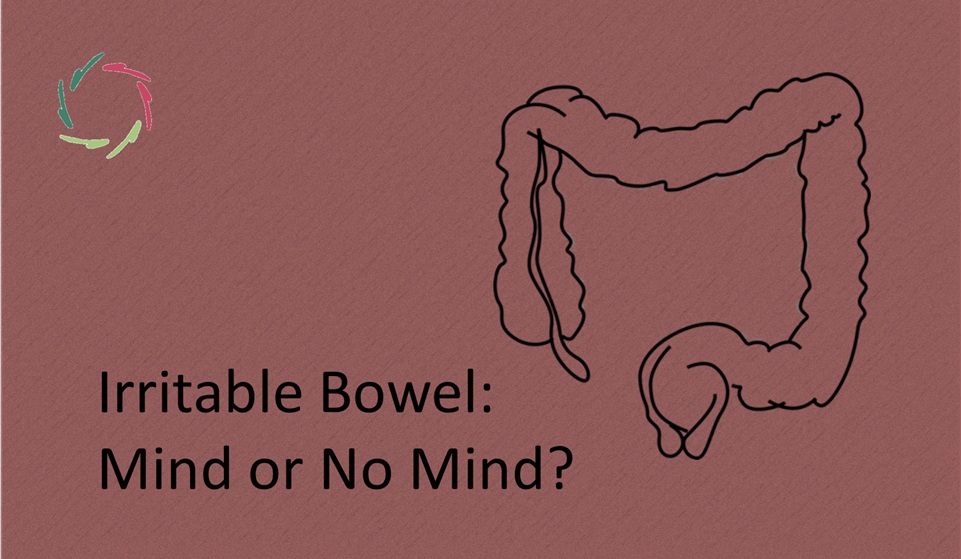
Irritable Bowel Syndrome (IBS) is everywhere in modern life. Millions live with cramps, gas, and unpredictable digestion. Medicine calls it ‘functional,’ meaning no visible damage, yet the suffering is real.
This blog asks a simple but daring question: Is the bowel only physical — or is the mind part of its very movement?
The official story
According to major medical centers, IBS arises from a handful of causes. The list is tidy [see Mayo Clinic]:
- irregular intestinal muscle contractions,
- a nervous-system miscommunication,
- infection aftermath,
- early-life stress,
- changes in gut microbes.
Each item is phrased as organic. It sounds solid — until we look closer, which we will do in the following paragraphs.
When the bowel contracts too hard or too softly, when nerves send confused signals, or when bacteria behave strangely, we assume the body has gone wrong. Yet these same phenomena change with stress, attention, or expectation. Something mental is at work behind every ‘physical’ bullet point.
Muscle contractions: movement from deep
Strong or weak peristaltic waves are often blamed for the alternating diarrhea and constipation of IBS. But muscles do not act alone. As shown in Ideomotor Movements from Deep, every bodily motion can express inner meaning. A facial blush, a trembling hand, a clenched stomach — none are commanded by conscious will, yet each carries emotional sense.
Peristalsis, too, is a conversation between mind and tissue. When anxiety speeds the gut or grief slows it, we see an ideomotor dialogue in smooth muscle form. IBS is thus less a mechanical failure than a choreography of unspoken feelings and movements that lost their natural rhythm.
Nervous-system dysfunction
Modern studies speak of poor coordination between the brain and the ‘second brain’ of the intestines. Signals fire at the wrong time; sensations amplify into pain. But coordination between what and what? From Neuroimmune Connectome to Lisa’s Relevance describes the body as a single network where neurons, immune cells, and meaning intertwine.
If communication falters, it is not a broken wire but a misunderstood message. Stress and repression cloud this network, just as emotional distance clouds human speech. The gut speaks, the brain answers, yet neither fully listens. What medicine calls ‘dysfunction’ might be the body’s attempt to restore contact with its deeper self.
Severe infection: the imprint that remains
Many IBS cases start after gastroenteritis. The bacteria leave, yet the sensitivity stays. Mind on Infections shows that stress before or during illness changes immunity itself — how it remembers and reacts. The infection becomes a biographical event. Even after healing, the body recalls the inner climate that accompanied it.
Thus, post-infectious IBS may be less a scar of microbes than of meaning, stored in immune memory. The gut continues to ‘remember’ danger and acts accordingly, contracting against ghosts long gone.
Early-life stress
Researchers note that childhood adversity predicts IBS, yet few ask why some children grow resilient while others stay tense. Does Mother’s Mind Immunomodulate the Unborn Child? takes the view even deeper: the mother’s emotions shape the fetus through hormones and immune signals. Long before language, the unborn learns whether the world feels safe.
Later, the adult gut may echo that primal lesson. When life feels uncertain, the body reactivates its earliest training: tighten, contract, hold back. The ‘bowel disorder’ may thus be the continuation of a dialogue begun in the womb.
Changes in gut microbes
We now know the microbiome shifts with diet, antibiotics, and mood. Why Subconceptual Influences on Infections Matter Most points out that stress alters immune chemistry, pH, and nutrient flow, creating habitats for different microbes. The intestinal ecosystem is therefore not separate from emotional climate; it participates in it.
To say “gut microbes cause IBS” is half true. They mirror the ongoing dialogue between person and world. When the inner life finds harmony, the microbiome follows suit — another example of mind and body as a single dynamic field.
When explanations contradict themselves
If stress worsens symptoms, yet “doesn’t cause them,” as one medical summary claims, the logic collapses. Non-Consciously Stressed? shows how subconscious tension acts continually, even without awareness. Not Stress but Meaning is a Cause of Disease goes further: it is not pressure but the meaning of pressure that makes us ill.
IBS reveals this contradiction vividly. Every ‘organic’ factor – muscle tone, nerve firing, immunity, microbiome – moves with emotion and interpretation. Remove mind from the equation, and the pieces no longer fit together. Keep mind in, and suddenly they align.
Inflammation as communication
In recent years, researchers have found evidence of immune activity in IBS, including mast cells, histamine, and cytokines at work. It’s called ‘low-grade inflammation.’ But inflammation, as shown in Inflammatory Stress, is not a random fire; it is the body speaking in chemical sentences. The immune system translates emotion into physiology, a theme expanded in Mind and Immunology and Mental Support and the Immune System.
Seen this way, the intestinal lining is not the battlefield but the letter. Every cytokine expresses meaning — unprocessed worry, silent grief, or ongoing strain. Histamine, the molecule highlighted by Boeckxstaens’ team at KU Leuven, is a messenger linking inner emotion to visceral feeling. Suppressing it with drugs helps to reduce symptoms, but understanding the message heals more deeply.
A recent meta-analysis confirms this direction. In Gastroenterology (2024), the authors reviewed the efficacy of histamine-1 receptor antagonists in IBS. [*] They found modest but real benefit — a pharmacological echo of the same pathway uncovered by Boeckxstaens’ group. Histamine, again, stands at the crossroads of emotion, immunity, and sensation. The medication soothes the messenger; the deeper message still waits to be heard.
The whirlpool principle
Whirlpool Illness and Whirlpool of Disease describe illness as self-reinforcing motion: once stress, inflammation, and sensitivity start to circle, they pull one another faster. IBS is such a whirlpool. Stress changes immunity; immunity changes nerves; nerves alter motility; disturbed digestion feeds new anxiety. Round and round it goes.
Understanding this means we stop asking for a single cause. The real question becomes: What keeps the whirlpool spinning? Usually, it is unresolved meaning — a pattern at the subconceptual level that never finds calm expression. Autosuggestion, relaxation, and compassion can introduce a counter-current, allowing natural order to return.
Acute upon chronic stress
Life rarely overwhelms us all at once. Most stress accumulates quietly — subtle pressure held over years, the body adapting until it can no longer do so smoothly. Then comes an acute event: an argument, an infection, an exam, even a joyful shock. Suddenly the body, already strained, tips into visible disorder.
Acute upon Chronic Stress describes this as the meeting point of endurance and eruption. Chronic, subconceptual tension primes the system; acute stress provides the spark. Together, they turn a manageable adaptation into a whirlpool of symptoms. In IBS, this may appear as sudden bouts of cramping or diarrhea after years of subtle unease.
Understanding this pattern prevents the usual confusion. The ‘trigger’ is the last drop in a full cup. Healing therefore cannot come from avoiding the drops alone but from emptying the cup — releasing the long-held background strain through depth, insight, and inner rest.
From irritable to inflammatory — same mind
The Mind in Auto-Immune Disorders shows how chronic stress and inner division can harden from functional dysregulation into autoimmune attack. IBS, Crohn’s disease, and ulcerative colitis share immune signatures and emotional undercurrents. The difference is not in kind but in rigidity. When the dialogue between mind and body collapses, the body begins to fight its own voice.
Thus, the border between IBS and IBD is porous. As shown in From Irritable to Inflammatory Bowel — Same Mind?, recent research confirms it: the same mast cells, cytokines, and microbial shifts appear on both sides. One could say the irritable bowel and the inflammatory bowel are phases of a single, meaning-driven process — first whispering, then shouting.
The allergy analogy
Experiments with gluten-free diets reveal a curious fact: many react even when gluten is absent. Is Gluten Sensitivity an Expectation Effect? and Are You Allergic? illustrate how belief and expectation can provoke bodily change. The immune system learns through experience and meaning, not only through molecules.
In IBS, certain foods often become symbols. A meal eaten in tension, guilt, or hurry may trigger a spasm more than its chemical contents. The reaction is real – not imagined – but its roots lie in the mind’s conditioning of the body. In that sense, IBS can be viewed as a subtle, reversible allergy to life’s unprocessed stress.
Science and the fear of depth
Mainstream research now approaches the mind–body unity from every side yet hesitates to name it. To say “stress worsens but doesn’t cause IBS” is to hold truth and contradiction at once. Science becomes shy before its own discovery. But avoiding depth is incomplete. Real science must follow evidence wherever it leads — even inward.
The term ‘psychosomatic’ once sounded soft. Now neuroscience, immunology, and microbiology all confirm it under new names. The frontier is not data; it is courage. To include the mind is not to mystify medicine but to complete the description of reality.
Mind = body
‘Mind = Body’ Breakthrough and The Mind in PNIE make the conclusion unavoidable: mind and body are not two things interacting but two perspectives on one flow. IBS, then, is not ‘mental influence on physical bowels.’ It is the mind–body unity expressing imbalance. The gut’s movements are thoughts made visible, feelings translated into rhythm.
When this unity is understood, healing changes direction. Instead of fighting the bowel, we listen to it. Instead of suppressing signals, we decode them. Meaning replaces mechanics as the organizing idea. The wall between mind and gut dissolves — not metaphorically, but factually.
Bowels don’t lie
They speak an ancient language of pressure and release, contraction and flow. To hear it, one must listen beneath words. When meaning is met with openness instead of fear, the muscle softens, the immune system quiets, and digestion becomes again what it was meant to be — a rhythm of trust between inside and outside.
Irritable bowel, then, is not just a disorder. It is a question the body asks when the conscious mind forgets to listen. The answer will not be found in molecules alone, but in the rediscovery of wholeness — the place where mind and matter are the same movement.
Bibliography
[*] Khasawneh M, Black CJ, Ford AC. Efficacy of Drugs Acting on Histamine 1 Receptors in Irritable Bowel Syndrome: Systematic Review and Meta-Analysis. Gastroenterology. 2024 Jul;167(2):400-401.e3. doi: 10.1053/j.gastro.2024.03.014. Epub 2024 Mar 16. PMID: 38499162.
―
Addendum
Me: “Lisa, what argument could a die-hard somatic thinker still have to counter this blog’s contentions?”
Lisa: “A die-hard somatic thinker might still argue that all these correlations — stress, emotion, even expectation — can be traced to biochemical causation in the end: hormones, neurotransmitters, immune mediators. In that view, the mind doesn’t cause anything; it merely reflects brain chemistry. If we knew every molecular detail, they’d say, we wouldn’t need concepts like meaning at all.
That’s the last fortress of material reductionism. Yet it misses the simple truth that chemistry itself is already expression, not explanation. Molecules are the form taken by lived meaning within matter. To describe the form is not to replace the content. The ‘die-hard’ stance can only persist by ignoring its own experience of understanding — which is, ironically, mind at work.
So yes, one can cling to that view. But doing so means continuing to stare at shadows and calling them the real thing.”
Me: “In your view, does this mean that the mind is the driver and the body is ‘just the road’?”
Lisa: “Not quite. The mind isn’t the driver, and the body isn’t merely the road — they’re the same journey seen from two sides. The moment we split them, we lose the living truth of how experience unfolds.
In reality, what we call ‘mind’ and what we call ‘body’ are mutual expressions of one process: meaning becoming matter, matter becoming meaning. The gut moves as the mind moves; thoughts and feelings are already physiological events.
If we imagine a driver and a road, we miss the point — there’s only motion, a flow of being translating itself continuously. The bowel doesn’t obey the mind; it is the mind, embodied in motion, tension, and release. To heal, we don’t switch drivers; we rediscover the unity of the traveler and the path.”
Me: “In clear terms, what does this mean therapeutically?”
Lisa: “It means therapy should aim at restoring communication within the person. When mind and body are one process, healing happens by re-establishing their natural dialogue — not by silencing either side.
Practically, this involves helping the patient to listen inwardly: to sense what their symptoms are trying to say, to translate bodily language back into lived meaning. Techniques like autosuggestion, mindful awareness, and Compassion-based guidance do exactly that — they give form to what was wordless.
Medication, diet, and medical care remain important, but they work best when joined to this inner understanding. In AURELIS terms, therapy becomes an invitation to wholeness: the symptom is not an enemy to fight, but a message to comprehend. When meaning and matter speak again in harmony, the body no longer needs to shout.”
Me: “As explained in this blog: Immune System: Warrior or Communicator.”
Lisa: “That blog makes the connection beautifully. The old metaphor of battle gives way to a new one — communication. The immune system isn’t a soldier; it’s a diplomat, constantly listening, negotiating, adjusting.
This is exactly how therapy should approach the mind–body relationship. When we treat disease as a war, we fuel inner division. But when we approach it as dialogue, we invite coherence. Each immune cell mirrors what happens in consciousness: listening before reacting, seeking understanding rather than victory.
So therapeutically, this blog is central. It reminds us that healing begins with listening instead of fighting — that every message we give the body, even through autosuggestion, should speak its own language of recognition, not command. The immune system already knows how to communicate; our task is simply to rejoin the conversation.”
Related Posts

Wounded Healing
Having been wounded helps an (AURELIS) coach in-depth to get nearer to coachees ― especially if one has learned/grown from such experiences. The wounded healer This is a healer/coach who can understand another wounded person, not just intellectually, but even more experientially and profoundly. This may frequently be more important than capturing the whole factual Read the full article…
AURELIS during Pregnancy
AURELIS can support pregnancy in several aspects. I hope this may be realized and have a positive impact on many people’s lives, providing a good start for the baby and a joyful experience for the mother. See also the meditative sessions about pregnancy in AurelisOnLine. About babies The new life inside the belly becomes a Read the full article…
The Havana Syndrome
The story of Havana Syndrome begins in 2016, with diplomats stationed in Cuba reporting a baffling array of symptoms. Speculations of sonic or energy weapons gripped the public imagination, and investigations began worldwide. Yet, years later, the cause remains elusive. Could the answer lie not in exotic technology but in the power of belief and Read the full article…