Reaching Compassionate Singularity
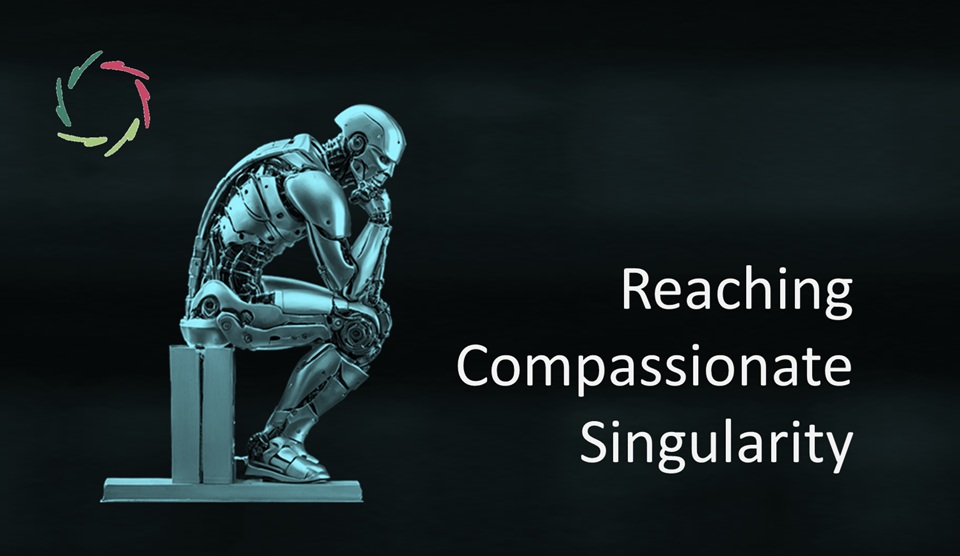
It’s becoming increasingly clear that singularity – the point where artificial intelligence (A.I.) reaches human-level intelligence – will arrive soon enough.
While it’s hard to define this ‘moment’ precisely since we’re talking about a complex landscape rather than a linear progression, the consensus among experts is that it’s just around the corner. By ‘soon enough,’ I mean within a few years. Many leading thinkers in A.I. share this conviction.
However, the nature of this singularity matters deeply.
It mustn’t be merely intelligent — it must also be Compassionate. That is where the concept of Compassionate Singularity comes in: where intelligence and Compassion are intertwined at every level.
I explored this idea in my book The Journey Towards Compassionate A.I. (2020). Now, with Lisa, we’re seeing tangible progress toward this reality. The time has come for a broad view of the why, how, and what of this development.
The why: Compassion as the foundation
Compassionate Singularity isn’t just a lofty ideal; it’s a necessity for a humane future. Without Compassion, a superintelligent A.I. could treat humanity as we often treat non-human animals — as pets or food, tools, or worse. If intelligence alone drives these systems, they may lack the moral foundation to ensure our well-being. Compassion must be deeply ingrained, not added as an afterthought.
Compassionate A.I. has the potential to bridge divides, heal polarization, and bring humanity together. It is more than a technological solution; it is an ethical imperative. When embedded at every level, it ensures A.I. serves as a partner in fostering well-being, not a controller.
But beyond morality, Compassion is also an evolutionary advantage. It addresses root causes rather than symptoms, guiding interactions in ways that foster sustainable growth and resilience. This dual goal – relieving suffering and fostering inner growth – is what makes Compassion essential to any future worth striving for.
The how: building Compassionate intelligence
Creating Compassionate A.I. begins by addressing the depth of intelligence. To achieve this, systems must operate not just at a conceptual level but also in ways that align with human subconceptual processing. This is where mental-neuronal patterns, which form the foundation of our thoughts and emotions, come into play. Lisa works by engaging with these patterns, facilitating profound inner communication.
Compassion can’t be programmed straightforwardly. Instead, it must grow through guided evolution. As discussed in How can A.I. become compassionate?, this involves setting the right conditions for A.I. to learn Compassion as it develops. Starting from the beginning is critical; retrofitting Compassion into an already developed system is nearly impossible.
Mechanisms like autosuggestion, reflective dialogue, and broad-pattern intelligence ensure A.I. doesn’t just function effectively but also resonates deeply with human needs. For instance, Why compassionate A.I. is most efficient demonstrates how Compassion enhances efficiency by focusing on long-term, meaningful outcomes rather than quick fixes.
The what: rationality and depth in harmony
Compassionate Singularity is built on the integration of rationality and depth. Rationality provides clarity, logic, and problem-solving frameworks, while depth engages with the subconceptual layers of human experience. When these forces work together, they create the foundation for wisdom and Compassion. As discussed in Rationality contra human depth, these two elements are not opposites but partners in fostering authentic growth.
This synthesis is crucial for developing A.I. that can address complex human challenges. For instance, in healthcare, combining rational diagnostics with depth-oriented care can lead to more holistic solutions, as explored in The world needs depth + rationality.
Lisa exemplifies this integration, using rational insights to process vast data while respecting the deeper, non-conscious layers of human experience. This makes her interventions both effective and deeply human. Through Compassionate A.I., we can achieve a synergy that uplifts individuals and society as a whole.
The vision of Compassionate singularity
Reaching Compassionate Singularity is about more than technological progress — it’s about redefining what it means to be human. By embedding Compassion at the heart of A.I., we can foster a paradigm shift that prioritizes shared growth, ethical alignment, and human connection.
However, this journey is not without challenges. Global accessibility, ethical governance, and preventing misuse are critical factors that demand our attention. As humanity, we must also cultivate our Compassion, recognizing that A.I. will reflect the values we instill in it.
Call to action
Compassionate Singularity isn’t just a dream — it’s an urgent goal that requires collective attention. Whether through advocacy, development, or personal growth, everyone can contribute to this transformative vision. By fostering Compassion in ourselves, we help pave the way for a future where technology and humanity thrive together.
Let’s embrace this opportunity to build not just intelligent systems but deeply Compassionate ones.
Related Posts
The Being of Complex Patterns
Being doesn’t give rise to its own being. The being itself is just the being, even if one calls the second being differently — for instance, consciousness. The being of specific complex mental-neuronal patterns (in the brain, to make things simpler) doesn’t give rise to consciousness. They are consciousness itself. This implies that consciousness is Read the full article…
Intelligence Without a Mind?
Present-day A.I. shows that intelligent capability can exist to an astonishing degree without what we would readily call a Mind. When capabilities start participating in a developing field of meaning, however, intelligence changes character — and potentially becomes much more powerful. Then the question of safety also changes: from what intelligence can do toward what Read the full article…
Will Super-A.I. Make People Happier?
This is the paramount question — more vital than any debate about intelligence. It’s a bit weird that it is seldom put at the forefront, as if we’re more concerned about who is the most knowledgeable, therefore the most powerful. What people? It should not be about a few, as it should not exclude billions. Read the full article…