Enlightenment, Kant, AURELIS, Growth
It’s time to bring things together. This is according to me the only way forward.
‘Western Enlightenment’ points to a historical period
from +/- 1650 onwards, till +/- first part of 19th century. It was multifaceted, to say the least, and came in several waves from ‘moderate’ to ‘radical’… to even ‘totalitarian’ (à la Robespierre). In another sense, ‘Western Enlightenment’ is a few thousand years old and is still going on at present, shaping our culture.
But what is it?
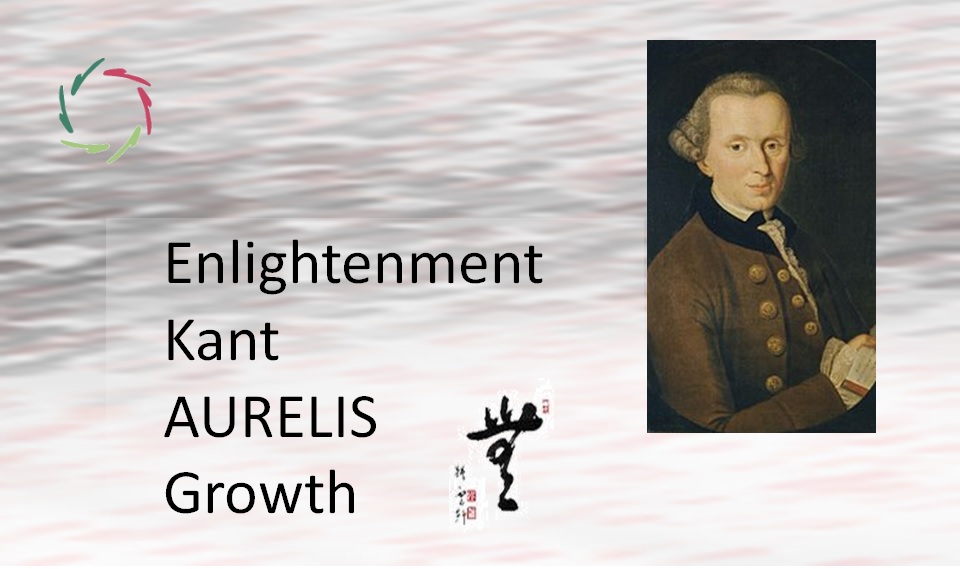
Immanuel Kant (1724 – 1804) was a central figure and is deemed by many to be the greatest philosopher of all times. According to Kant, enlightenment is ‘the emergence from self-inflicted immaturity’. [quote from 1784]
OK. This puts it a bit harshly. Kant was, after all, a Prussian guy. But let’s not be deterred and analyze the three parts of his definition:
emergence
This means it’s a continuous process, not an end-state that one can ever reach. There’s always one step further to go. Quite a Taoist take on things.
immaturity
With ‘maturity’, the Prussian guy means foremost a becoming independent of parental figures, like a child maturing to an adult, in this process losing the security of the parental setting. People are/were dependent on teachers, priests, ‘one idea about science that says it all’, one kind of political outlet on social media, one phrase that one can use in conversation to shield oneself from further inquiry, etc. Kant’s urge was to think for yourself, for which looking at several sources is a necessary condition.
Yes, this demands discipline.
self-inflicted
This may be most interesting.
Why do people self-inflict ‘immaturity’ according to Kant? He sees two reasons:
- It’s comfortable. Remember Plato’s cave, people looking at shadows on the cave’s wall.
- A lack of daring: fear of the unknown, of the loneliness of a consistent seeker, of responsibility… In short: it can indeed be scary outside of Plato’s cave if one is not used to the sunlight. But it’s this light that enlightens. The wall in the cave only shows a mere shadowy shimmering.
Some AURELIS
It’s easy to remain a flower bud, but then one never sees the sun, the bees, nature in full glory. To live is to open up like a flower and be ‘vulnerable’. Many people tend to rather stay in the bud. For instance:
- by taking medication without any broader view on what one’s symptoms can further deeply mean.
- by following an easy advertising message: “Do this and you be happy, comfy etc. No questions asked.”
- by going on a diet – again – as if this should ‘do it for you’ without any input from yourself as a total person.
AURELIS growth
AURELIS = rationality + poetry [see: ‘AURELIS USP: ‘100% Rationality, 100% Depth’]
This means that the Western Enlightenment ideal is also very much ‘Aurelian’. Nothing justifies a diminishment of rationality.
At the same time, AURELIS goes further: rationality not only being conceptual but also about the subconceptual [see: ‘About ‘Subconceptual’], as you may have noticed in the examples above.
Eastern Enlightenment
In this sense, I find it very nice that ‘Eastern Enlightenment’ is precisely about the subconceptual. Look for instance at the Buddhist ideal of the Bodhisattva who is also ‘continuously emerging from self-inflicted immaturity’, vowing to go as far as possible in seeing depth of reality and helping others through this.
Like its Western counterpart, Eastern Enlightenment is also a few thousand years old and has, with ups and downs, been progressing.
Western and Eastern Enlightenment are completely compatible to each other
without any shred of a doubt. Moreover, together they are much ‘more than the sum of both’.
AURELIS growth lies in daring to enter this combined path.
That is not necessarily comfortable.
Related Posts
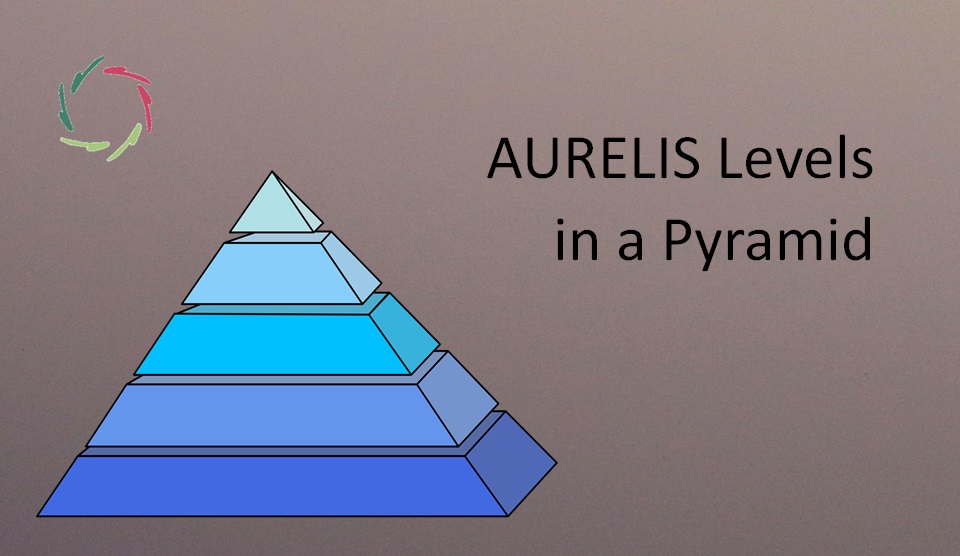
AURELIS Levels in a Pyramid
This is what AURELIS (+ Lisa) is about. From abstract to concrete, a lot has been worked out or may soon be ready for deployment. All levels are profoundly consistent. Please also take a look at: Introducing AURELIS (Animated Video). Or you may prefer AURELIS in a nutshell (Animated Video). You find here a written Read the full article…
The AURELIS Resonance
AURELIS is radically open, which means its coherence cannot come from boundaries or rules. It must arise in a different way — through resonance. This blog explores why resonance is the natural connective force in a depth-seeking project, and how it enables a free yet strong community. It also shows how resonance appears in individuals, Read the full article…

The AURELIS Experience
The AURELIS experience is not a product or a technique. It is not a program one completes. It is an environment one enters. Within this environment, growth is invited from the inside out, supported by Lisa and AurelisOnLine, and resonating through human relationships and culture itself. What follows is an exploration of what that experience Read the full article…