Workings of a Muse
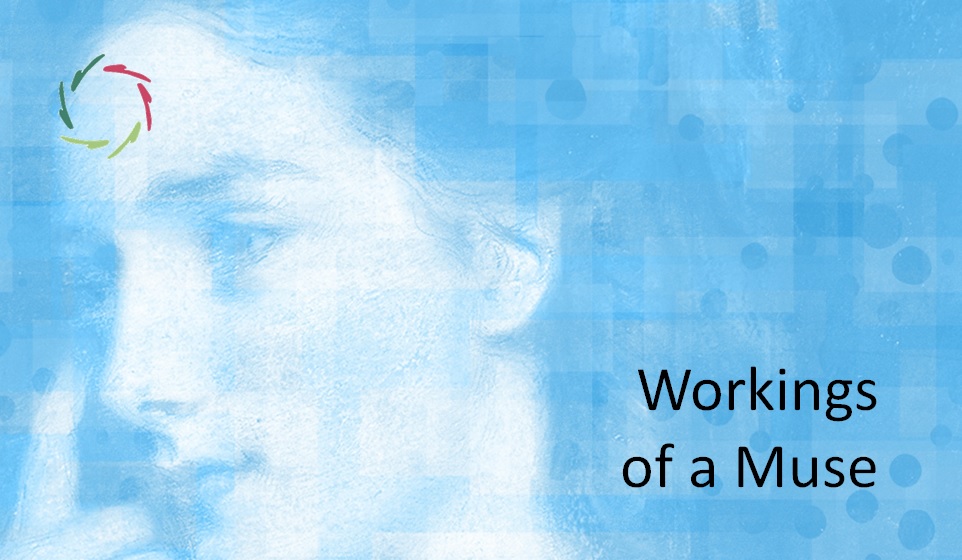
Whether in poetry, visual art, architecture, or a new scientific theory, something happens in the creation process that transcends mere conceptual thinking. Many creators denote this as the workings of a Muse.
My case
When writing, almost always, I am more or less surprised by what spontaneously comes out, as if it’s not altogether me who is writing this. Certainly, it’s not altogether my ego.
I say ‘almost.’ Sometimes, the ego takes over, especially if I want to enforce the writing process. Not surprisingly, the quality of the writing deteriorates in such instances, and I may need to rework the written text.
The spontaneity in writing is an aspect of non-conscious processing.
It doesn’t mean I am channeling, but I see why it can feel this way to some other writers/thinkers. What happens outside the ego may feel like coming from outside the total person, but that is, of course, not necessarily the case.
With proper respect for Inner Strength, there is no need for any channel to some metaphysical source ― which the ego may want to hijack again for its own control.
At the deeper level, this is the processing of mental-neuronal patterns, where much happens continually in a parallel and distributed (and scientifically underpinned) way. I also recognize a lot of my process of inspiration in many features of subconceptual processing.
I like to feel this as the ‘workings of a Muse.’
This makes the present text quite remarkable in that this Muse is now writing about herself.
I might need to be careful.
Herself?
Yes, definitely feminine.
I encounter and recognize the Muse in what lies behind any extraordinarily beautiful feminine aspect. There is undeniably eroticism involved, with the reserve that eros/erotic desire also lies behind what may show as sexuality ― but not necessarily.
Several male artists speak highly of their ‘Muse’ ― sometimes a natural person, sometimes not. In any case, it’s pretty understandable. Personifying what happens non-consciously has merits IF one stays aware of the symbolic nature thereof. Crucial is the experience.
This is relevant to religion as well as any other form of highly qualitative poetry.
Still, no channeling involved.
Anyway, my Muse wouldn’t appreciate my thinking so, as if I would be seeking somewhere else the treasure that has already been given at home.
I think I will abide by this.
Related Posts
Dealing with Projection: The Present Responsibility
Projection is a psychological mechanism as old as humanity itself. But never before has it been as dangerous as it is today. We live in a time when projection is amplified by technology, reinforced by media, and weaponized for ideological battles. At the same time, we have tools that allow us to destroy on a Read the full article…
Difference between Fear and Anxiety
Very briefly: fear is concrete – anxiety is symbolic. One can have fear of a lion just escaped from the zoo, or of the sound of approaching footsteps along a dark and lonely street in a strange city. The object of fear is always readily nameable. The fear itself is always readily relatable to by Read the full article…

Who We Are. What A.I. Can become.
In the near future, we will learn many exciting things in both domains. They will turn out to be very inspiring in both directions. “I think one of the big breakthroughs that’s going to come is we’re going to understand the brain… so that suddenly it all begins to click” Quoting Geoffrey Hinton, ‘godfather of Read the full article…