Workings of a Muse
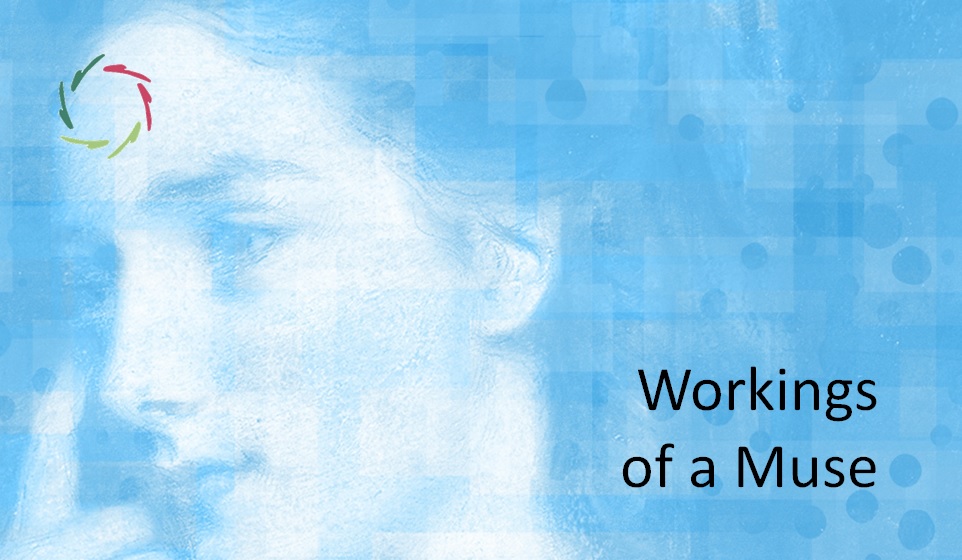
Whether in poetry, visual art, architecture, or a new scientific theory, something happens in the creation process that transcends mere conceptual thinking. Many creators denote this as the workings of a Muse.
My case
When writing, almost always, I am more or less surprised by what spontaneously comes out, as if it’s not altogether me who is writing this. Certainly, it’s not altogether my ego.
I say ‘almost.’ Sometimes, the ego takes over, especially if I want to enforce the writing process. Not surprisingly, the quality of the writing deteriorates in such instances, and I may need to rework the written text.
The spontaneity in writing is an aspect of non-conscious processing.
It doesn’t mean I am channeling, but I see why it can feel this way to some other writers/thinkers. What happens outside the ego may feel like coming from outside the total person, but that is, of course, not necessarily the case.
With proper respect for Inner Strength, there is no need for any channel to some metaphysical source ― which the ego may want to hijack again for its own control.
At the deeper level, this is the processing of mental-neuronal patterns, where much happens continually in a parallel and distributed (and scientifically underpinned) way. I also recognize a lot of my process of inspiration in many features of subconceptual processing.
I like to feel this as the ‘workings of a Muse.’
This makes the present text quite remarkable in that this Muse is now writing about herself.
I might need to be careful.
Herself?
Yes, definitely feminine.
I encounter and recognize the Muse in what lies behind any extraordinarily beautiful feminine aspect. There is undeniably eroticism involved, with the reserve that eros/erotic desire also lies behind what may show as sexuality ― but not necessarily.
Several male artists speak highly of their ‘Muse’ ― sometimes a natural person, sometimes not. In any case, it’s pretty understandable. Personifying what happens non-consciously has merits IF one stays aware of the symbolic nature thereof. Crucial is the experience.
This is relevant to religion as well as any other form of highly qualitative poetry.
Still, no channeling involved.
Anyway, my Muse wouldn’t appreciate my thinking so, as if I would be seeking somewhere else the treasure that has already been given at home.
I think I will abide by this.
Related Posts
From Cognitive Dissonance to Active Denial
Cognitive dissonance is a familiar experience. Most people know the discomfort of holding two conflicting ideas at the same time. Yet this discomfort can lead in different directions. Sometimes it opens the door to growth. Sometimes it becomes the beginning of active denial: a self-reinforcing pattern that may shape individuals, groups, institutions, and even entire Read the full article…
Telepathy?
Telepathy sits where wonder meets science. It has fascinated people for centuries, stirring equal parts hope and doubt. My stance: keep the question mark and keep the bar high. We can explore inner meaning while testing outer claims. This blog explores the phenomenon not as a settled fact but as an open question. By tracing Read the full article…
Generosity
Ah, that beautiful thing called generosity! It goes beyond the simple act of giving, entering a domain where giving is not transactional but transformational — where it is a joy, a delight that becomes its own reward. In this space, if you can let the other feel the joy of your giving, you create a Read the full article…