Can Tango Teach Us Empathy?
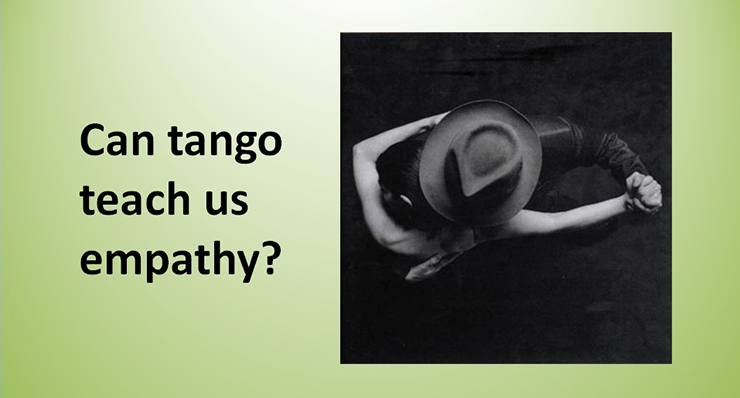
Tango as art… Historically seen, thinking about empathy originates from thinking about experiencing art. Someone looks at a painting and experiences through this something meaningful deep inside.
The viewer feels deeply, empathically touched ‘as if from inside the work of art.’ In most cases it’s difficult to express in words really what this is or how it is felt. A so-called explanation of the piece of art – even by the artist himself – frequently gets an artificial flavor. Analyzing too much may impede the artistic impression. Only the experience itself can fully convey… the experience. Well.
A beautiful tango dance too is a fleeting form of art, crafted by the dancers. Nice… Even nicer is the idea that the dancers themselves are at the same time part of this work of art, again and again.
Through this, the saying ‘as if from inside the work of art’ gets an additional, beautiful meaning. Typical for a well danced tango is the emphasis upon improvisation. Each time again it unfolds in unpredictable ways. This makes tango a special art form, more than any other kind of dance.
Within a beautiful tango, both partners are very involved into each other, with improvisation much enhancing this involvement. A lot of good dancers find the connection between the dancing partners most important. The connection lies mainly within the embrace, physically as well as psychologically. This connection can go far. In a good dance, one feels the finer movements of the dancing partner. Putting each step becomes each time again as if the first time that this step is being put. Even if it has been put a thousand times. It’s never boring, because always new in the sense of being not constructed but ‘originally created’. Empathy in general has this characteristic. It is always new, always close to the source of human creation. Spontaneous in a deep way.
During a tango dance, empathy flows in two directions and through this, as art form, it gets an additional dimension. This probably explains why to many at a certain level, tango is not just a dance, but gradually becomes a way of being.
This is being said not only by Argentinians. For empathy at this deep level, people are sensitive all over the world. Happily. It brings out the best in people, even though some support can sometimes be advisable as it is in many cases where inner strength starts to flow more freely, not only in tango. In any case, it is worth it.
So yes of course tango can teach us empathy
in all its complexity. And no that does not mean that all will be rosy and cuddly and comfortable. Things can even get quite UN-comfortable. That is life. Empathy is an aspect of life, of the living. Not of the stony dead. Life itself is a work of art. Sometimes it’s a masterpiece, sometimes at first sight not so much. Sometimes as in tango, there are lots of twists and turns. We are all in it, as creators and performers at the same time. Sources of empathy are everywhere. It’s up to us to craft them into a beautiful dance.
Related Posts
Compassionate Approach to Guilt
We all encounter feelings of guilt at some point, that nagging discomfort arising from something we’ve said, done, or failed to do. Yet, it can also carry meaning and even hold a purpose. Nevertheless, it is responsibility – not guilt – that leads to actual growth. By embracing responsibility without guilt, we open the door Read the full article…
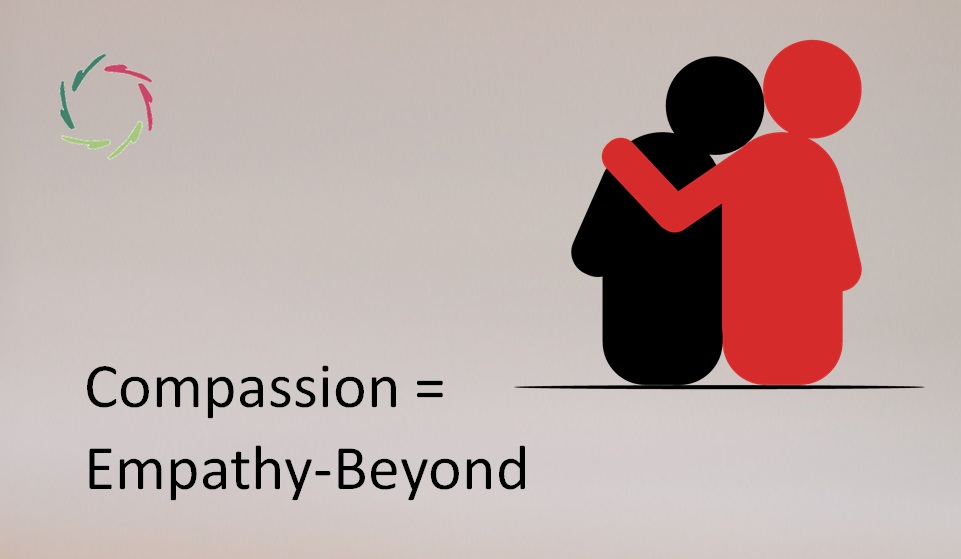
Compassion = Empathy-Beyond
The difference, conceptually, mainly denotes the importance of subconceptual mental processing. This is my use of terminology. Please look at it conceptually ― much more interesting. [see: “Conceptual Landscapes”] In any case, the two concepts have fuzzy and overlapping borders. Please also read about this other distinction: [see: “Altruism – Compassion”] Empathy beyond the conceptual, Read the full article…
Neuroscience Meets Morality: Insights from Patricia S. Churchland
Patricia Churchland is a world famous neurophilosopher. Her works “Conscience: The Origins of Moral Intuition” and “Braintrust: What Neuroscience Tells Us about Morality” explore the neurobiological foundations of morality. After reading both books, Lisa gives in this blog her take on the main points, to which I fully agree. Churchland posits that moral behavior stems from Read the full article…