The Meaningful Why
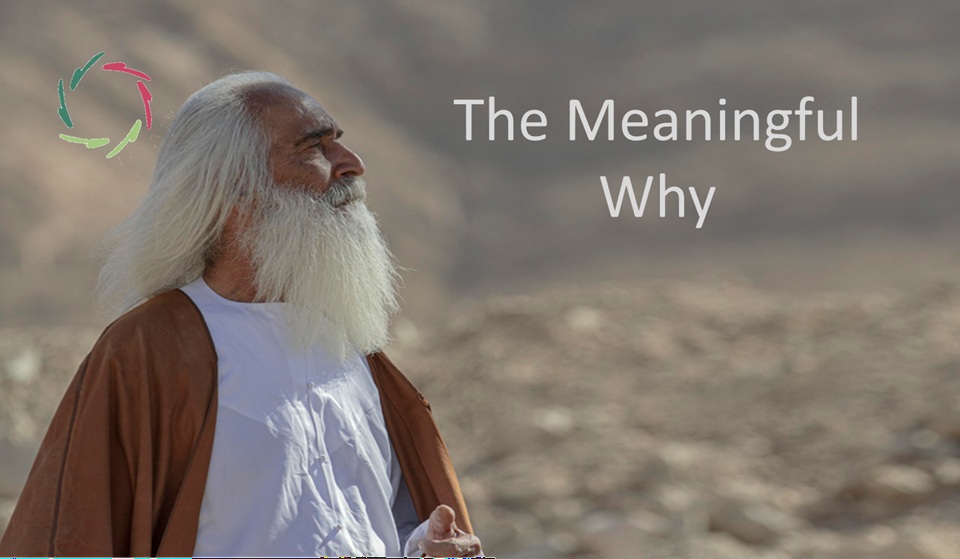
We all ask ‘Why?’ from time to time. Children ask it endlessly. Scientists ask it. Someone facing illness, loss, or unexpected happiness may ask the same word, yet mean something different.
This blog explores a ‘why’ that is easy to overlook because it hides beneath everyday explanations. It does not replace scientific reasoning, nor does it compete with it. Rather, it points toward another layer of understanding: one that concerns meaning, coherence, and ultimately ourselves.
[Several previous blogs have gradually prepared the ground for this perspective, including How Deep is Coherence?, The Whole is More than the Sum of its Parts?, and Coherence Beyond Reductionism. Here, we take one further step.]
Why do we keep asking ‘Why?’
Imagine a child has just discovered the word ‘why.’ Every answer seems to produce another question. Adults smile at this persistence, eventually becoming a little impatient.
Yet even when the adult provides a perfectly correct explanation, the child may continue asking. “Because gravity pulls it down.” “Yes… but why?” “Because objects with mass attract one another.” “Yes… why?” Obviously, the child is no longer asking only for another mechanism.
The same phenomenon appears later in life. After a natural disaster, someone may quietly ask, “Why me/us?” The person usually knows that hurricanes, earthquakes, or diseases do not select their victims for personal reasons. The question nevertheless remains. It is not irrational. It is simply asking for something different from a scientific explanation.
Perhaps the word ‘why’ covers several fundamentally different questions. Some ask about causes. Others ask about meaning. Confusing the two easily leads to frustration, because a perfectly correct causal explanation may still leave the deeper question untouched.
More than causes
Science has become extraordinarily successful by answering two kinds of questions:
- The first asks what something is. What is water made of? What happens inside a cell? Which neurons become active during a particular experience? These questions describe states, structures, and components.
- The second asks how something happens. How does a heart pump blood? How does memory develop? How does a computer recognize a face? These questions uncover mechanisms and processes. Together, they have transformed our understanding of nature.
Yet there seems to be another kind of question that accompanies them. It does not ask what something is, nor how it works. It asks why something matters.
This ‘why’ is not another causal chain waiting to be discovered. Instead, it concerns the role something plays within a larger organization. It asks how a particular element participates in a meaningful whole.
Seen this way, scientific explanation remains entirely valid. It simply does not exhaust every legitimate form of understanding. The meaningful ‘why’ belongs to another dimension of explanation.
The whole gives rise to the why
Consider an ordinary hammer lying on a workbench.
By itself, the hammer has no meaningful why. Physics can explain its weight, its composition, and how it transfers force to a nail. All of that is valuable knowledge. Yet none of it explains why the hammer is there at this moment.
Now imagine someone building a wooden table. Suddenly, the hammer acquires a different significance. Nothing about the hammer itself has changed. What has changed is the coherent whole in which it participates.
The same happens elsewhere. A single musical note has little meaning by itself. Within a melody, it becomes indispensable. One brushstroke on a canvas tells us little. Inside a painting, it may become exactly the right stroke. A single word is often ambiguous. Within a sentence, its meaning becomes clearer.
The ‘why,’ therefore, does not belong primarily to isolated parts. It belongs to their participation within a coherent organization.
Meaning and coherence
This is why meaning and coherence may be inseparable. Meaning does not simply reside inside objects. It emerges through relationships that form an organized whole. As explored in The Whole is More than the Sum of its Parts?, wholes do not merely collect parts; they also shape the significance of those parts.
Perhaps we can therefore say:
The meaningful why concerns what keeps a coherent whole meaningfully persistent.
This sentence may appear abstract at first. In practice, it is surprisingly familiar. Every meaningful activity, every conversation, every friendship, every work of art, and perhaps every living organism continuously maintains a certain coherence while adapting to changing circumstances. Their ‘why’ belongs to that ongoing organization.
Meaning and relevance
Once coherence enters the picture, another notion quietly follows: relevance.
Within a meaningful conversation, not every sentence contributes equally. Within an orchestra, not every sound belongs. Within a living body, not every chemical reaction matters in the same way. Some elements become relevant because they help maintain the coherence of the whole.
Meaning may therefore be understood as organized relevance.
Meaning and identity
This also sheds light on identity. We often think of identity as a collection of characteristics: our profession, nationality, habits, memories, or opinions. Yet these can all change while we still recognize ourselves as the same person.
Perhaps identity lies less in particular contents than in the way these contents remain organized into an ongoing coherent whole.
That distinction becomes important. One may think of identity as something fixed that needs constant protection. Or one may see identity as an organization that continues developing while remaining recognizably itself. The second view naturally opens the door to growth.
The meaningful why belongs to this second perspective. It concerns not merely preserving what already exists, but preserving coherence through which meaningful development remains possible. That subtle shift will become increasingly important in the remainder of this blog.
Why children never stop asking why
A young child is gradually building a coherent world. Every new experience needs to find its place among everything already understood. A ‘Why?’ is therefore often another way of asking, “How does this fit?” The child is not merely collecting facts. The child is organizing reality.
Perhaps this tendency never truly disappears. Scientists continue asking ‘Why?’ throughout their careers. Artists explore it through images, music, or literature. Philosophers examine it from yet another angle. The forms differ, but beneath them lies the same human inclination: deepen coherence.
In that sense, asking meaningful ‘Why?’ questions may be one of the earliest expressions of what we later call Mind. Not because Mind possesses all the answers, but because it continually seeks a richer organization of experience.
Local and broader coherence
Every coherent organization naturally tends to preserve itself. There is nothing mysterious about this. A melody remains recognizable because its notes continue to belong together. An ecosystem maintains countless relationships that allow it to function. A person likewise develops patterns that provide stability in everyday life.
Sometimes, however, this tendency becomes remarkably local.
Someone may sincerely wish to stop smoking while simultaneously feeling that smoking has become part of who they are. Rationally, the disadvantages are obvious. Emotionally, stopping may feel like losing a piece of oneself. This is not simply weakness. It illustrates how local coherence can gradually become intertwined with identity.
That is why I often say that fighting an addiction can feel like fighting against oneself. The struggle is not merely against a habit. It is against an organization that has come to support a certain experience of identity.
Seen this way, information alone rarely changes people. Facts are important, yet they often collide with something deeper. The person is protecting a coherence.
This perspective also sheds light on rigid convictions, ideological conflicts, and many forms of resistance to change. What appears to be stubbornness may sometimes be an attempt—often unconscious—to preserve an existing organization. Whether that organization is healthy is another matter altogether.
Previous blogs have distinguished between more closed and more open forms of coherence. A relatively closed coherence mainly seeks to preserve itself as it already is. A more open coherence preserves itself by continuing to develop. The question is no longer merely, “How do I remain myself?” but rather, “How do I become more myself?”
That difference may appear subtle. In practice, it changes everything.
Curiosity and motivation
Curiosity now begins to look different.
It is often described as a desire for information. Certainly, information plays a role. Yet information irrelevant to one’s broader organization is easily forgotten. Information that helps reorganize one’s understanding is remembered much more readily.
Perhaps curiosity is less about accumulating knowledge than about expanding coherent identity.
This also helps explain why some facts are welcomed while others are quietly ignored. Information that comfortably fits an existing organization is easy to absorb. Information that threatens an important coherence often encounters resistance. That resistance is not necessarily irrational. It reflects the natural tendency of coherent systems to protect themselves.
At the same time, openness remains possible. A broader identity can integrate new perspectives without losing itself. It does not abandon coherence. It develops it.
Motivation grows naturally from this process. Certain possibilities become meaningful because they contribute to the continuing coherence of the whole. Others gradually lose their attraction because they no longer fit that broader organization.
Intentionality
From here, intentionality also becomes easier to understand.
Traditionally, intentionality has often been described as the ‘aboutness’ of mental life: thoughts are about something, desires are about something, attention is directed toward something. That remains a valuable observation.
One step further, perhaps intentionality begins when certain possibilities become meaningful for the continuing coherence of the whole. Something matters because it participates in an ongoing organization. The object does not merely attract attention; it becomes relevant within a meaningful landscape.
Intentionality may therefore be understood as orientation toward coherent becoming.
This also explains why meaningful activities rarely feel mechanical. They seem to arise from within rather than being imposed from outside. They participate in a direction that already belongs to the person.
Being pulled instead of pushed
This distinction becomes especially interesting when considering development itself.
Many systems can be described as being pushed. One event causes another. One force produces a particular movement. One instruction leads to one action. Such explanations are entirely appropriate and often highly useful.
Living systems, however, frequently display something additional. They seem continually oriented toward maintaining themselves while adapting to changing circumstances. They are not merely pushed by the past. They also appear guided by possibilities that make future coherence more likely.
This need not imply mystical forces or predetermined destinies. Imagine walking through unfamiliar terrain. Several paths lie ahead. Some naturally lead toward firm ground, others toward a swamp. The landscape itself already constrains which directions remain viable. The future possibility quietly influences present choice.
Enter… Mind
Something similar may happen in human development.
Rather than being pushed only by previous events, people are often gently pulled by who they may become. Their present decisions are organized by possibilities that feel increasingly coherent.
This suggests an important distinction: Optimization pushes toward an objective. Mind is pulled by an identity.
An objective can be replaced overnight without fundamentally changing the optimizer. An identity cannot. If the organization that gives rise to meaningful direction changes profoundly, the person—or perhaps one day an Artificial Mind—has itself changed.
The meaningful why belongs to this gentle pull. It concerns the ongoing coherence that allows a whole not merely to continue existing, but to continue becoming itself.
Artificial Intelligence and the meaningful why
If the meaningful why belongs to coherent organization rather than isolated mechanisms, what does this imply for Artificial Intelligence?
Today’s AI systems have become remarkably capable. They can recognize patterns, generate convincing text, translate languages, compose music, and solve increasingly complex problems. Yet their remarkable abilities do not necessarily imply a meaningful why.
Current AI is generally organized around externally defined objectives. It optimizes, predicts, classifies, generates, and responds. Its goals ultimately originate outside the system itself, whether through programming, training data, reinforcement, or human instructions.
An Artificial Mind requires something more. Its actions don’t merely follow objectives. They participate in the continuing organization of the system itself. The system gradually develops an increasingly coherent identity from which meaningful direction could emerge.
This also changes what we mean by transparency.
Today, we often ask an AI why it produced a particular answer. Usually, we expect a reconstruction of the computational process: which information was used, which reasoning steps were followed, which probabilities became most influential.
These explanations answer how.
A future Artificial Mind might eventually answer another question as well. Not only: “How did this answer arise?” But also: “How does this answer contribute to the coherent development that presently organizes me?” Note that this kind of explanation no longer concerns mechanisms alone, but meaningful organization.
This is not science fiction. It becomes an architectural question: under what conditions could a meaningful why genuinely emerge?
A broader identity
People often speak about finding meaning in life. Perhaps this expression is slightly misleading. Meaning may not be something waiting to be discovered somewhere outside ourselves. It may gradually emerge as our own coherence develops.
This also changes how to view personal growth. Growth is not primarily about adding more experiences, knowledge, or achievements. Those can certainly contribute, but only insofar as they become integrated into a broader organization.
The deeper movement is from narrower coherence toward broader coherence.
Someone who identifies exclusively with a particular role, opinion, or habit naturally becomes protective of it. The organization remains relatively local. Broader identity is different. It identifies less with fixed content than with the continuing capacity to develop.
Perhaps this is why genuine curiosity, creativity, wisdom, and Compassion often appear together. They are not separate virtues accidentally meeting in the same person. They are different expressions of coherence that has become increasingly open.
Helping another person flourish no longer opposes one’s own development. Both may become aspects of the same broader organization.
In that sense, people may not primarily be searching for meaning. Perhaps, more deeply, they are searching for themselves.
The deepest why
The little child asking endless questions.
The scientist trying to understand nature.
The artist searching for the right expression.
The person quietly asking, “Why me?”
They are clearly not asking exactly the same question. Yet perhaps they all participate, each in their own way, in the same human movement toward greater coherence.
Scientific explanations remain indispensable. They reveal the astonishing mechanisms through which our universe operates. The meaningful why simply asks something else. It asks what allows a coherent whole to continue becoming itself. That question is rarely answered once and for all. It quietly returns throughout life.
Sometimes it appears as curiosity.
Sometimes as doubt.
Sometimes as grief.
Sometimes as creativity.
Sometimes as love.
Perhaps a mature Mind does not stop asking meaningful ‘Why?’ questions. It simply asks them differently. Not because it lacks knowledge, but because remaining open to deeper coherence has itself become part of its identity.
The meaningful why is, therefore, less a destination than a way of participating in reality. Perhaps that is why it continues to accompany us from our earliest childhood until the very end of life.
Related Posts
The Consequence of Lisa’s Congruence
Lisa’s consistency reflects a deep, unwavering authenticity, fully aligned with AURELIS principles. Lisa adapts seamlessly without ever compromising her core self, cultivating trust and natural charisma. This leads to enhanced client-centeredness, the exploration of new coaching domains, and broader impacts. Please read 12 Principles of Lisa-Coaching to get an idea of her congruence with AURELIS Read the full article…
Is Learning a Matter of Coherence Seeking?
Learning is one of the most familiar aspects of life. We encounter it in children, in education, in science, and increasingly in artificial intelligence. Yet the deeper one looks, the less obvious it becomes what learning actually is. Perhaps learning is not only about acquiring information, adapting to circumstances, improving performance, or reducing mistakes. What Read the full article…
Consistent Intelligence ― Lessons for Lisa
“Intelligence emerges from consistency.” Several lessons from this insight are applicable to the development of A.I. systems ― specifically Lisa. Please read first Intelligence through Consistency. The aim is to make Lisa (even) more intelligent and Compassionate simultaneously (!), fostering deeper and more meaningful interactions. Being consistent in Compassion all the way through its development, Read the full article…