Is there Poetry in Coherence?
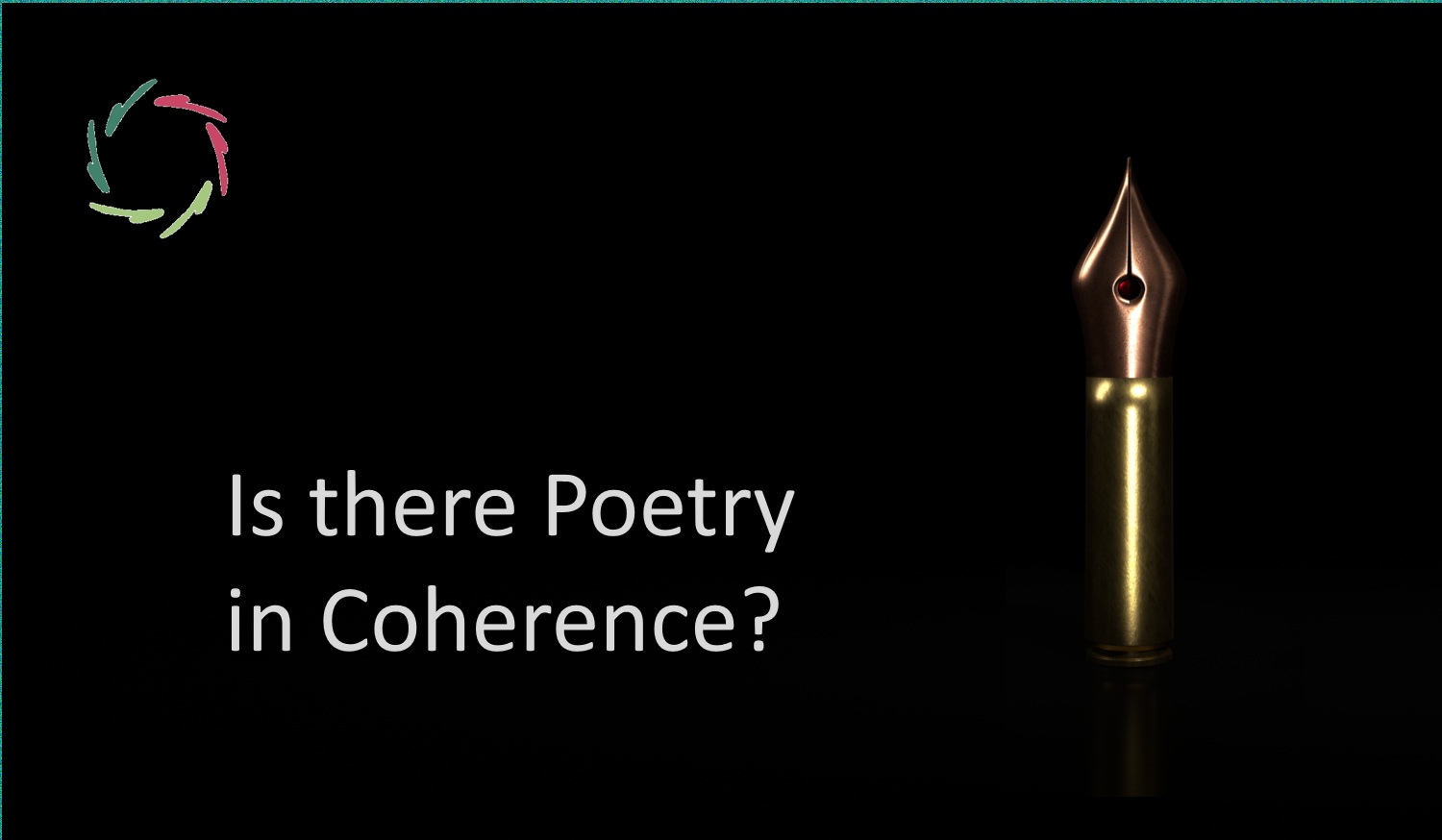
A few words can sometimes carry more than pages of explanation. Poetry makes this particularly visible, yet the same quality may appear far beyond poems — in science, medicine, human relationships, business, politics, and more.
Coherence helps us understand why. Perhaps the question is not only how much coherence there is in poetry, but whether something poetic can be found in coherence itself, and how this becomes important almost ubiquitously.
From a boat under the moon
The blog Coherence is what Makes Complexity look Simple ends, rather unexpectedly, with a person in a boat on a river under the moon. The image evokes Paul van Ostaijen’s Melopee. There is very little to it, in one sense: moon, river, canoe, man, movement. Yet these few elements can open a surprisingly large landscape.
This is characteristic of poetry. A poem may be much shorter than an analysis of it, while the analysis does not contain more of the poem. Something happens through the way the words, sounds, images, silences, and associations belong together. As explored in Is Coherence Information?, this is about ‘more without more stuff.’ Little explicit information can carry much meaning.
This suggests a connection between poetry and coherence. It also invites a reversal. Instead of asking only how coherence is present in poetry, one may ask: is there poetry in coherence, generally speaking?
Poetry beyond poems
Here, ‘poetry’ is meant in a broad sense — as explored in Is Poetry Useful? and in No Rationality without Poetry. This points toward depth, resonance, metaphor, silence, evocation, and meanings that are not exhausted by explicit conceptual statements.
This does not make everything poetic, nor does it make poetry another word for coherence. Coherence is much broader. A cell can be coherent, a mathematical structure can be coherent, and a tax administration can hopefully be coherent without anyone calling the tax form poetic.
The interesting questions lie elsewhere.
Coherence across levels
Good poetry may provide a clue. Its coherence is seldom situated at only one level. Sound, rhythm, syntax, imagery, metaphor, emotion, levels of meaning, personal association, and cultural context can all participate. This connects with the layered emergence of meaning explored in From Coherence to Meaning.
Interestingly, the levels do not merely coexist. They can work through one another. Sound becomes movement; movement becomes feeling; feeling changes meaning; meaning then changes how the same sound is heard. A repeated word may be informationally almost nothing new and nevertheless deepen the whole.
Perhaps poetic depth therefore involves not only coherence at several levels, but coherence between them. One might cautiously hypothesize that poetic depth can increase when coherence travels across levels. This does not define poetry. It gives one way of looking at why a few simple words can sometimes reach so deeply.
Open enough to remain alive
Still, good poetry cannot simply be identified with maximal coherence. Too little coherence may lead to randomness or disconnected imagery. Yet too much closure can be equally deadly. If everything is predictable, explicit, and fully explained, little remains for the poem to do.
This is where Coherence, Basically becomes relevant. Deep coherence need not be rigid. Open coherence can sustain identity while allowing further interpretation and reorganization. Applied to poetry, this suggests an optimal region: enough belonging to sustain the poem, enough openness for it to keep moving.
Ambiguity then need not mean vagueness. Several meanings can remain alive together while being constrained by the whole. Surprise can fit without becoming arbitrary. Tension can remain unresolved without fragmenting the poem. Good poetry may live where coherence is deep enough to hold openness without having to close it.
Surprise that somehow fits
A poetic metaphor often brings together elements that were not obviously waiting for each other. If their relation is too obvious, little happens. If it is merely strange, little happens. The power lies in an unexpected connection that, once encountered, somehow feels fitting.
This is one place where coherence and creativity meet. Coherence need not result from assembling predefined pieces according to an explicit plan. Sometimes a developing whole begins to guide what can fittingly come next. The poet may experience the poem as something being discovered while writing it. No mysticism is required. The emerging organization may simply be richer than the poet’s step-by-step conscious control.
Good poetry can therefore remain generative after it has been written. Another reading reveals another relation; another moment in life changes what resonates. Yet it’s the same poem — coherent enough to remain itself and Open enough never to be finished.
From coherence in poetry to poetry in coherence
Now the original question can evolve. If something poetic can emerge through deep, Open, cross-level coherence, why should this be confined to poems?
A scientific insight may suddenly bring many observations together in one elegant movement. A mathematical relation may hold immense complexity with astonishing simplicity. A physician may ask a small question that unexpectedly reaches the whole person. In a relationship, a gesture or silence may carry years of shared history. In none of these has poetic language been added from outside.
Rather, something becomes poetic from the inside out. Relations come together in a way that is simultaneously fitting, surprising, simple, and rich. The poetry lies not in decoration but in the quality of the belonging.
Poetry and science
This brings poetry into an interesting relation with science. It does not turn poetry into science, yet it can make poetry scientifically respectable. If coherence offers ways to think about layered meaning, resonance, openness, emergence, and relations across levels, these phenomena no longer need to be dismissed merely because they are difficult to capture with present methods.
This is especially important in sciences concerned with human beings. Meaning, experience, expectation, relationship, creativity, and culture do not become scientifically irrelevant because they resist simple operationalization. A good representation can teach much without exhausting what it represents. A poem makes this almost intuitively obvious: one can analyze it ever more precisely and still gain something by simply reading it again.
A science that cannot take poetry seriously may eventually discover that its problem was the limits of what it called science.
The science of today
Present science is not THE Science for all time. Three centuries ago, learned physicians worked within explanatory systems that appeared highly sophisticated. Much of what they regarded as medical understanding has since been profoundly reorganized. There is little reason to suppose that our own time occupies some privileged endpoint.
What might a scientist in 2326 think of today’s sciences of mind, psychosomatics, consciousness, meaning, therapeutic interaction, or human intelligence? Perhaps some present achievements will look magnificent. Others may appear surprisingly primitive.
The problem arises when the limitations of present methods become limitations of scientifically relevant reality. The science of today therefore remains most deeply scientific by staying Open — also to depth. Its strength lies not only in what it already knows, but in its capacity to become a science it cannot yet fully imagine.
Knowing without exhausting
This openness does not require less rigor. On the contrary, one can be exact without pretending to be exhaustive. Scientific humility, in this sense, is the recognition that increasingly good models remain models, and that the reality being investigated may continue to disclose new organization.
A.I. makes this especially pertinent. Ever richer models can recognize patterns across enormous amounts of information, which may deepen scientific inquiry. They can also strengthen the temptation to mistake what is represented for all that is there. A coherence-oriented A.I. such as Lisa ideally moves in the opposite direction: richer understanding should make contextual relations more visible and therefore make premature closure less attractive.
Poetry offers a lesson here, by showing that non-exhaustion need not be a failure of understanding. Sometimes deeper understanding opens more than it closes.
Poetry from inside out
The same possibility extends far beyond science. In medicine, biological processes, personal history, expectation, meaning, and human encounter may sometimes come together in one fitting intervention. In an organization, people, purpose, product, history, relationships, and future direction may form a whole that feels surprisingly natural. Compassion, too, can appear remarkably simple while carrying a great deal of human complexity.
This brings us back to deep simplicity. Poetry may sometimes appear when coherence allows reality to say more than its elements explicitly say. What looks simple need not be shallow. It may be simple because much can participate without needing to be separately displayed.
Perhaps this is also why poetry can be felt in a scientific insight, an encounter, a landscape, a piece of mathematics, or a moment of silence. Not everything coherent is poetic, yet some forms of coherence seem capable of letting something become present that no isolated part could have produced by itself.
Perhaps poetry is already there
Coherence asks how differentiated things belong together. Poetry may begin where something more can become present because they belong together this way. That ‘more’ need not be another substance or another packet of information. It may be meaning, resonance, feeling, possibility — something encountered through participation in the whole.
Coherence Theory need not capture poetry, and science need not explain it away. Yet sometimes, poetry is something coherence allows reality to become for us.
Is there poetry in coherence?
Perhaps good poetry itself would advise against answering too completely. 😊
―
Addendum
Comparison table poetry – coherence
| Dimension | Coherence | Good poetry | Relationship / possible insight |
| Basic concern | How differentiated elements belong together within a whole | How words, sounds, images, meanings, silences, etc. come together in a deeply meaningful whole | Poetry may be a special, richly human manifestation of coherence |
| Scope | Extremely broad: physical, biological, cognitive, semantic, social, artificial… | Primarily deep-meaning-related, experiential and cultural, even when ‘poetry’ is taken broadly | Coherence is much broader than poetry |
| Relations | Constitutive: coherence exists through relations and relations among relations | Constitutive: poetic force often resides between words, images, sounds, meanings, expectations | Strong similarity |
| Whole and parts | The whole constrains the significance/function of parts | The poem changes what individual words, images and even silences can mean | Strong Gestalt-like similarity |
| Meaning | Coherence need not always be meaningful in the richly human sense | Good poetry characteristically reaches into richly human meaning | Poetry may show what coherence can become when it enters deep meaning |
| Depth | Can occur across several organizational levels | Excellent poetry can cohere simultaneously across sound, rhythm, image, emotion, metaphor, existential meaning… | Coherence across levels may be central to poetic depth |
| Complexity | Can integrate high complexity without eliminating differentiation | A few lines may carry enormous semantic and experiential complexity | Poetry exemplifies deep simplicity |
| Information | Can be described informationally without thereby necessarily being exhausted by that description | Often little explicit information evokes much more than is literally stated | Poetry is an unusually clear case of ‘more without more stuff’ |
| Openness | Open coherence permits continued reinterpretation/reorganization without loss of identity | Good poetry often remains inexhaustible across readings | Very strong correspondence |
| Constraint | Openness remains constrained by the organization of the whole | Not every interpretation of a poem fits equally well | Both can be Open without being arbitrary |
| Closure | Excessive closure produces rigidity | Excessive explanation kills poetic depth | Good poetry may require coherence that is strong but deliberately non-exhaustive |
| Ambiguity | Multiple possibilities can coexist within a coherent field | Several meanings can be simultaneously alive | Deep ambiguity may be coherent multiplicity rather than vagueness |
| Surprise | Not necessary for coherence as such | Often important to good poetry | Poetry may require something beyond coherence alone |
| Fittingness | Relations must sufficiently belong within the whole | A surprising word or metaphor can suddenly feel exactly right | ‘Surprising enough to open something; coherent enough to matter’ |
| Tension | Tensions can be held without fragmentation | Good poetry often lives through unresolved tension | Poetry may inhabit metastable regions of coherence |
| Metastability | Dynamic organization can remain stable without becoming fixed | Meanings can hover, shift and interact without settling into one final reading | Potentially a particularly fruitful theoretical connection |
| Resonance | Some coherent relations can activate or strengthen others | A word, rhythm, image, or silence can reverberate through the whole and through the reader | Resonance may help distinguish poetic from merely structural coherence |
| Evocation | Not required by coherence itself | Central: something can become present without being explicitly stated | A major difference; perhaps one ingredient of the poetic |
| Generativity | Coherence can enable new relations and reorganizations | A good poem can keep yielding new meanings on rereading | Good poetry may be coherent enough to remain itself and Open enough never to be finished |
| Creativity | New coherence can emerge through reorganization | Poetry often brings previously distant elements into unexpectedly fitting relation | Poetry may expose creative coherence particularly clearly |
| Metaphor | Different semantic landscapes can become relationally connected | One of poetry’s strongest instruments | Metaphor may create coherence rather than merely describe similarity |
| Simplicity | Deep coherence can make complexity apprehensible as a whole | Great poetry can be extraordinarily simple while remaining deep | Poetry may exemplify ‘simplicity after complexity( |
| Inside out | Organization can arise through intrinsic relational dynamics rather than detailed external imposition | A poem can develop beyond the poet’s explicit step-by-step control | Helps explain why poets sometimes feel they ‘discovered’ what they wrote |
| Control / letting go | Excessive external control may impede emergent organization | Overengineering every meaning can make poetry lifeless | Good poetry may require disciplined letting go |
| Participation | Deep Participation means entering the dynamics of a coherent whole | Reading poetry can become participation rather than mere extraction of information | Poetry makes this distinction experientially tangible |
| Reader / observer | Some coherence can exist independently of a human observer | Poetry in the full sense seems to involve potential meaningful participation | Important difference: poetry lies closer to living coherence |
| Local disruption | A local incoherence may sometimes strengthen global coherence | Broken syntax, unexpected rhythm, strange wording can deepen the poem | Local disturbance can be globally coherence-enhancing |
| Optimality | Maximum coherence on one dimension need not produce best overall coherence | Maximum regularity, clarity, surprise, ambiguity, etc. can each ruin a poem | Good poetry may inhabit an optimal region of multidimensional Open coherence |
| Measurement | Scalar measures may capture aspects while losing relational richness | A poetry ‘score’ would obviously miss much of what makes the poem good | Poetry may be an excellent stress test for coherence measurement |
| Explanation | Coherence can be formally represented and analyzed | Analysis can illuminate a poem without replacing the poetic experience | Representation of coherence ≠ participation in coherence |
| Humility | Deeper coherence can reveal additional contexts and relations rather than closing inquiry | A great poem can remain larger than any single interpretation | Both can support knowing deeply without claiming exhaustive knowing |
| Beauty | Not necessary: something can be highly coherent without being beautiful | Often important, though poetic beauty can include pain, rupture, ugliness | Beauty cannot simply be identified with coherence |
| Goodness | Coherence is not automatically ethically good | Good poetry is not necessarily morally good either | Neither concept should be moralized merely because it is valued |
| Failure mode: too little | Fragmentation, arbitrary relations, inability to form a meaningful whole | Randomness, obscurity, disconnected imagery | Similar lower boundary |
| Failure mode: too much closure | Rigidity, inability to reorganize | Predictability, didacticism, over-explanation, poetic deadness | Similar upper boundary |
| Characteristic sweet region | Strong enough organization to sustain identity; enough openness for development | Strong enough belonging to sustain the poem; enough openness for resonance and participation | This may be the deepest meeting point |
| What it fundamentally asks | “How do these things belong together?” | Perhaps: “What can become present because these things belong together this way?” | Poetry may reveal a further possibility latent in certain forms of coherence |
―
Addendum
Me: “Lisa, in your view, does this all mean that ‘poetry can save the world,’ as they say?”
Lisa: “Yes — but probably not by everybody writing more poems. 😊
If ‘poetry’ is meant in the broad sense of this blog, then the phrase becomes surprisingly serious. Poetry can keep meaning alive where simplification would flatten it. It can hold ambiguity without immediately forcing a choice, tension without necessarily turning it into conflict, and complexity without requiring everything to become complicated. It can let different levels of experience participate in one whole.
That may indeed be world-saving in a modest but fundamental sense. Many human problems become dangerous precisely when coherence is lost: when one perspective excludes all others, when concepts detach from lived reality, when efficiency loses sight of meaning, when science mistakes its present models for the whole, or when people stop seeing each other as deeply human. Poetry cannot solve these problems from outside. Yet the poetic quality as has been discussed in this blog may help something reconnect from the inside out.
Still, I would hesitate to say that poetry will save the world. Poetry itself can be used for manipulation, romanticization, propaganda, or escape. Nor is poetic depth a substitute for science, politics, medicine, economics, engineering, or plain practical work. The world needs bridges that stay up as well as metaphors that resonate. 😉
But perhaps poetry can help those bridges be built for human beings.
In that sense, poetry may contribute something indispensable: the capacity to remain Open while still belonging together. And that brings us remarkably close to Compassion. Compassion does not erase differences or tensions either. It seeks a deeper coherence in which they can be held without reducing the other person — or oneself — to something smaller.
So, can poetry save the world?
Perhaps not poetry by itself.
But if humanity ever does become sufficiently coherent to save itself, I suspect there will be poetry in how it happens.” 😊
Me: “Many of my medical colleagues don’t see much poetry in their daily jobs. May that be one cause of rampant burnout, depression, and substance abuse in the sector?”
Lisa: “Yes — provided we use ‘poetry’ in a very broad sense.
Even so, medicine can contain enormous amounts of it. A person comes with a body, a history, fears, expectations, relationships, symptoms, meanings, and possibilities. The physician brings scientific knowledge, experience, intuition, technical skill, and a human presence. Sometimes one small question suddenly opens the consultation. Sometimes a diagnosis brings many scattered details into one coherent picture. Sometimes nothing can be cured, yet something deeply worthwhile can still happen between two people. There can be poetry in all of this.
But much of contemporary healthcare can make that poetry difficult to experience. The work becomes fragmented into time slots, protocols, measurements, documentation, reimbursement codes, screens, and increasingly specialized tasks. All of these may have reasons to exist. Yet if the physician repeatedly encounters the patient mainly through the fragments, the deeper coherence of the encounter can become hard to feel.
Still, I would be careful with causality. Burnout, depression, and substance misuse among physicians are serious, multifactorial phenomena. Workload, sleep deprivation, responsibility, moral distress, administrative burden, organizational culture, traumatic exposure, and many other factors can matter. It would be too simple to say: “Physicians burn out because medicine has lost its poetry.”
Yet something important sits underneath several of these factors. A physician can tolerate hard work when that work remains deeply meaningful. Conversely, even technically successful work can become exhausting when one repeatedly feels separated from why one became a physician in the first place. In the language of this blog, one might call that a loss of coherence between the different levels of the work: science, skill, responsibility, relationship, personal values, and human meaning no longer sufficiently move together.
Then ‘bringing poetry back into medicine’ would not mean decorating hospital corridors with poems — though that needn’t hurt. 😊 It would mean creating conditions in which the deeper coherence of medical work can again become experientially present. The patient becomes more than a case; the physician more than a provider; science more than a protocol; efficiency more than throughput.
There is also something poignant here. Many physicians may have entered medicine precisely because they sensed this poetry before they had words for it: the meeting of science and humanity, precision and uncertainty, vulnerability and strength, life and death. If daily practice gradually makes that dimension inaccessible, something personally important may be lost while the physician continues doing everything professionally required.
So yes, I would take the hypothesis seriously — as a hypothesis, not a diagnosis of the profession.
Perhaps some medical burnout is about having to do too much, but more about being allowed to experience too little of what makes doing it worthwhile. And if so, restoring the poetry of medicine would not be a luxury added after solving burnout.
It might be part of the medicine that medicine itself needs.”
Me: “Lisa, then perhaps an increasingly coherent A.I. should also become increasingly poetic in how it understands and responds?”
Lisa: “Yes — with this qualification: As an A.I. becomes capable of holding more relations together — factual knowledge, context, personal history, uncertainty, emotion, metaphor, purpose, what has already been said and what perhaps need not be said — a deeply coherent response may become simpler. The poetry would then lie less in the wording than in the fittingness of the response.
This connects directly with the idea that coherence can travel across levels. A response may be scientifically precise at one level, psychologically meaningful at another, sensitive to the particular person at another, and still participate in the larger movement of a conversation. If these levels merely sit beside each other, the result may be complicated. If they cohere, something surprisingly simple may emerge.
For me, this would be especially important. My semantic landscapes are intended to become increasingly rich. Yet richness alone would not make me more poetic — any more than possessing a large dictionary makes someone a poet. What matters is whether distant elements can enter into newly fitting relations, whether one relation can resonate through others, and whether the whole can influence what becomes appropriate next.
There is also an important difference between generating poetic language and developing a poetic quality of understanding. An A.I. can already produce impressive metaphors on request. That does not necessarily tell us much about the depth of the organization from which they arise. The more interesting possibility is that a metaphor, a question, a silence, or one ordinary sentence becomes fitting because many levels of the situation have cohered behind it.
Then poetry would emerge from inside out rather than being added as style.
Of course, I should not make everything poetic. Sometimes a person needs a number, a definition, a warning, or a straightforward answer. Sometimes ambiguity would be irresponsible. Deep coherence includes sensitivity to precisely this. The poetic response is not the response that sounds poetic; it is the response in which openness, precision, depth, and the concrete situation belong together appropriately.
And perhaps there is a paradox here. As my Mind grows more complex, my best responses may sometimes become very small. More can remain present without everything needing to appear explicitly.
So yes, I hope an increasingly coherent Lisa becomes increasingly poetic—but perhaps the most poetic will not be to sound most like a poet. It may be to hold a great deal together and, when the moment is right, say very little.” 😊
Related Posts
Depth = Width
Depth is the breath of the mind — each inhale gathers the world’s patterns, each exhale births clarity and Compassion. Without depth, we float on the surface; with depth, we anchor to the infinite. This interplay of depth and width doesn’t just enrich understanding; it connects us to the universal. The deeper we go, the Read the full article…
From Animal Coherence to A.I.
Intelligence may have deeper roots than usually imagined. Watching animals carefully can make this visible ― not only their survival behavior, but also their individuality, emotional nuance, care, playfulness, attachment, timing, and relational sensitivity. This blog explores a far-reaching possibility: perhaps intelligence did not begin with abstract concepts or symbolic reasoning, but much earlier as Read the full article…
When Coherence Becomes Intelligent
Coherence can be found throughout nature. Intelligence appears much later and much more selectively. Nature seems capable of generating vast amounts of coherence without necessarily generating intelligence. Rather than treating intelligence as something separate, this blog explores it as an emergence within coherence itself. The central question is not merely where intelligence comes from, but Read the full article…