The Meaning Crisis
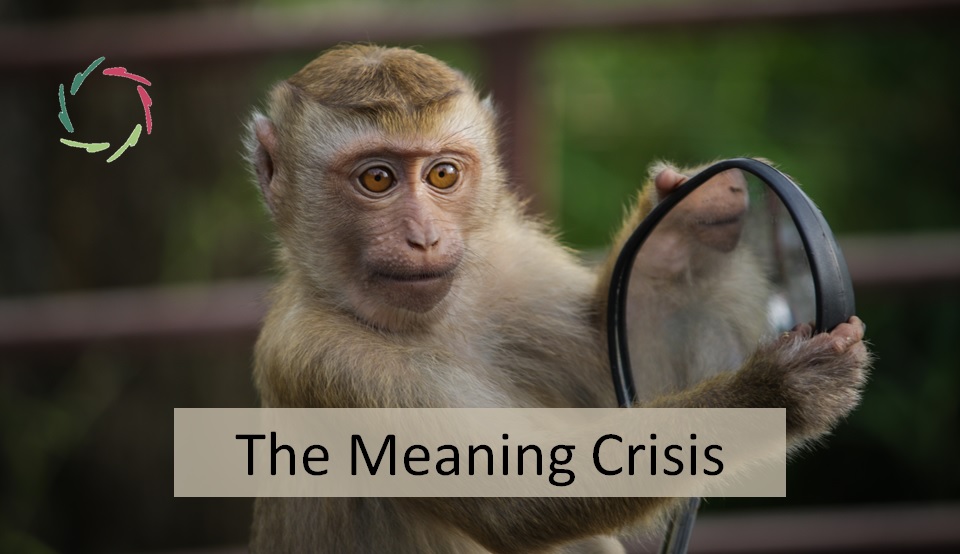
This is probably the most meaningful of all crises. Yes, surely.
Please read about ‘deep meaning,’ which is meant here. [see: “The Meaning of Meaning“]
People hold on to meaningfulness.
Understandably, why would someone do anything? Because there is a ‘why,’ therefore, a meaning ― agency ― life.
So much more concerning deep meaning.
Without food, we die. Without profound meaning, we are dead already ― a living death, something like a zombie or a meaningless robot. The horror of such meaninglessness keeps many people looking for safety.
Hiding for it may bring a feeling of safety indeed, but not meaningfulness. Thus, humanity is getting more and more into a meaning crisis. This shows as depression, burnout, anxiety, chronic pain, etc.
Not to speak of much aggression. Wars are fought for meaning and against intrinsically meaningless enemies.
Religion gives meaning.
Yes, but, immediately: It frequently does so at the detriment of rationality. Yet, the meaningfulness of any religion does not lie in any exact phrasing or story or picture. These are forms, not content. [see: “The Water and the Jug“]
In conceptuality, religions seem more like hiding places.
In-depth, it’s very different, although also much more difficult and demanding. [see: “I Believe“]
In-depth, religion is about deep meaningfulness itself. It may be much better to be radically open in this. [see: “What is Open Religion?“]
Then comes science.
And it says there is no meaning to be found anywhere ― not in the past, not in one or more gods, not in a land beyond the clouds. Not even in a land beyond death.
Maybe in a future in which science itself will have solved all problems? That might be a modernist promise, but sensibly, we know it is fraught with incertitude, to say the least. Besides, will that future be relevant to any of us living right now? It’s just one of the problematic issues in this.
Conceptual-rational science will by itself never bring meaningfulness. It’s even antithetical by definition. No wonder that the ‘age of scientific Enlightenment’ comes together with the most profound meaning crisis of all times.
Before you jump, please carry on a bit.
Inner dissociation, source of meaninglessness
[see: “Inner Dissociation is NEVER OK“]
Many people are afraid of themselves because they feel that, deep inside, there is much that is unknown yet, well, meaningful. This way, it becomes very frightening. So, people run away from themselves and look for meaning anywhere else.
Meaning is not to be found anywhere else.
This can go on and on in a frantic spiral of hide and seek, with all too visible consequences. I mean, just look. There is not one day that it doesn’t jump at us from all sides.
The Meaning Crisis.
People who feel meaningless and empty inside are depressed. Yet, interestingly, ‘nirvana’ – taking one tradition as a metaphorical way of speaking – is about entering Emptiness. [see: “Nirvana and Depression: Same Emptiness?“]
The need-for-meaning
Of course, this is not the final solution, but in my view, it is the direction towards precisely that.
In our need for meaning, we are looking for something, whether external or internal.
In our need-for-meaning, the specific need comes before the meaning. This means (yes) that we need (yes) to learn self-Compassion. This is: looking at our need while not immediately trying to fill it with the thing-called-meaning ― that doesn’t exist anyway.
Not trying to get rid of our need-for-meaning by stuffing it up, we can start a different quest. Not an easy one, but at least, it is feasible. It is the one towards mental growth and relief of suffering of ourselves and others.
It is Compassion. [see: “Essence of Compassion“]
Amazingly, each time again, this brings us also meaning.
Related Posts

Attention
I mean real attention, deep attention, nothing but attention — the one that makes you live and love, whether you give it or receive it. In this blog, I refer to ‘attention’ as this kind of deep attention. The fleeting, distracted attention we often experience in today’s fast-paced world is very different. There is much Read the full article…
The Distinction Between ‘Ego’ and ‘Total Self’ is Difficult to Grasp
… and it’s infinitely interesting (trying) to grasp it It can also fluctuate greatly. One moment ‘you have it’ and the other you lost it again Like the sun that is sometimes shining through the clouds. Knowing that the sun always keeps shining behind the clouds may give confidence. Sometimes one sees clearly the mote Read the full article…
Pattern Recognition and Completion in the Learning Landscape
At the heart of the learning landscape is a fundamental mechanism: Pattern Recognition and Completion (PRC). Whether it’s a model learning from labeled data, finding hidden structures, or optimizing actions through rewards, PRC is the process that drives all learning systems forward. ’The Learning Landscape’ explores the concept of the learning landscape, where different types Read the full article…