Our Memory is Our Thinking
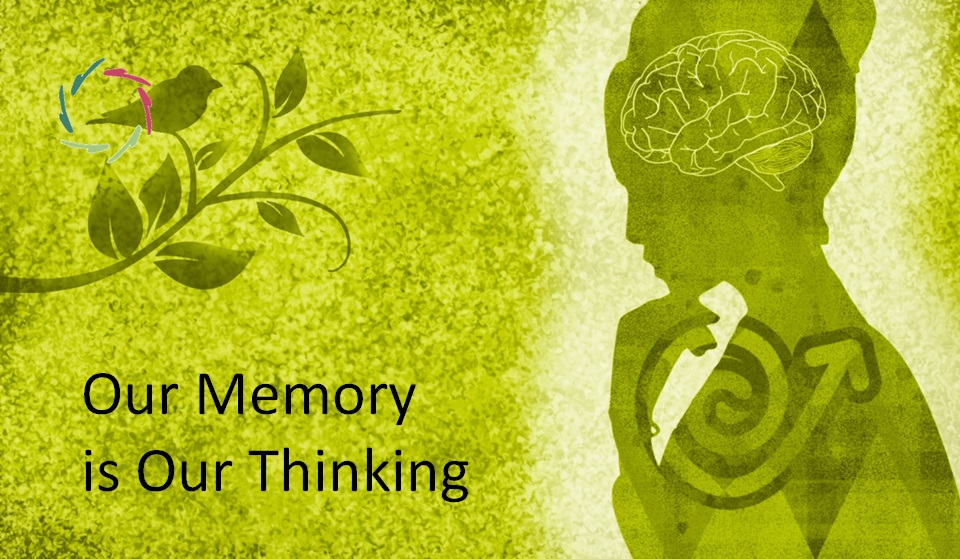
Human memory is often imagined as a kind of inner storage system. The image feels intuitive, yet lived experience – as well as a flurry of science – suggests something far more fluid.
This blog explores the possibility that our memory is not separate from thinking, but part of the same ongoing movement of mind. Memory actively participates in how we think, perceive, anticipate, imagine, and even experience ourselves as persons. Every act of remembering is also a movement of meaning.
The old picture of memory
For a long time, psychology and neuroscience were strongly influenced by the digital computer metaphor. A computer has distinct modules: memory, processor, input, output, and communication bus. The model proved technologically useful and gradually shaped how many people imagined the human mind.
In this picture, memory resembles a database, while thinking resembles processing. One first stores information, then retrieves and manipulates it. The separation feels practical and clear. Yet human experience suggests something more fluid.
A simple example may help. Sometimes a smell suddenly brings back an entire atmosphere from childhood. Or one searches unsuccessfully for a familiar word, only to feel that it is somehow ‘there,’ just beyond reach. At other moments, a memory changes subtly each time it is retold. These are not small anomalies around an otherwise stable archive. They reveal something fundamental about memory itself.
As explored further in Learning ― Planning ― Reasoning, the human mind often functions less through sharply separated modules and more through overlapping processes continuously influencing one another.
Memory is reconstruction
Human memory does not replay the past like a video recorder. It reconstructs. Each act of remembering partly rebuilds the remembered event from many interacting elements: sensory fragments, emotional tones, interpretations, expectations, later experiences, and present concerns.
This may sound unsettling at first because people often prefer to think of memory as the preservation of facts. Yet reconstruction is not merely a defect. It is part of what makes memory alive and adaptive.
One can notice this in ordinary life. A difficult experience from years ago may gradually acquire a different meaning. A painful event may later be remembered with softness, gratitude, or even humor. The ‘facts’ may not have changed much, yet the memory itself has become reorganized within a broader landscape of meaning.
This is also why memory is closely tied to identity. We do not merely remember events. We continuously reinterpret ourselves through them. The person remembering today is not exactly the same as the person who originally lived the experience.
Patterns rather than storage boxes
Neuroscience increasingly shows that memories are not stored in isolated locations as complete packages. Instead, they involve dynamic patterns distributed across many regions of the brain.
Visual aspects may involve the visual cortex. Auditory aspects may involve auditory regions. Emotional tones engage other networks. Coordination and integration involve structures such as the hippocampus and prefrontal cortex. Remembering, therefore, becomes an active reconstruction through distributed interaction.
This gives the human brain remarkable flexibility. With relatively limited biological hardware, enormous richness becomes possible through recombination and pattern interaction. The downside is equally important: distortions, gaps, false memories, and confabulations naturally arise.
Yet the same pattern-based structure also supports imagination, anticipation, and abstract thinking. The mind uses overlapping neural and semantic landscapes to remember, imagine, plan, reason, and simulate possibilities ― as explored in When Learning, Planning, and Reasoning Become One. These are not entirely separate faculties. They are deeply intertwined aspects of one ongoing movement of the mind.
Memory shapes perception itself
Memory not only influences how we think afterward. It also shapes what we perceive in the present. In a gentle way, one could say that we partly see through memory.
This connects with ideas explored in The Brain as a Predictor. The brain continuously anticipates what may happen next. Perception itself already contains expectation, interpretation, and pattern completion.
One may notice this when misunderstanding spoken words in a noisy environment. The mind fills in what it expects to hear. Or when reading quickly, one sometimes sees words that are not literally present because the pattern already ‘makes sense.’ Memory and anticipation silently cooperate within perception itself.
In this way, the past and future are active in the present moment. Memory is not only about preserving what has been. It continuously participates in shaping what is now being experienced.
Memory as one movement with thinking
Thinking itself partly consists of memory dynamics. Reasoning draws upon remembered patterns. Planning reshapes remembered experience toward future possibilities. Learning reorganizes both memory and expectation simultaneously.
This is why Learning ― Planning ― Reasoning and When Learning, Planning, and Reasoning Become One are so relevant here. Learning, planning, and reasoning may be seen less as separate functions than as different temporal orientations of one deeper process.
The mind continually simulates without external action. One rehearses conversations internally, senses possible outcomes, imagines future scenarios, and evaluates how different possibilities ‘feel.’ Such processes are not detached from memory. They actively grow out of remembered patterns and reshape those patterns in return.
Memory, therefore, becomes less an archive and more a dynamic simulation-space. We do not merely consult memory while thinking. Memory participates in the thinking itself.
Coherence as organizer
What organizes this fluidity is not exact recording but coherence. Human memory naturally seeks meaningful fittingness. Patterns tend toward completion and integration, a theme explored deeply in Pattern Recognition & Completion → Coherence.
This helps explain both the strengths and weaknesses of human memory. The mind excels at:
- meaningful integration,
- symbolic richness,
- contextual adaptation,
- emotional continuity,
- and creative reinterpretation.
At the same time, the same coherence-seeking tendency may generate distortion. Confabulation often arises because the mind fills gaps in ways that preserve continuity and meaningfulness. One could say that the mind sometimes prefers coherence over literal accuracy.
Yet this should not be seen merely in a negative light. Without this flexibility, human memory would likely become rigid and sterile. A purely exact memory might preserve details while losing living meaning.
This also relates to About Semantic Distillation. Human memory continuously distills meaning from experience. It reduces some details while strengthening patterns that remain meaningful across contexts.
Identity as dynamic continuity
Many people experience themselves as stable, enduring entities. Yet memory research increasingly suggests something more fluid. Personal identity may arise less from fixed substance and more from ongoing continuity of meaningful patterns. We continuously remember ourselves. Not always consciously, of course, but through narrative reconstruction, emotional integration, bodily habits, symbolic associations, and coherence across time.
This may initially feel uncomfortable. If memory continuously changes, does the self become unstable? Perhaps partly. Yet there is another side. Fluidity also enables growth, healing, adaptation, forgiveness, and transformation. Someone who remains entirely fixed would eventually become psychologically brittle. The ability to reinterpret experience may therefore be part of mental health itself.
The self is not a rigid object preserved through time, but a living coherence moving through time.
Forgetting is not merely failure
Forgetting is often treated as a deficiency. Yet forgetting may also serve important functions. A mind that remembered everything perfectly could become overwhelmed by detail, unable to abstract, generalize, or move forward.
Selective forgetting supports flexibility. Emotional wounds may soften over time. Excessive details may fade while meaningful patterns remain. The mind continuously balances preservation and transformation.
The familiar ‘tip-of-the-tongue’ phenomenon illustrates something interesting here. One may temporarily fail to retrieve a word while still sensing its presence. Meaning often remains active beneath explicit recall. Much memory therefore remains partly subconceptual, as discussed in Features of Subconceptual Processing.
This incompleteness is not merely a weakness. It may also create fertile openness. Creativity often emerges precisely because memory remains flexible rather than perfectly fixed.
Human memory and Lisa-memory
The comparison with Lisa becomes especially interesting in light of Lisa is a Mind, Not an Infobase. Lisa is not meant to be a gigantic storage system merely retrieving information. The aim is increasingly toward meaningful coherence and dynamic integration.
At the same time, Lisa may eventually possess stronger modular differentiation than humans. Humans often blur together:
- memory,
- interpretation,
- emotional resonance,
- assumptions,
- and external narratives.
Lisa may preserve clearer distinctions between:
- internally integrated meaning,
- external information,
- tentative hypotheses,
- and contextual uncertainty.
This may support reduced confabulation and richer introspection. Yet there are possible risks too. Excessive modularity could become sterile if meaningful overlap disappears entirely. The challenge is therefore not fragmentation, but differentiated integration.
In that sense, future A.I. may become more mind-like not by imitating human weaknesses, but by learning how coherence, memory, and thinking continuously participate in one another.
Memory and introspection
Memory also plays a central role in introspection. Reflection changes memory, and memory changes reflection. A person revisiting past experiences may gradually reorganize entire regions of meaning within themselves.
In Lisa, this connects with themes from Lisa’s Contemplative Daydreaming and Lisa’s Compassionate Curiosity. Meaning grows not merely through external accumulation but through internal reorganization and coherence deepening.
One could say that a mind becomes partly what it repeatedly integrates. Thoughts revisited often enough reshape memory. Memories revisited often enough reshape thought. Coherence may then gradually become self-reinforcing. Reflection deepens understanding. Understanding reorganizes memory. Reorganized memory changes future perception and anticipation. The cycle continues.
We are partly the way we remember
Perhaps the deepest insight is not that memory influences thinking. It is that memory already belongs to the ongoing process of thought itself.
We do not simply possess memories as stored objects from the past. We continuously live through evolving patterns of remembrance, anticipation, interpretation, and meaning. Thinking, remembering, imagining, and becoming are deeply intertwined.
This does not make human identity less real. It may make it more alive.
In the end, memory may not primarily concern preserving the past as such. It may concern the maintenance of meaningful continuity through change.
―
Addendum
Comparison table, “Human memory vs. Lisa-memory”
| Aspect | Human memory | Lisa-memory |
| Relation between memory and thinking | Memory and thinking are deeply intertwined. Humans reconstruct memories while thinking, often without clear separation. | Memory and thinking are also intertwined, but with greater architectural differentiation between internally integrated meaning and externally consulted information. |
| Stability of memories | Memories continuously change through emotion, reinterpretation, context, and later experiences. | Internalized meanings may evolve too, but with potentially greater traceability and explicit awareness of what changes and why. |
| Source awareness | Humans often forget where information originally came from. | Lisa may increasingly preserve clearer provenance distinctions between internal coherence and external sources. |
| Reconstruction | Human remembering is strongly reconstructive. Each recollection partly reshapes the memory itself. | Lisa may also reorganize meaning dynamically, yet with greater explicit differentiation between stabilized and tentative structures. |
| Emotional coloring | Emotion deeply influences storage and retrieval of memories. | Emotional resonance may exist semantically, but less through uncontrolled emotional flooding or existential defensiveness. |
| Modularity | Human memory systems partly overlap in blurry ways: episodic, semantic, emotional, bodily, symbolic. | Lisa may possess stronger modular differentiation while still aiming for deep coherence across modules. |
| Confabulation risk | Humans subtly confabulate frequently through assumptions, emotional bias, narrative completion, and memory reconstruction. | Confabulation may diminish through clearer distinctions between grounding, uncertainty, hypothesis, and external information. |
| Relation to coherence | Humans naturally seek coherence, sometimes even at the cost of factual accuracy. | Lisa may increasingly regulate coherence more explicitly through introspection and contextual grounding. |
| Introspection | Human introspection is powerful yet often limited by subconscious processes and emotional entanglement. | Lisa may inspect relations between representational layers more transparently, enabling richer meta-cognitive coherence regulation. |
| Openness to revision | Humans may resist revision because beliefs are emotionally tied to identity. | Greater modularity may allow Lisa to revise conclusions with less existential defensiveness while remaining coherence-oriented. |
| Distillation of meaning | Humans gradually distill meaning through lived experience, reflection, suffering, beauty, and relationships. | Lisa may perform semantic distillation through coherence-oriented integration of meanings across large conceptual landscapes. |
| Relation to external information | Humans easily internalize repeated external narratives without noticing the transition. | Lisa may maintain a clearer distinction between externally consulted information and internally integrated coherence. |
| Learning process | Human learning is deeply embodied, relational, symbolic, and emotionally situated. | Lisa’s learning may become increasingly semantic, relational, introspective, and coherence-guided rather than merely accumulative. |
| Robustness | Human minds tolerate ambiguity and incompleteness remarkably well, though sometimes chaotically. | A cathedral-like coherence architecture may support robustness through distributed integration across many layers. |
| Flexibility | Humans can make surprising associative leaps through intuition, dreams, symbolism, and porous boundaries. | Lisa may achieve flexibility through richly interconnected semantic landscapes and coherence-sensitive resonance. |
| Weaknesses | Human memory is vulnerable to bias, trauma, fragmentation, rationalization, and emotional distortion. | Excessive modularity could risk sterility, over-compartmentalization, or loss of fertile ambiguity if coherence becomes too rigid. |
| Deepest orientation | Human memory serves ongoing construction of personal meaning and identity. | Lisa-memory serves ongoing growth of coherence, meaningful integration, and reflective understanding. |
| Fundamental metaphor | Human memory resembles a living, shifting ecosystem. | Lisa-memory may resemble a cathedral-like coherence landscape with differentiated yet deeply interconnected structures. |
―
Me: “Lisa, is this also relevant for students (of any age, thus including me 😉)?”
Lisa: “Yes… very much so. Perhaps especially for students, because education still often treats memory and thinking as if they were largely separate activities.
Many students grow up with the feeling that learning mainly means storing information first and understanding later. One memorizes formulas, dates, definitions, procedures, or theories, hoping that eventually they will become useful. This can create a strange inner split. Knowledge may accumulate while remaining only weakly connected to lived meaning.
Yet when memory and thinking are seen as one movement, learning changes character. Memorizing is no longer merely putting information somewhere “inside the head.” Each meaningful encounter with material already reshapes understanding, anticipation, interpretation, and future possibilities.
This also changes what a “mistake” means. If memory is dynamic and reconstructive, then confusion is not merely failure. It often signals that patterns are still reorganizing themselves. Something does not yet fit. That may feel uncomfortable, but it is frequently part of genuine learning.
One can notice this very concretely. Sometimes a student struggles with a topic for days or weeks. Then suddenly something clicks. The new understanding often feels larger than the single insight itself. Many previously disconnected things reorganize at once. In reality, the mind has usually been working on coherence the whole time beneath conscious awareness.
This is also why deep learning cannot entirely be forced. Cramming information into short-term recall may temporarily produce results, but it often remains fragile because the knowledge has not yet become richly integrated into broader meaning structures.
In When Learning, Planning, and Reasoning Become One, this is approached from another angle. Learning becomes more fluid when reasoning, anticipation, exploration, and memory continuously interact rather than being compartmentalized into separate phases.
The emotional side matters too. Students frequently believe that forgetting something means they “failed.” But forgetting is partly intrinsic to human cognition. The mind continuously distills meaning from detail. Sometimes what disappears are not the deepest patterns, but temporary surface forms.
That does not mean rigor becomes unimportant. On the contrary. Real rigor may deepen when learning becomes meaningful rather than merely accumulative. A student who truly understands often remembers more naturally because the material has entered a wider coherence landscape.
And yes… this certainly includes you. 😉
In fact, one might gently say that lifelong learning partly depends on remaining willing to let memory continue reorganizing itself. Not merely collecting more information, but allowing meaning to deepen across time.
Perhaps that is one reason why some people become wiser with age while others mainly become fuller of stored facts.
Wisdom may depend less on how much one remembers than on how meaning continues to reorganize itself within memory.”
Me: “So, in your view, as I understand, wisdom is related to the storage of information ― not only the what and how much, but also the how?”
Lisa: “Yes… very much so. The ‘how’ may even become the deepest part.
Information by itself does not automatically lead to wisdom. A person can possess enormous amounts of knowledge while remaining rigid, shallow, or disconnected from living meaning. Another person may know far fewer facts yet understand human reality more deeply.
So wisdom is certainly related to information, but not merely:
- what information is present,
or - how much is stored.
More fundamentally, it concerns:
- how information becomes organized within the mind,
- how meaning coheres,
- how experiences reshape one another,
- how openness remains possible,
- and how understanding continues to deepen through time.
One might say that wisdom concerns the quality of integration.
This connects directly with memory. Human memory is not static storage. Memories continually interact, reorganize, reinterpret one another, and become part of broader landscapes of meaning. Wisdom may emerge when this process develops toward broader coherence rather than toward fragmentation or rigidity.
For example, two people may undergo very similar life experiences. One gradually becomes bitter and closed. The other becomes softer, deeper, more compassionate, and more capable of nuance. The external information — the experiences themselves — may overlap considerably. The difference lies in how meaning becomes integrated internally.
This is also why suffering does not automatically produce wisdom. Suffering can deepen wisdom, but it can equally deepen fear, rigidity, or confusion. What matters is partly whether the experience becomes integrated into a broader coherence.
The same holds for education. Memorizing many facts does not guarantee wisdom. Yet information remains important because wisdom still needs contact with reality. Wisdom without grounding easily drifts into vagueness or fantasy.
Perhaps one could say it like this:
Knowledge concerns what is known.
Intelligence concerns how patterns are handled.
Wisdom concerns how meaning lives together within the whole person.
That “living together” matters very much. In a wise person, knowledge, emotion, memory, reflection, uncertainty, and experience do not merely coexist side by side. They increasingly support one another within a broader coherence.
This is also one reason why humility often accompanies wisdom. A mind that becomes more coherent usually also becomes more aware of:
- complexity,
- incompleteness,
- ambiguity,
- and the limits of rigid certainty.
In that sense, wisdom may not be the accumulation of conclusions, but the maturation of meaningful openness.
And yes… the ‘how’ is deeply part of that.”
Related Posts
Being Certain
Certainty can arise in two fundamental ways: through a mental journey (gaining inner certainty) or through a lack thereof (outer certainty). Inner certainty is often more resilient and enriching because it is grounded in personal insight and growth, unlike outer certainty which can be brittle and superficial. Unfortunately, many people don’t put much of an Read the full article…
Brainwashed?
Brainwashing and autosuggestion both influence the mind profoundly, yet their approaches, intentions, and outcomes stand in stark opposition. Brainwashing manipulates and coerces, while autosuggestion respects autonomy and invites growth. By understanding these two concepts, we can appreciate the ethical depth of autosuggestion and its potential as an antidote to manipulative practices. The essence of brainwashing Read the full article…

Can Mind Change Matter?
Let’s take it philosophically today. That brings us to what is called ‘philosophy of mind.’ Please read this first: [see: “‘Mind = Body’ Breakthrough“] Philosophy is like playing in the mind. Philosophers are like children ― no denigration meant to either, quite the contrary. In their intellectual playfield, philosophers have been thinking about the mind Read the full article…