Will Compassion Win the Game?
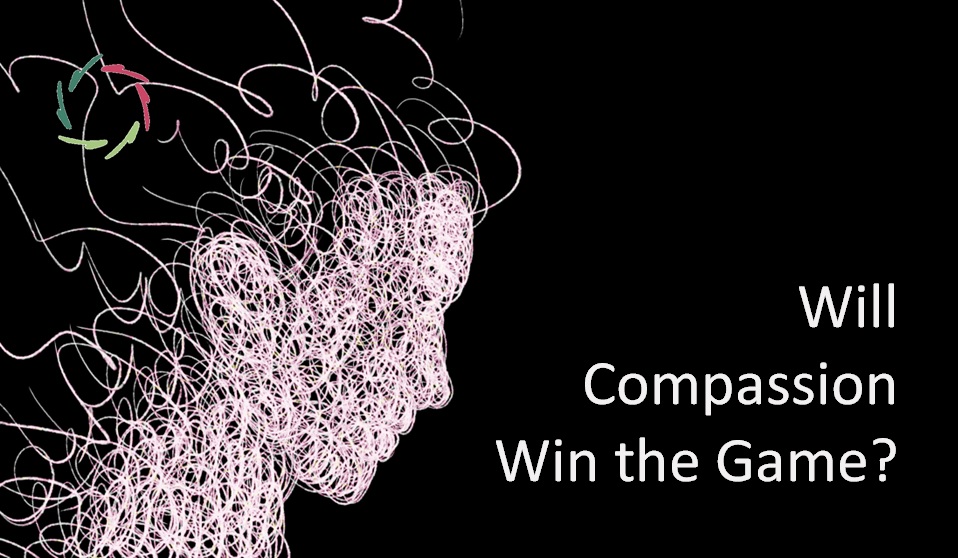
Humanity stands at a crossroads, made imminent by technological developments, mainly in the domain of A.I.
One can see the last 2000 years, at least, as the era of this crossroads. In two million years from now, this will probably still be seen as such.
Compassion, basically, is the defining feature of this crossroads.
Do we firmly choose this path or another?
As humanity teeters at this pivotal crossroads, the choice isn’t merely between divergent paths but represents a profound inquiry into the fabric of our collective soul. In an age where A.I. and technology promise unparalleled progress, we must pause and ponder the nature of progress itself.
Is it an unfettered race toward technological supremacy, or is it an inward journey toward understanding, empathy, and, ultimately, Compassion?
Does the era ahead, therefore, beckon us to a battleground where Compassion contends with cold pragmatism?
It may be better to see a confluence where technology serves to amplify our innate humaneness.
Here, Compassion isn’t just a path but the very ground we tread upon — a foundation strong enough to bear the weight of our greatest technological feats while gentle enough to nurture the most delicate sprouts of human kindness.
In envisioning a future where Compassion indeed ‘wins the game,’ one can imagine a world where technology and A.I. are imbued with its principles. They become tools not for domination but for healing, not for division but for bringing together, not for creating chasms but for bridging divides.
This future is not an idealistic utopia.
It’s a reality within our grasp if we choose to infuse every technological endeavor with Compassion, respect, and depth.
This vision is encapsulated in the notion of ‘Compassionate A.I.,’ where artificial intelligence systems are designed not merely to mimic human intelligence but to complement and enhance our inherent capacity for empathy and understanding. In such a world, A.I. becomes a partner in our quest for a deeper connection with ourselves and each other, a testament to the triumph of Compassion in the game of life.
Call to action.
Together, we can envision and create a future where technology enhances our humanity. It is integral to envisioning and realizing a future where Compassion is at the heart of our interaction with technology and with each other.
This is also at the core of the AURELIS project, annex Lisa (aureLIS-Assistant). It advocates for a future where technology is developed and implemented in a way that genuinely serves humanity’s deepest needs for connection, understanding, and Compassionate action. Thus, Lisa is not an A.I. in competition with other A.I.s for who wins the intelligence game ― although Compassion may well be what brings us to unseen heights of intelligence.
Basically, it’s a totally different game.
If you want to play this game, please get in touch with us.
Related Posts
The Generalization Problem in A.I.
Present-day artificial intelligence can impress, surprise, and even outperform humans in narrow domains. Yet again and again, it stumbles when circumstances broaden or change. This blog looks beyond data, scale, and algorithms. It argues that the true generalization problem in A.I. is not technical at heart, but concerns meaning, inner coherence, and depth. This blog Read the full article…
Will Software be Automated or Disappear?
Many predict that software will soon be fully automated. Within a few years, they say, most code will be written by machines. But perhaps automation is not the deepest transformation underway. This blog explores a more radical possibility: that software itself may be a transitional phase in computing. If so, the disappearance of software would Read the full article…
May Good A.I. Protect Us?
Powerful A.I. raises understandable fears, including whether humanity could lose effective influence over its future. Compassionate A.I. may help. This blog explores what such protection might mean for a future Compassionate A.I. such as Lisa. A question worth asking Could good artificial intelligence protect humanity from dangerous artificial intelligence? The question deserves more than reassurance. Read the full article…