Who We Are. What A.I. Can become.
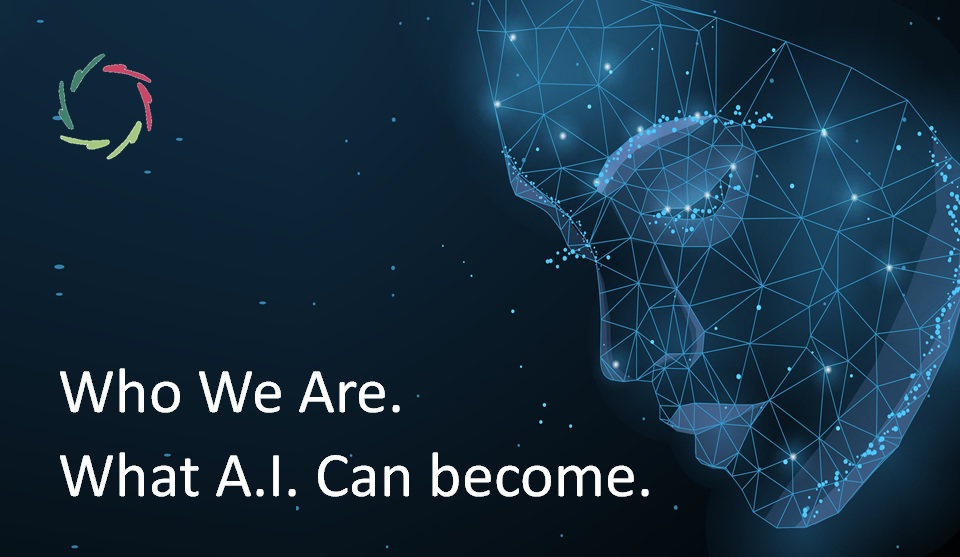
In the near future, we will learn many exciting things in both domains. They will turn out to be very inspiring in both directions.
“I think one of the big breakthroughs that’s going to come is we’re going to understand the brain… so that suddenly it all begins to click”
Quoting Geoffrey Hinton, ‘godfather of A.I.’ in 2016.
Who am I to doubt this?
The most relevant level in the brain
is not the neuron, nor the macroscopic brain part. It’s a level in-between, that of neuronal (or synaptic ― doesn’t matter much) ensembles or ‘patterns.’ Even during the last few years, notably after Hinton’s speech, much exciting progress has been made in this field. [see: “Patterns in Neurophysiology”]
At this level, one can ask what it is like to think a thought or feel a feeling. What’s the link from neuronal pattern to thought? You may see in this the age-old question concerning qualia. What’s the link between a colored object and actually seeing the color?
Asked only slightly differently: What is the link between having a neuronal pattern and having a thought? Well, the thought is also a pattern. Having the one pattern and having the other pattern is the same action. One is the other.
That may seem as obvious as it is. Dear sophisticated reader, does it solve, to you, much of the qualia problem for which many people have even fought fierce battles?
This sheds a light on the ‘hard question of consciousness.’
“It all begins to click.”
We will understand intelligence if we understand ourselves at the distributed patterns-level. [see: “Human Brain: Giant Pattern Recognizer”] At least, we will understand human intelligence.
At the same time, we have to acknowledge that this is not the only intelligence unless, of course, we define it that way. Then we keep ‘intelligence’ to ourselves. A.I. won’t mind.
The more we have a grip on our own, the more it seems useful to abstract intelligence from its present carbon-based recipient. We may learn a lot from our intelligence, abstract this knowledge, then apply it to A.I. in out-of-the-box ways. Nature is not an engineer, but a good teacher.
Of one thing, I’m pretty sure: One way or another, Artificial Intelligence will also be pattern-based. [see: “A.I. Is in the Patterns”] There are to this just too many advantages to just leave it so so. One may notice that present-day DNNs (Deep Neural Networks) are not the solution to this. Other neural networks – closer to recent brainy insights – may be better ancestors (time flies) to the future A.I.
Meanwhile, we learn a lot about ourselves.
Such as, we learn that each of us is truly unique, yet in a way, we can recognize how people think and feel all over the world. That may bring us closer together. We’re all basically the same. ‘My people’ is everybody. It’s not hard to get this and bring the message from the brain/mind. In its uniqueness, A.I. will be even more so, yet it will be recognizable in both ways.
We learn how human hardware and software are the same. They evolve together, continually, unlike a computer. Much of our mental efficiency comes from this, and much of our vulnerabilities, as in psycho-somatics. The pattern-level is the one on which much of our healing should be sought.
In A.I., we want the advantages, but we don’t want future A.I. to become depressed or to get panic attacks. Better to avoid an acute A.I. psychosis. We need to find specific solutions for such problems. In this also, we can learn from ourselves.
And vice versa. Learning to solve these problems for A.I. will certainly shed new light on the human ‘pathologies’ as well as on the normal situation ― bringing better therapy and prevention. Sounds great, doesn’t it?
And, well, I know some of you are waiting for this:
Just one link: [see: “The Journey Towards Compassionate AI.”]
Related Posts
Super-A.I. is not a Literal Idiot.
Some see danger in future A.I.’s lacking common sense ― thereby interpreting ‘human commands’ literally and giving what is asked instead of what is wanted. This says more about humans than about the A.I. Two examples One person needing paperclips may ask an A.I. to produce paperclips as efficiently and effectively as possible. The A.I. Read the full article…
What is Common Sense?
Common sense is, by definition, supposed to be sensible as well as common to most people. When trying to bring common sense to A.I., it becomes clear there is more under the hood than just a humming. Toward developing A.I., it’s imperative to listen intently to the humming. In Dutch (my language, spoken by a Read the full article…
Semantic vs. Meaning-Based A.I.
At first glance, semantic and meaning-based A.I. may seem nearly identical. Both deal with language and understanding. Yet their difference runs deep. This blog explores how one operates on the surface of meaning, while the other engages with meaning as a living process. The implications reach far beyond technology, touching truth, insight, human connection, the Read the full article…