Complexity of Complexity – About Being an Organism
Is this important? Indeed, it has the direst consequences. For instance, in a Western democracy, comes COVID, the difference in outcome is hardly fathomable.
Complexity
We are complex creatures, being (almost) infinitely more than the sum of our parts. [see: “Complex is not Complicated“] That way, intractable things happen within us, and we don’t see them happening. [see: “The Basic Cognitive Illusion“] Instead, we kind of ‘see’ them happening in our environment, largely also socially. [see: “Projection“] In a society, we do so together, pushing each other to conform. [see: “Streaming Underneath“]
Wow, sounds quite complex
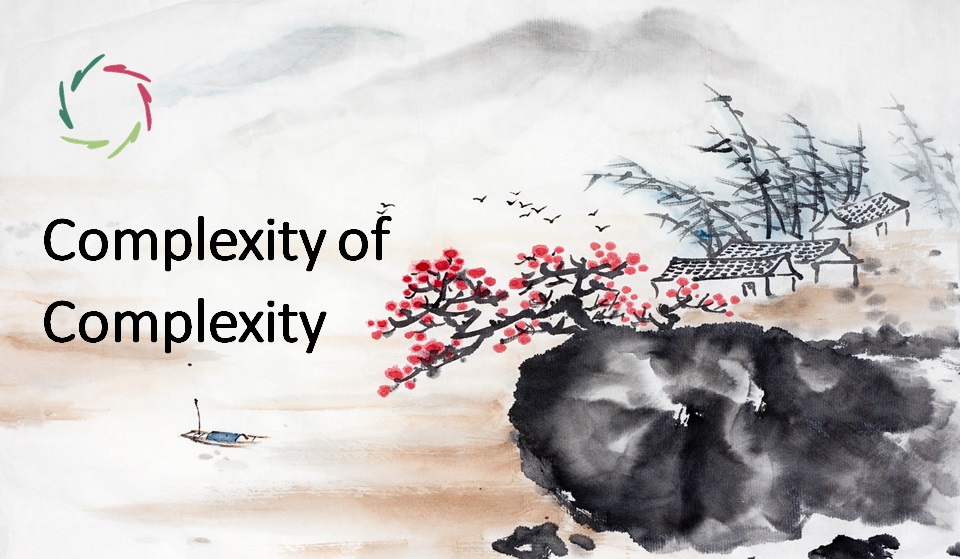
Indeed. Yet, at the same time, there is a huge simplicity in all this. It is the simplicity with which a Zen master, in one stroke, paints a character of the highest complexity in the simplest way.
It is the simplicity of an experience of transcendence. For instance, at sunset over the sea, sitting in the dunes, seeing the stars gradually appear, being in the universe.
Love. Compassion.
Then again, so complex
Indeed. In trying to get away from natural complexity, culture builds many walls. Since nature is a formidable adversary, when fighting against it, these become thick and complex walls.
Then, in trying to break through those walls, one fully encounters the complexity of complexity.
You see, ‘breaking through’ will not succeed. That may give the impression that it’s hopeless, and one can only undergo. Aren’t you fighting against windmills?
‘Breaking through’?
In my view, the energy (deep human motivation) is way too big to attain something worthwhile, this way. Besides, there is always destruction involved, this way. That is not a reason to drop it but to be careful. One may destruct very much more than was the initial intention.
Look at almost any war.
The way of the Zen master?
Yes, but, well, one needs to be extremely patient, this way. In one-on-one, progress at the society level goes slowly. Or, as in ancient Eastern tales, the Zen master may reach the ear of the emperor. That’s a lovely tale.
Right, right, and what in present-day worldwide Westernized culture with its bent on quick-fix?
AURELIS
This is what in AURELIS, everything is about: to take into account complexity from inside out.
Not breaking through walls, but being here, then being there.
No magic needed, of course. It follows the way our brain is made. It is perfectly compatible with all science.
But it is very much counter-cultural. The ‘streaming underneath’ is quite heavy. That makes the way of the salmon also quite tricky, even without ‘breaking through.’
It’s challenging enough, so what are we waiting for?
Related Posts
What is Aurelian Autosuggestion?
Aurelian autosuggestion is a method rooted in the AURELIS philosophy, which emphasizes the power of the mind to influence the body and promote inner growth. Unlike traditional suggestion techniques, which often involve direct commands or affirmations, Aurelian autosuggestion is more subtle and works by gently inviting the deeper, subconceptual layers of the mind to participate Read the full article…

Is Lisa the Durable Answer?
Lisa promises mental support for an indefinite number of people one-on-one and simultaneously. In this, the ‘heart’ is most important and most durable now and in the future. Who is Lisa? [see: “Lisa”] In short, Lisa-software has three purposes, as: an assistant to AURELIS, guiding users to the appropriate AURELIS tool(s) an A.I. coaching chatbot, Read the full article…
AURELIS Coaching is Open Therapy
One may call it ‘fundamental’ psychotherapy. This is Open to the subconceptual level inside the coach and coachee. As in Open Leadership, Open Religion, Open Mindfulness. Not one more kind of psychotherapy It is not just one more construct on top of the many but based on what underlies conceptual psychotherapy in general, being what Read the full article…