Sticky Thoughts
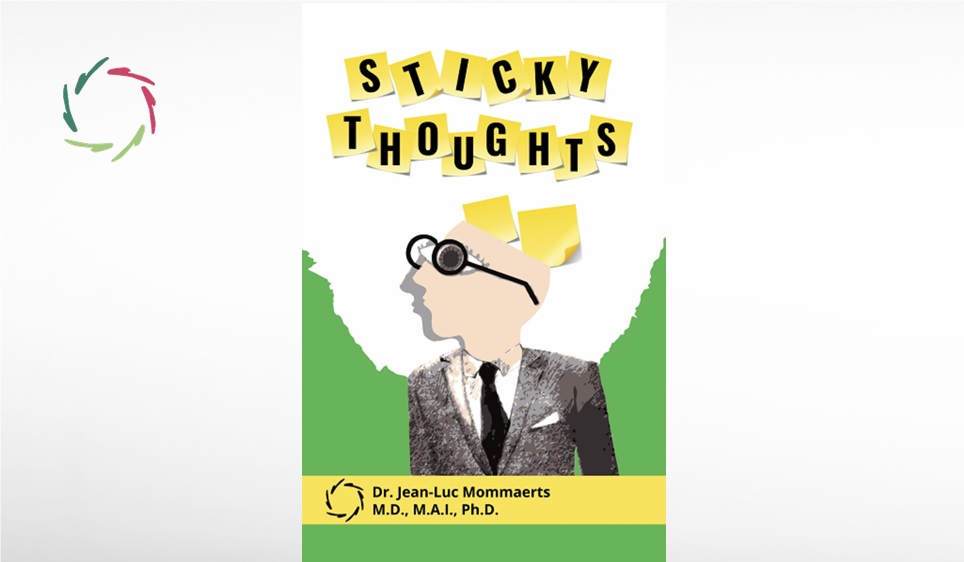
This is the foreword to my book ‘Sticky Thoughts’ that you can find on Amazon (see menu).
The purpose of Sticky Thoughts is to bring in a concise way (so that each of them ‘fits on a sticker’) many ideas that may be ‘sticky’ in that they linger on in the reader’s mind. The stickers are stuck, so to speak, in your mind. The rest is up to you.
The content is mostly mind-related. What is the mind capable of, mainly in the domain of health, wellness, and addiction? What is known or not known about it in present-day science? What are existing gaps in materialistic science that can be filled by a mind-explanation? Much revolves around what should be modern-day humanism.
Controversial domains are not avoided, on the contrary. The ‘stickiness’ (here: unsophisticatedness at the surface) means that more is said – at times ironically – than otherwise might be acceptable for some. At the same time, I bring them as little things that cannot easily be argued against from any reasonable source, that are not readily disposed of and therefore are sticky in another sense. I stick to what is rational while not avoiding depth. I like to see these sticky thoughts as stones to be used against the Goliath of materialistic thinking, mainly in health and wellness, and also in a broader social context.
Inside information
You also find them in this blog, under the category ‘Sticky Thoughts.’ Does this show a complete lack of commercial thinking, or is it a seemingly naive but ingenious way of sticking them to your to-do?
Anyway, you find the latest and edited versions in the book, not in the blog.
Related Posts
From Grief to Growth
There can be positive elements in grief – if you open yourself. The death of a person – the death of an idea – the death of a relationship – even the death of a hoped-for electoral outcome… One should not get rid of grief or bypass it. Yet what regularly happens, is that a Read the full article…
Placebo Based Medicine
Alternative medicines – whether or not called ‘complementary’ – are not to be dismissed just for being alternative but to the degree that they are based on placebo-as-a-lie. Placebo >< empathy I see a huge difference between both at a conceptual level, transcending terminology. [see: “Empathy: What it Was, Is and… Will Be?”] This text Read the full article…
We’ll Make it Through
We may get sick. We will die. We encounter adversities of many kinds. We’ll make it through, together. This is more than a promise. It is a faith. Humankind at its best. Is anything worth anything that diminishes this? I am for you, and you are for me. Compassion in coaching and anywhere else. All Read the full article…