Sticky Thoughts
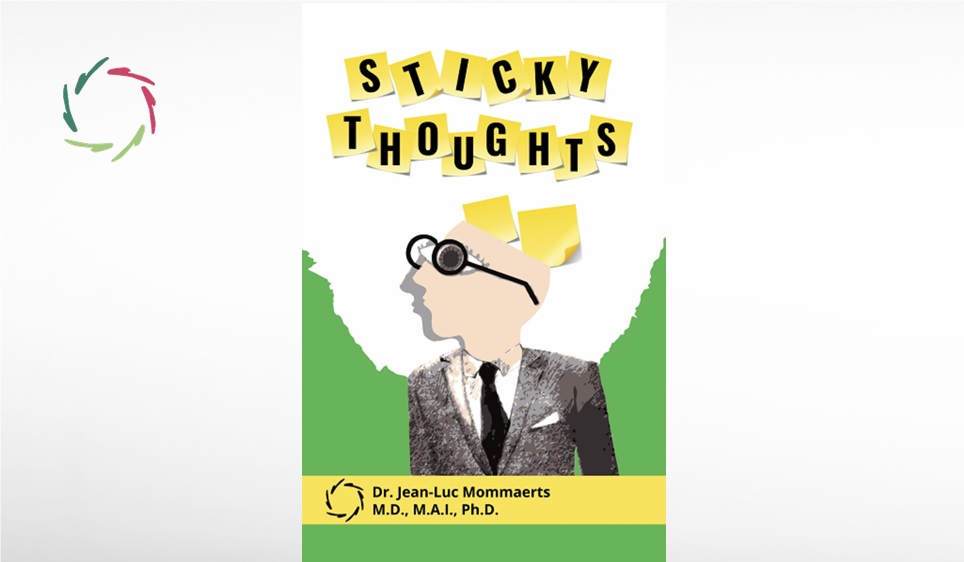
This is the foreword to my book ‘Sticky Thoughts’ that you can find on Amazon (see menu).
The purpose of Sticky Thoughts is to bring in a concise way (so that each of them ‘fits on a sticker’) many ideas that may be ‘sticky’ in that they linger on in the reader’s mind. The stickers are stuck, so to speak, in your mind. The rest is up to you.
The content is mostly mind-related. What is the mind capable of, mainly in the domain of health, wellness, and addiction? What is known or not known about it in present-day science? What are existing gaps in materialistic science that can be filled by a mind-explanation? Much revolves around what should be modern-day humanism.
Controversial domains are not avoided, on the contrary. The ‘stickiness’ (here: unsophisticatedness at the surface) means that more is said – at times ironically – than otherwise might be acceptable for some. At the same time, I bring them as little things that cannot easily be argued against from any reasonable source, that are not readily disposed of and therefore are sticky in another sense. I stick to what is rational while not avoiding depth. I like to see these sticky thoughts as stones to be used against the Goliath of materialistic thinking, mainly in health and wellness, and also in a broader social context.
Inside information
You also find them in this blog, under the category ‘Sticky Thoughts.’ Does this show a complete lack of commercial thinking, or is it a seemingly naive but ingenious way of sticking them to your to-do?
Anyway, you find the latest and edited versions in the book, not in the blog.
Related Posts

From Stress to Parkinson
Parkinson’s disease is often seen as a purely neurological condition. But what if its roots go deeper — into the silent currents of long-term stress and inner meaning? This blog invites a fresh view, combining hard science and lived depth, to trace a path from chronic inner tension to the unfolding of Parkinson’s. In doing Read the full article…
The Subconceptual in Future Medicine
Modern Western medicine has been built on an exaggeratedly conceptual premise ― even concerning the mind. What place is there for the subconceptual in the future? Huge current tensions in Western medicine Many patients consult physicians for subconceptual issues. However, with little insight into the domain, many physicians would instead like to eradicate any dealing Read the full article…
26. ‘My pain is real! It’s not mental!’
The outcry in the title is the result of a way of thinking that, sadly enough, still pervades our culture very much. It is as if what is mental cannot be real at the same time. This seems to be very deeply ingrained, so deep that many people don’t even question it at any time Read the full article…