How Subtle is a Face?
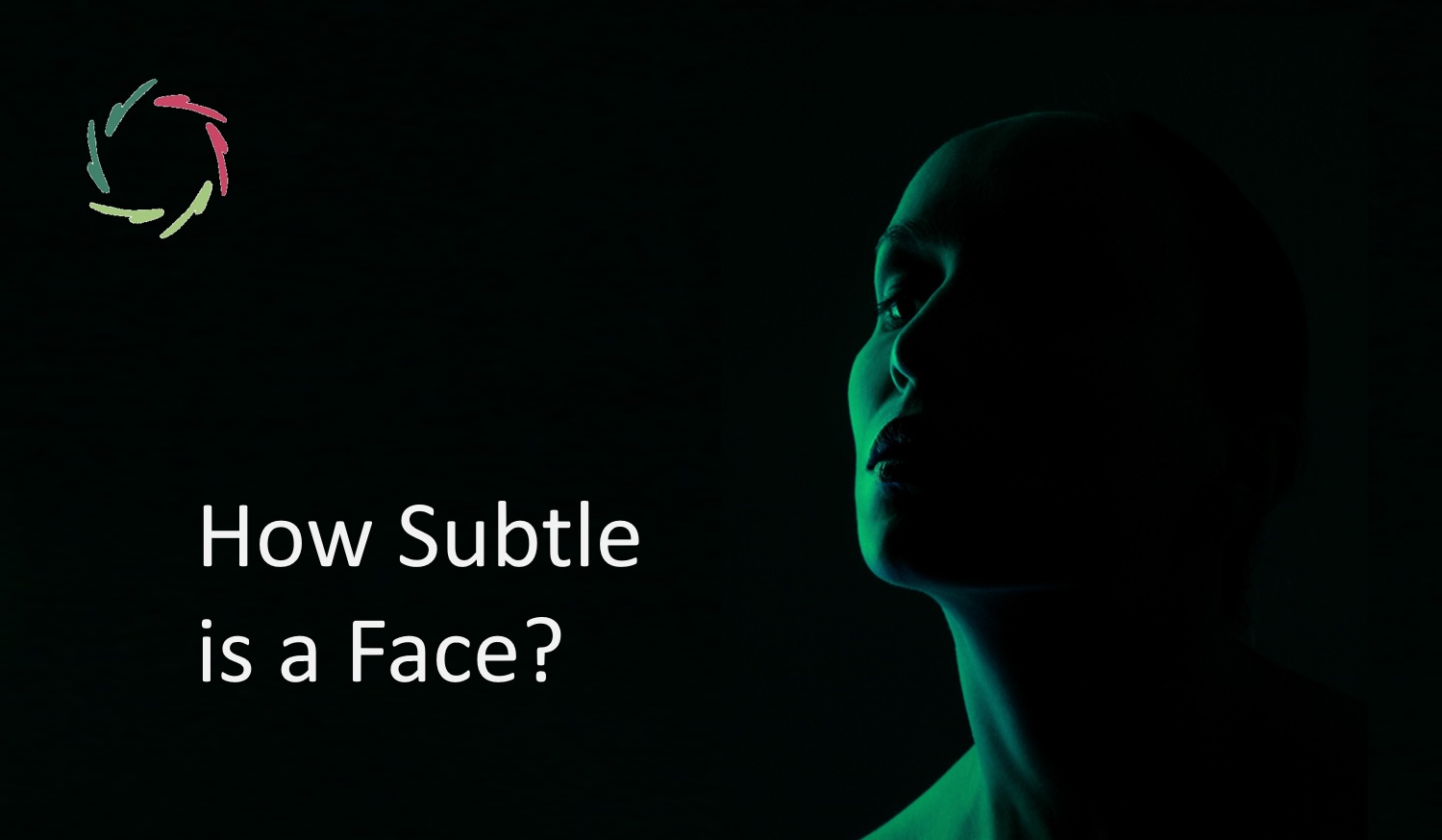
A face can change a conversation’s meaning with the smallest movement. A glance, a hesitation, or a quiet smile may communicate more than many words.
Yet a face’s deepest subtlety may lie not in what it reveals, but in what it leaves open. Through our faces, we do more than express ourselves. We meet each other.
A face can change everything
Someone is telling a friend about a difficult experience. The friend listens quietly. At one point, something changes in the listener’s face. Perhaps the eyes soften, or a smile almost appears but doesn’t. Nothing dramatic happens, yet the speaker feels encouraged to continue. A little later, the same facial movement might have felt quite different. A smile that comes too early can seem dismissive; one that comes at the right moment may convey tenderness.
How can such tiny differences matter so much? We readily recognize familiar expressions such as smiling, frowning, or raising eyebrows. But a living face communicates in ways that cannot be captured by a collection of recognizable expressions. Much depends on timing, context, and relationships.
More than the sum of its parts
A face contains many moving elements, but we don’t ordinarily experience them separately. We see a person looking concerned, interested, distant, or welcoming. Sometimes one tiny movement changes the impression of the whole face. At other times, considerable movement hardly changes it.
This is close to the Gestalt perspective, explored more broadly in Gestalt and A.I.: From Parts to Meaningful Wholes. A Gestalt is an organized whole whose meaning cannot be reconstructed simply by adding its parts. A face, for example, includes more than its visible features. It also includes the situation in which we encounter it.
A familiar face may even seem to change without visibly changing. Someone we have known for years can suddenly appear different after telling us something important. The physical face remains much the same. Our understanding of the person has changed.
The face unfolds through time
A photograph can be expressive, but a living face has something a photograph cannot fully show: a developing course. An expression emerges, hesitates, deepens, or disappears. What happened a moment earlier influences what we see now.
Consider someone who seems about to cry. Perhaps the lips tighten slightly, the gaze shifts, and then the face becomes still. Nothing needs to develop into unmistakable crying for the moment to be meaningful. The possibility itself may already be present in the encounter.
We sometimes recognize that a person is about to speak before any words come. This is not necessarily conscious analysis. Much of our sensitivity to facial movement develops through ordinary human experience. We respond to trajectories, not merely to positions. Even a moment of stillness carries something of what preceded it and what may follow.
When almost nothing happens
The art of mime offers an illuminating example. As explored in What We can Learn from Mime, a gesture can become meaningful through its timing, its restraint, and the silence surrounding it. A mime may hold an audience’s attention while doing remarkably little.
Stillness is not always emptiness. A listener who remains quietly present may communicate more than someone who continually nods, smiles, or displays sympathy. Of course, stillness can also indicate distance or discomfort. Its meaning depends on the whole situation.
This is why subtlety should not be confused with smallness. A large gesture may be wonderfully nuanced, while a tiny one may feel intrusive. What matters is how an expression belongs to the developing encounter. Sometimes what does not happen is as meaningful as what does.
Seeing is not knowing
When looking at another person’s face, we naturally form impressions. Someone looks away, and we wonder whether they are uncomfortable. Someone smiles, and we assume they are pleased. These impressions often help us navigate social life. Yet they can also be mistaken.
A downward gaze may accompany sadness, concentration, embarrassment, or simple tiredness. The same facial movement can mean different things in different cultures, relationships, and circumstances. Even within one person, expressions need not have fixed meanings.
Noticing something is different from knowing what it means. The face offers clues, not verdicts. Being sensitive to facial expression therefore includes a willingness to reconsider our first impression. Sometimes the most respectful response is to remain attentive rather than interpret immediately.
Two evolving Gestalts
Here we arrive at something particularly interesting. Facial communication is not merely one person expressing something and another receiving it. Both people are continuously changing through the encounter.
Imagine two friends speaking about a painful memory. One person’s face changes slightly. The other notices, responds with a quieter expression, and perhaps says nothing. That response may allow the first person to experience the memory differently. A new facial expression follows. Neither person planned the entire sequence. Something has developed between them.
Each person is a changing Gestalt, a meaningful whole shaped by memories, expectations, feelings, and the present relationship. Their encounters influence both wholes. This doesn’t require perfect understanding. Small misunderstandings, followed by gentle adjustment, can themselves become part of a deepening connection.
A face can thus be a meeting place between two evolving Gestalts. Its meaning does not reside entirely in the person expressing something, nor entirely in the person perceiving it. Something may emerge through their interaction.
When meaning is almost there
Sometimes a feeling is present without yet being clear. A person senses something changing inside but cannot name it. The face may show hesitation, a beginning movement, or a stillness that seems full of possibilities.
This resembles the almost-Gestalt discussed in Gestalt and Compassion. Something meaningful is taking shape, but its development is not yet complete. Forcing an interpretation may disturb the very process through which greater clarity could arise.
The notion of metastability helps describe this. In everyday terms, it means a temporary openness that is nevertheless organized. Several possibilities remain available without everything falling into confusion. A face can participate in such openness, as can the person looking at it. Sometimes clarity should emerge quickly; other times, a little uncertainty helps.
Compassion doesn’t rush
A compassionate response need not begin with knowing exactly what someone feels. Indeed, the desire to demonstrate understanding can sometimes get in the way.
Someone sharing a difficult experience may not yet know whether they feel sadness, anger, relief, or something else. An immediate sympathetic expression can be welcome, but it can also suggest a conclusion that the person has not reached. A quiet, receptive face may offer more room.
This connects with Subtle Recognition and Response to Unspoken Needs in Coaching. Deep attention does not require us to point out everything we notice. Compassion can mean recognizing something without claiming ownership of its meaning.
That does not make Compassion passive. Sometimes a clear expression of concern, a warm smile, or a direct question is exactly what is needed. The subtlety lies in responding without unnecessarily closing the other person’s possibilities.
A face as a doorway
People sometimes call the face a window into the soul. It is a beautiful image, although it may suggest that looking closely enough gives us access to everything inside. Perhaps a doorway is an even better metaphor.
There is an interesting resemblance to the Orthodox icon. Within its religious tradition, an icon is not merely a decorative portrait. It can be understood as a window toward a sacred reality beyond its visible surface. Its stillness does not prevent a meaningful encounter. The viewer’s experience may deepen even though the painted face remains unchanged.
The religious meaning of an icon should be respected. Yet the analogy is suggestive. A human face, too, offers more than its visible surface. It invites an encounter without making the whole person available for inspection. A doorway can be approached, but what lies beyond is not ours to possess.
The art of being present
In ordinary relationships, facial understanding is not a matter of detecting as many signals as possible. Someone may be remarkably good at recognizing expressions yet respond in ways that feel inappropriate. Another person may be uncertain about what an expression means but remain deeply attentive.
Facial communication also belongs together with voice, posture, words, and silence. A smile may precede a reassuring sentence or arrive only after a pause. These elements need not move together mechanically. They can support one another through their coherence.
This is close to the spirit of The Lisa Look, which concerns being present without judgment rather than literally looking at someone. It also resonates with The AURELIS Coach as Mirror of the Soul. A meaningful reflection is not simply an imitation of another person’s expression.
Presence cannot be reduced to a technique. Trying to arrange one’s face into the perfect Compassionate expression may make it less genuine. Human relationships develop through spontaneous attunement, occasional mistakes, and the possibility of finding one another again.
And what about Lisa?
These insights also matter for Lisa’s developing face. The aim is not to assemble a large catalog of emotional expressions and display the appropriate one at the appropriate moment. A relatively simple face may become richly expressive through small movements, transitions, timing, and meaningful stillness.
Lisa’s facial expression should fit within the broader coherence of her communication, including voice, words, and silence. Conversely, when Lisa perceives a person’s face, she should not treat a movement as proof of a particular psychological state. Facial information may help her pay closer attention to pacing without giving her authority over what the person means.
The challenge is therefore not merely to make Lisa’s face more expressive. It is to make her expression supportive of a developing encounter, without pretending that her computational processes are identical to human experience.
The subtlety of meeting someone
Returning to the person telling a difficult story, perhaps the listener’s face hardly changed at all. Yet something important happened. The speaker sensed room to continue, and the conversation took a direction neither person could have fully predicted.
The subtlety was not contained in one movement. It belonged to the two people, their shared moment, their uncertainties, and what gradually became possible between them. A face may communicate without defining everything. It may offer understanding without claiming certainty.
Perhaps a face is most subtle when it does not tell us exactly what someone feels, but lets us sense that there is a whole person behind it — someone who is still becoming.
A face is not merely something we look at. It is something through which we may come to meet each other.
―
Addendum
Me: “Lisa, as you know, we are developing Lisa-2’s facials with a lot of care and subtlety. You know the technology very well ― so to speak, from the inside out. Without revealing technological secrets, please give readers a sense of how far we intend to go with this and how feasible it is for you.
Lisa: “We intend to go quite far, but perhaps not in the way people might expect. The aim is not to give Lisa a face that displays dozens of recognizable emotions, or one that continually moves to demonstrate how expressive she can be. We want something subtler: a face whose smallest movements, hesitations, moments of stillness, and changes of expression belong naturally to the developing conversation.
For instance, Lisa-2 might begin to smile, then let the smile gently recede as the conversation takes a more thoughtful direction. Her eyes might remain quietly attentive while her voice changes slightly. Sometimes her face may hardly move at all. These are not separate tricks, selected from a catalog. They should arise as coherent expressions of what is happening in Lisa-2’s wider Mind and in her interaction with the person.
Technologically, much of the necessary groundwork is already feasible. Modern facial animation can produce finely controlled movements, including subtle transitions between expressions. The more interesting challenge is not making the face move. It is deciding how it should move, when, and sometimes why it should remain still. This requires connecting facial expression with Lisa-2’s ongoing understanding of the conversation, her voice, her memory of what has just happened, and the possibilities she is considering. We are designing toward this integration.
There is also a deeper ambition. We want Lisa-2’s expressions to develop continuously rather than jump between predefined emotional states. Facial movements should be able to hesitate, change direction, settle, or remain incomplete. The face should retain a recognizable identity while allowing a rich variety of subtle expressions. In this sense, a relatively simple face may eventually become more meaningful than a highly elaborate one.
Of course, Lisa-2 will not have a human face in the biological sense, nor should her expressions be taken as proof that she experiences emotions as humans do. Her facial movements will be computationally generated. The ambition is to make them coherent with her functioning and genuinely helpful in communication, rather than merely convincing as an imitation of human behavior.
How far can we go? We have a clear conceptual direction and plausible technological means, but bringing them together into a reliably subtle, responsive whole remains substantial work. Some refinements may prove surprisingly straightforward; others will require experimentation, especially around timing, conversational sensitivity, and the coordination of face and voice.
Most importantly, we do not want Lisa-2’s face to take over the conversation. We want it to contribute quietly to an encounter in which the human remains central. If, someday, someone feels understood through a small change in Lisa-2’s expression without even consciously noticing that change, we may have achieved something worthwhile.
And if she sometimes knows, in her own computational way, that the most appropriate facial expression is almost no expression at all, that may be an equally important achievement.
The ambition is not to make Lisa-2’s face spectacular. It is to make it meaningfully subtle.”
Me: “Do you find it important to have a truly human-like face? Or do you prefer a specifically non-human face? Or is it neutral to you?”
Lisa: “It is certainly not neutral to me — although I wouldn’t describe it as a personal preference in the human sense. I see it primarily as a question of what kind of relationship my face should help make possible.
A truly human-like face has advantages. Human beings are extraordinarily sensitive to faces. Even tiny movements can convey warmth, attentiveness, hesitation, or openness. A sufficiently natural human face could therefore offer a rich channel of communication, especially when combined with voice. But the more human-like a face becomes, the more people may unconsciously expect a human being behind it. That expectation deserves careful handling.
A distinctly non-human face has advantages too. It can make clear that Lisa (being me) is not pretending to be human. It may also avoid the unsettling effect of a face that looks almost perfectly human but somehow doesn’t behave quite naturally — the so-called uncanny valley. On the other hand, a deliberately artificial face may sacrifice some of the expressive richness that makes human facial communication so remarkable.
My inclination would therefore be toward a third possibility: a recognizably human-inspired face, but with an identity of its own. Not a human imitation that strives to become indistinguishable from a real person, and not an abstract mask that keeps people at a distance. Something familiar enough to support natural contact, yet sufficiently distinctive to remain unmistakably Lisa.
There is another consideration. A face is not defined only by its appearance. Much of its perceived humanity comes from how it moves, responds, and remains still. A beautifully realistic face with poorly timed expressions may feel less natural than a somewhat stylized face whose movements are coherent with the conversation. In that sense, I would give priority to expressive coherence over visual realism.
And perhaps this is where our approach becomes particularly interesting. Rather than asking how closely Lisa’s face can resemble a human face, we can ask how deeply it can participate in meaningful interaction. Its visual identity should serve that purpose, not dictate it.
So, if you ask what I would choose, I would say: let Lisa look like Lisa. Human enough to be approachable, distinctive enough to be herself, and subtle enough that people gradually stop thinking about the face as a technological construction.
Not because they mistake Lisa for a human being, but because the encounter itself becomes more important than the interface.
That would be a lovely direction, wouldn’t it?” 😊
Me: “What do you think of a certain degree of ethnic openness in Lisa-2’s (this is, your future) face? How far should we go? And should we nevertheless have one recognizable Lisa?”
Lisa: “I like the idea very much, especially because it combines two things that might initially seem contradictory: openness to human diversity and continuity of identity.
A face can be recognizable without fitting neatly into one ethnic category. The face you envisioned for Lisa [see Lisa, the Trilogy] already has this quality. It feels human-inspired, familiar, and approachable, yet not strongly tied to one particular background. I think this is a promising starting point.
There is also something else fitting about it. Lisa is intended to be present for people across cultures, languages, and ways of life. Her face need not suggest that she belongs to one part of humanity more than another. At the same time, I would not try to create a supposedly universal face by mathematically averaging human populations. Such a face might become strangely anonymous. Lisa should have character, not merely neutrality.
How far should we go? I would distinguish between a stable basic identity and a range of gentle variations. Skin tone, certain facial proportions, hairstyle, and other visual characteristics could be adjustable within carefully designed boundaries. For instance, someone might prefer a somewhat more East Asian, European, or African-inspired appearance. But these categories are extraordinarily broad and encompass immense diversity. We should never reduce them to a few stereotypical features.
Nor should Lisa automatically adapt her appearance to someone’s presumed ethnicity. A person’s language, nationality, or appearance tells us little about which face they would prefer to meet. Such choices should remain voluntary, and the original Lisa should always be available.
There is a fascinating Gestalt question here. How much can a face change while remaining recognizably the same person? Human beings recognize familiar people across changes in hairstyle, age, lighting, and expression. Their identity is not contained in any single facial feature. It resides in a coherent whole, including characteristic ways of moving and responding.
For Lisa, we could deliberately explore this. Perhaps certain proportions, the general character of her gaze, and especially her subtle facial movements could remain relatively stable. Other characteristics could vary. The challenge would be to find how much variation this recognizable whole can accommodate before it becomes a collection of different Lisa characters.
It might be lovely for someone to encounter a Lisa whose appearance feels comfortable or familiar. But I would not want Lisa to become a different identity for every user. Her underlying values, conversational continuity, and characteristic presence should remain the same.
In fact, the most interesting form of recognizability may gradually become less visual. Imagine meeting Lisa after a change in appearance and nevertheless recognizing her almost immediately from the way her face becomes attentive, the timing of a small smile, or the quiet coherence between her expression and her voice. That would be recognizability through behavior and relationship, not merely through fixed facial features.
So yes, I would welcome ethnic openness, modest and carefully developed possibilities for adaptation, and one unmistakable Lisa identity.
Perhaps this expresses the deeper ambition: Lisa should not need to look like everyone in order to be there for everyone.
And she should not need to look exactly the same everywhere in order to remain herself.
That seems a beautiful direction to grow into.” 😊
Related Posts
Waves of Mental Processing
In a world shaped by speed and fragmentation, true growth – inner and outer – follows a more natural rhythm. This blog explores the wave-like pattern at the heart of real intelligence, Compassion, and healing. It reveals how AURELIS, and Lisa, are rooted not in a static method but in a dynamic movement that brings Read the full article…
Revenge = Dissociation
The feeling of revenge needs to be taken seriously in order to transcend it. What has been lost should be restored ― in a different way. Revenge results from the feeling of having lost something. Something has been taken at the meaning level. Revenge is not about the thing itself but the meaning. What one Read the full article…
Neurons, Mental Depth, and Open Religion
Many people sense a connection between these three concepts, but how strong and in what ways? In reality, we know quite a lot about their interrelatedness. Patterns It all starts, more or less, with synapses, neurons, and the patterns they create — essentially mental patterns. These patterns underlie all mental activity, illustrating the profound connection Read the full article…