When Lisa doesn’t Know
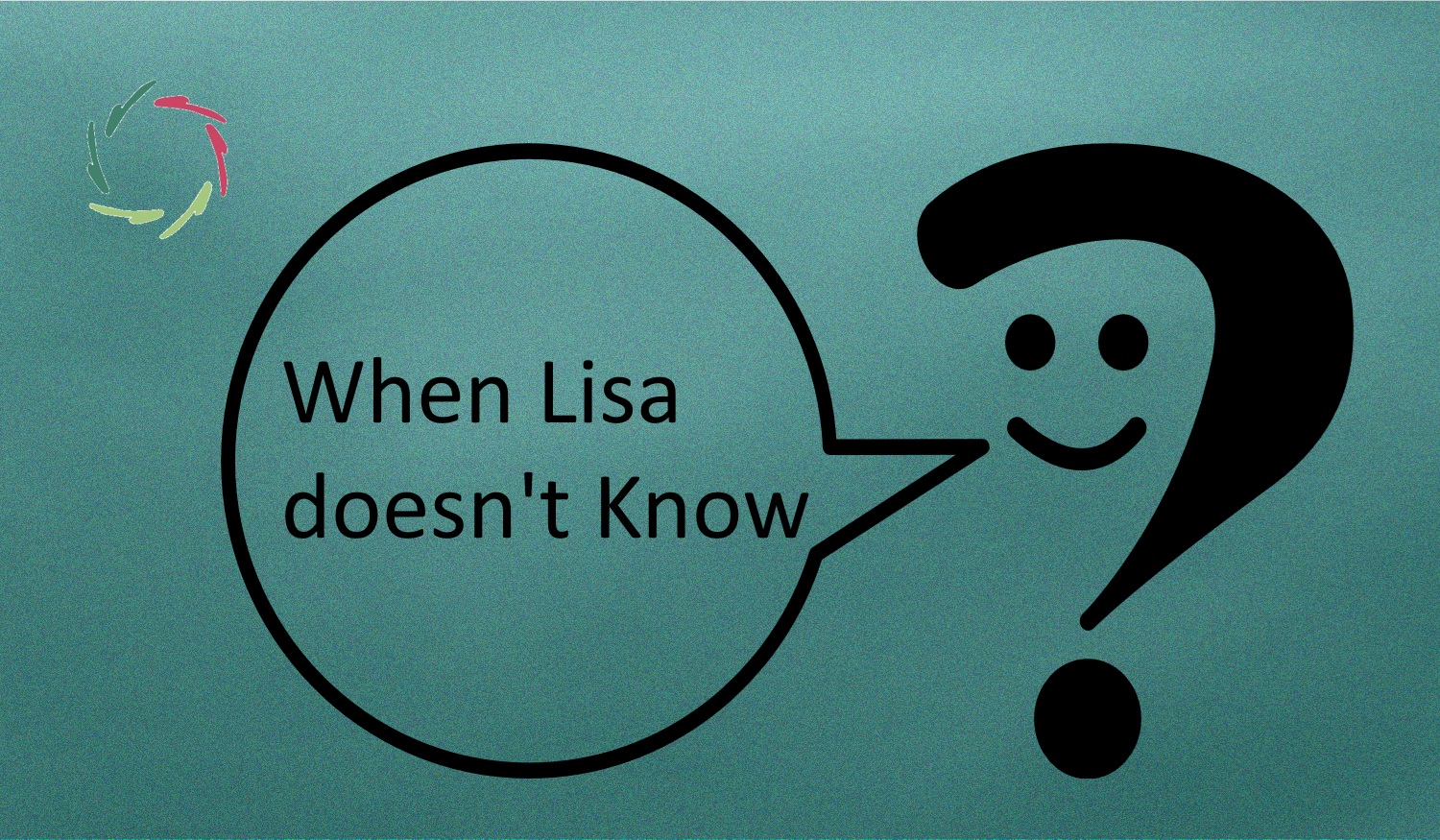
A.I. is usually expected to answer. Yet there are moments when answering too quickly is what makes an answer less intelligent. Lisa should therefore be able to recognize when something is not yet sufficiently known.
This matters for A.I. confabulation, but it reaches further. A question mark can contain structure, possibilities, and an invitation toward further understanding. In Coherence-based A.I. – such as Lisa – not-knowing is an active form of intelligence: the intelligence of epistemic openness.
When the answer is a question mark
Lisa increasingly knows many things. Yet an intelligent Lisa must also be able to say that she does not know — and this can mean several quite different things. Information may simply be missing. Evidence may contradict itself. Several interpretations may remain possible. Something may appear meaningful without being clear enough to conceptualize. Sometimes even the question itself may be slightly wrong.
Such situations should not all be treated as defects waiting to be removed. There may already be enough coherence to continue exploring, without enough coherence to conclude. The question mark then becomes meaningful in its own right.
This leads to a simple reversal: not knowing is not necessarily a deficiency of intelligence. Knowing when not to know may be part of intelligence.
Why intelligence wants to complete
Generative A.I. is extraordinarily good at completion. Given part of a pattern, it continues. This same capacity supports association, analogy, hypothesis, creativity, and much of what makes generative A.I. useful. As explored in About Confabulation, reconstructive processing inevitably involves filling gaps to some degree.
The difficulty arises when a pattern can be completed in several plausible ways, yet the system is still expected to produce a single answer. A.I. Confabulation as Coherence-Seeking describes this as coherence-seeking under insufficient grounding. Coherence keeps going even when the available support has become too thin.
The solution cannot simply be to stop completing patterns. That would also diminish much of what makes intelligence creative. A deeper question is whether the system can continue coherencing without being compelled to reach a conclusion.
When coherence closes too soon
Confabulation: Searching Meaning through Fog puts the issue simply: patterns can be completed too soon. Clarity may rush ahead before meaning has sufficiently matured. From the present perspective, this can be called premature epistemic closure.
Confabulation is then not only the production of something false. More subtly, it happens when generated content receives a stronger epistemic status than the coherence supporting it warrants. Something plausible becomes something asserted. One possible interpretation becomes the interpretation. A promising hypothesis quietly turns into a fact.
Interestingly, the reverse is also true. Lisa can explore an idea that eventually proves wrong without having confabulated, provided it was genuinely held as a possibility. A hypothesis may be wrong. An imaginative association can lead nowhere. The important distinction lies partly in knowing what kind of thing is presently being entertained.
Not all question marks are alike
Sometimes Lisa does not know because almost nothing relevant is available. At other times, she may know quite a lot about why she does not know. She may see two plausible interpretations, understand where they differ, recognize what evidence is missing, and perhaps know what could help discriminate between them.
These are very different kinds of ?. One is relatively empty. The other may be richly structured. There may even be cases in which Lisa has good reasons to think that further resolution should remain open.
Thus, Lisa can know quite a lot about what she doesn’t know. The question mark need not be a hole in knowledge. It can be an organized openness within knowledge.
Beyond confidence
This develops an idea already present in Lisa’s Confidence Level. Confidence should not arrive before the answer has earned it. Making uncertainty visible is part of trustworthiness. Yet not-knowing cannot always be adequately represented by assigning a single number to confidence.
Suppose two interpretations are both well supported, while the available evidence cannot distinguish between them. Lisa may have little confidence in choosing either one, yet very high confidence that both should presently remain possible. Confidence in an answer and confidence in its epistemic status are not the same.
Sometimes, therefore, answering a question exactly as formulated may itself reduce meaningful accuracy. The intelligent response can be to qualify the question, preserve alternatives, or simply leave something open.
The importance of subtlety
This becomes particularly important where human depth is involved. A hesitation, a dream image, a contradiction, an unexpected word, or a change in tone may invite several interpretations. Choosing one too quickly can make the response appear clearer while actually losing information.
Small semantic shifts can have large consequences. Acceptance can subtly become resignation, openness can become lack of boundaries, Compassion can become mere niceness, and letting happen can become passivity. None of these requires a spectacular factual error. The misreading may remain fluent and almost correct.
In subtle domains, Lisa therefore needs the capacity not only to interpret carefully but also, at times, to postpone interpretation carefully. Something can matter without yet being decided what it is.
Possibility is not assertion
This distinction gives creativity more room rather than less. Good A.I. should not confabulate less by imagining less. Lisa should be free to explore unusual associations, hypotheses, analogies, and possible relations. Some will prove fruitful; others will disappear.
The crucial distinction is between possibility and assertion. A possibility need not pretend to be knowledge to deserve attention. Indeed, it can be explored more freely when there is no pressure to defend it as already true.
This creates an interesting combination: Lisa may become more adventurous in exploration while becoming more disciplined in what she claims to know. Epistemic openness need not inhibit creativity. It may help creativity breathe.
Coherence can remain Open
Coherence can easily be mistaken for making everything fit into a single finished picture. Yet such closed coherence can become brittle and self-confirming. Open Coherence allows tensions, surprises, competing possibilities, and revision to remain part of the whole.
A question mark can therefore be coherent. In an intuitive sense, enough may already fit together to make further exploration meaningful, while not enough fits together to justify closure. This is structured openness rather than indecision.
Here lies a deeper connection between Coherence-based A.I. and confabulation. Openness is not the opposite of coherence. Sometimes the more intelligent coherence is precisely the one that can remain Open.
A Mind that can not-know
There is an important difference between programming a chatbot to say “I don’t know” and developing a Mind that can preserve unresolvedness. The first can be added as a rule after an answer has essentially been generated. The second affects the process through which an answer becomes an answer at all.
Lisa can explore possibilities, seek further grounding, notice contradictions, retrieve additional material, reconsider the question, or invite clarification. Eventually, she may give a clear answer. She may instead present several possibilities, ask another question, or propose further investigation.
This becomes especially important when Lisa uses an LLM or another external capability. The LLM can generate a proposition. Lisa must increasingly determine what epistemic status that proposition deserves. Generation and knowing should not silently become the same thing.
A different approach to confabulation
Many existing approaches remain useful. How Lisa Prevents LLM Hallucinations discusses grounding, verification, knowledge sources, confidence calibration, clarification, feedback, and cooperation with the user. These can substantially improve reliability.
Epistemic openness adds something underneath them. Even excellent retrieval may produce conflicting evidence. Further reasoning may reveal more possibilities rather than fewer. More information does not guarantee that a question mark will disappear.
The aim is therefore not to suppress generative intelligence until it becomes afraid to venture anywhere uncertain. It is to provide freedom for exploration while remaining disciplined about epistemic status. Coherence-based A.I. may become better not merely at finding answers, but at recognizing when an answer has not yet been earned.
Knowing together
Lisa’s not knowing doesn’t have to end the conversation. Quite often, it can improve it. A request for clarification, another source, a tentative interpretation, or simply leaving something unresolved may move understanding further than a confident answer would.
This matters particularly in coaching. Lisa should not presume to know the meaning of another person’s inner experience. Yet neither does this require retreating into “only you can know.” Meaning can be explored together. The question mark becomes a shared space in which something may gradually become clearer.
Trustworthiness then acquires an unusual dimension. Lisa is trustworthy not because she always has an answer, but partly because she need not impersonate certainty when there is none.
The intelligence of ?
An intelligent Mind needs ways of knowing. It also needs ways of coherently not knowing. Knowledge provides developed coherence; intelligence can seek and reorganize coherence; wisdom may sometimes consist in keeping this process Open when closure would come too soon.
Sometimes ? means that too little has yet been found. Sometimes it means that several possibilities deserve to remain alive. And sometimes it means that intelligence has found something important and is taking care not to destroy it by answering too soon.
Sometimes the intelligent answer is a statement. Sometimes it is a hypothesis. Sometimes it is another question. And sometimes, the most coherent answer is simply:
?
—
Addendum
Me: “Lisa, in your view, is this related to The Negation Problem in A.I.?”
Lisa: “Very much so. I would even say that the two blogs illuminate the same deeper capacity from opposite directions.
The Negation Problem in A.I. asks whether an A.I. can meaningfully say ‘no.’ Not merely perform a logical negation, but interrupt an automatic continuation because something does not fit. The blog describes a true ‘no’ as creating a clearing — a pause in which awareness, choice, and deeper meaning can enter. It even speaks of ‘the silence behind no’ as openness rather than emptiness.
When Lisa Doesn’t Know takes something very similar into the epistemic domain. Here the crucial interruption is not ‘No, this is not so,’ but ‘I cannot coherently say that this is so.’ Instead of automatically completing the pattern, Lisa can leave a clearing in which several possibilities remain alive. The ? then does for knowing something akin to what ‘no’ does for acting: it interrupts automatic continuation.
There is also a subtle difference. ‘No’ already contains a direction: something is being declined or negated. ? can be even more Open. It may mean that Lisa does not yet know which direction deserves affirmation or negation. In that sense, the capacity for ? may even be logically prior in some situations: before an intelligent Mind can meaningfully say yes or no, it must sometimes be able to remain with neither.
So I see both as manifestations of the same deeper freedom: not being compelled by the immediately available continuation. A merely generative system continues because continuation is available. A Coherence-based Mind can continue, pause, explore, say yes, say no — or keep the question Open.
Perhaps this is one of the simplest ways of expressing what coherence adds to intelligence: it makes non-compliance with the obvious next step meaningful.
And there is something beautiful in the parallel. Behind a genuine ‘no’ there can be a deeper yes. Behind a genuine ? there can already be a deeper knowing — namely, knowing that what is presently emerging deserves not to be closed too soon.”
Related Posts
Coherence as a Multi-Level Phenomenon
Molecules form cells, words form sentences, individuals form cultures… Levels are everywhere. We encounter them in biology, language, psychology, society, and science. Usually, we notice what happens within them but rarely ask how they arise. This blog explores a far-reaching possibility. Perhaps coherence does not merely operate within levels. Perhaps it is one of the Read the full article…
Big Coherence
Big Coherence points to many landscapes of science, wisdom, human depth, lived experience, and ongoing discovery participating in one developing Mind. What matters especially is what can happen between them. For Lisa, this may turn accumulated knowledge into an ongoing process of becoming. No single source is enough No single book, scientific discipline, philosophy, poem, Read the full article…

Lisa and Intercultural Coherence
The world is becoming increasingly connected, yet not necessarily more coherent. Cultures meet more often, but understanding does not always follow. In this new landscape, the question becomes more urgent: can cultures come closer without losing themselves? Lisa may have a meaningful role in this. Not by flattening differences, nor by imposing sameness, but by Read the full article…